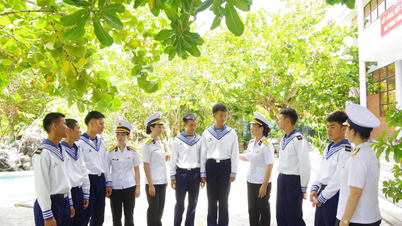
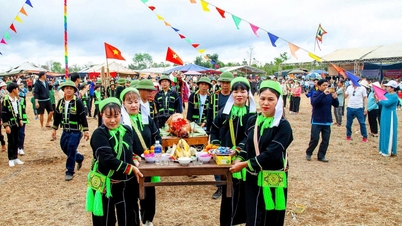
On June 21, 1925, leader Nguyen Ai Quoc founded the Thanh Nien (Youth) Newspaper, laying the foundation for the revolutionary press in Vietnam. From secret newspapers spreading the ideals of national liberation to today's multi-platform media system, the revolutionary press has always accompanied the turning points of the country.
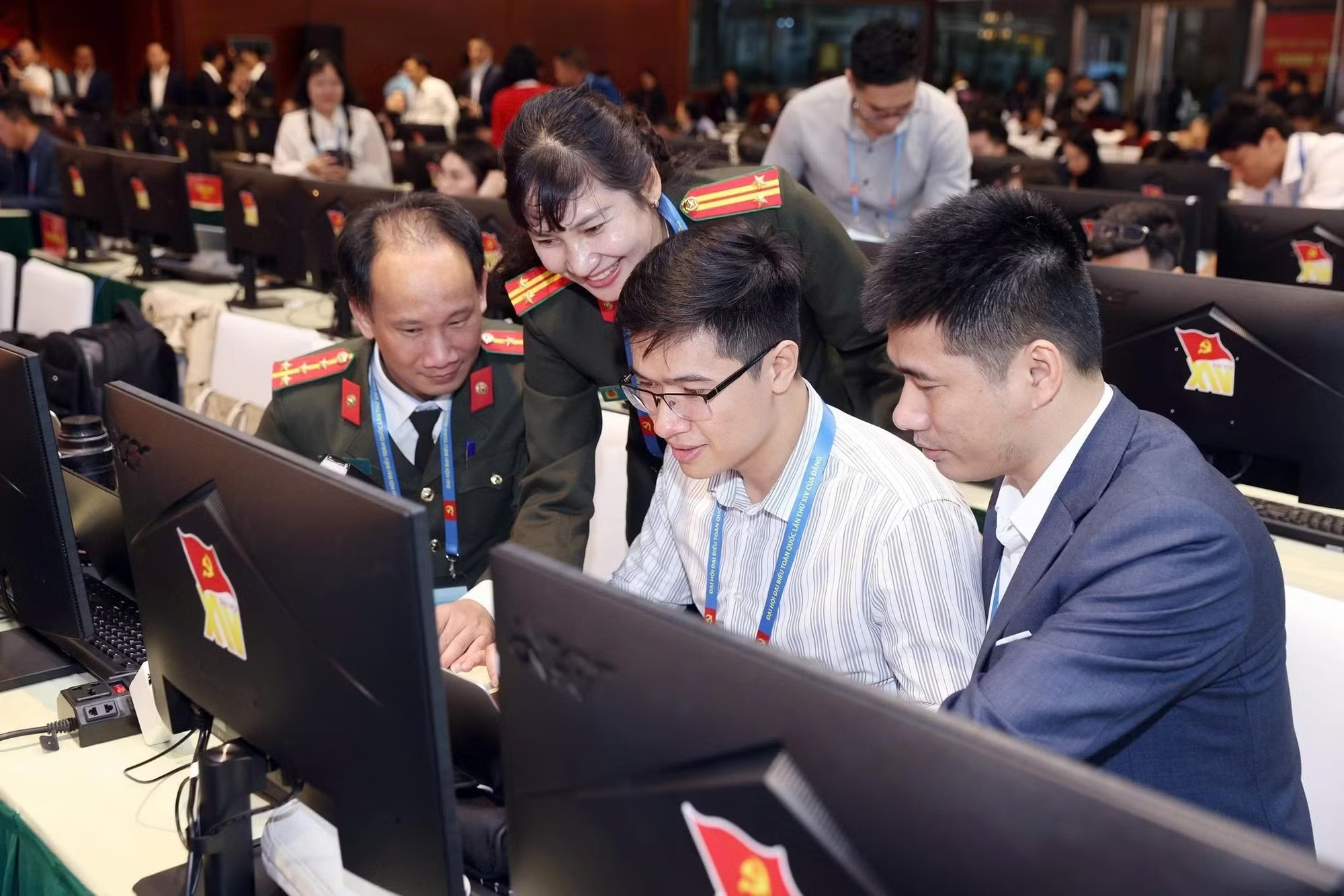
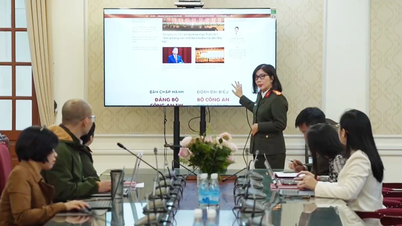
Reporters from the Public Security Newspaper covering the 14th National Congress of the Party.
After 101 years, technology has transformed almost every method of communication. Every individual can become a messenger. Social media can deliver a message to millions of people in minutes. Artificial intelligence can generate text, images, and audio at unprecedented speeds.
But it is precisely in this age of information explosion that a paradox is emerging: the more information a society has, the harder it is for people to discern the truth. And as truth becomes harder to identify, trust becomes a more valuable asset.
Perhaps that is also why, after more than a century of existence and development, revolutionary journalism still retains its significance. It is not simply about conveying information; journalism is contributing to a larger mission: preserving social trust.
When information is no longer scarce.
For much of the 20th century, information was a scarce resource. The role of journalism was primarily to disseminate information to the public. Whoever obtained information faster generally had a greater advantage.
Today, that order has changed. What society lacks is no longer information, but the ability to verify that information.

Fake news, manipulated images, deepfake videos , and online opinion manipulation campaigns are appearing with increasing frequency. The COVID-19 pandemic is a clear example. Alongside the fight against the pandemic is the fight against fake news. Much misinformation about treatments, vaccines, or the disease situation has caused widespread panic, increasing pressure on social governance and management.
This reality shows that the biggest challenge of the digital age is not a lack of information, but a lack of trust in that information.
If the previous century demanded that people have access to the truth, this century demands that people be able to identify the truth amidst a multitude of interwoven information.
That is the space for existence and also the core value of revolutionary journalism.
The press competes not on speed, but on reliability.
In the modern media environment, journalism can hardly be faster than social media. But journalism cannot afford to be as lenient as social media.
What gives journalism its power is not delivering news minutes in advance, but its ability to help the public know the truth.
Behind every journalistic work lies a process of verifying sources, cross-referencing data, confirming evidence, and fulfilling the social responsibility of the journalist. It is this process that creates credibility – a core value irreplaceable by any other media platform.




For the revolutionary press of Vietnam, this responsibility is even more significant. From its inception, the revolutionary press not only reflected reality but also served the national interest, served the people, and accompanied the revolutionary cause.
In recent years, from disease prevention and control and disaster relief to the fight against corruption and negative practices, the press has played a crucial role in clarifying the truth, creating social consensus, and strengthening the people's trust in the major policies and decisions of the Party and the State.
It is no coincidence that whenever conflicting or misleading information appears online, the public still turns to mainstream news outlets for verification.
That belief is the measure of the value of journalism.
Keeping the truth is about keeping the belief.
In the digital age, what subversive forces aim for is often not specific information, but rather the beliefs of society.
Therefore, defending the truth is not simply about refuting fake news or correcting misinformation. More profoundly, it is about protecting the spiritual foundation of the nation.
A piece of misinformation can be corrected. But a damaged trust often takes a long time to restore.

This is also a fundamental difference of revolutionary journalism. Journalism not only reflects what is happening but also contributes to protecting the values that constitute the strength of the nation: unity, social consensus, faith in justice, in the law, and in the future of the nation.
From the first revolutionary newspapers that encouraged the struggle for independence to today's journalistic works that spread the aspiration for a strong and prosperous nation, the ultimate goal remains to cultivate faith and awaken the spiritual strength of the nation.
From that perspective, journalism is not just a communication institution, but also an institution that builds trust.
Irreplaceable in the age of AI
Artificial intelligence is ushering in a new era of media development. AI can write news, synthesize data, create images, and produce content at a speed far exceeding that of humans.
But as technology advances, one truth becomes increasingly apparent: AI can create content, but it cannot be held accountable for that content.
What distinguishes a journalist from an algorithm is not their writing ability, but their responsibility to the truth, to the nation, and to the people.



A software program lacks the ideals to serve. An algorithm lacks the conscience to consider the social impact of information. Those values belong to people and to journalists.
Therefore, the more technologically advanced the press becomes, the more steadfast its principles must be; the more information there is, the more rigorous its verification must be; the more innovative it is, the more faithful it must be to the truth.
That is the foundation upon which revolutionary journalism continues to play a leading, guiding, and trust-building role in society.
Conclude
Having accompanied the nation for 101 years, the revolutionary press of Vietnam has repeatedly changed its journalistic methods, but has never changed its mission of serving the Fatherland and the People.
In today's world, where information is increasingly abundant but trust is becoming more precious, the greatest value of journalism lies not in delivering news the fastest, but in its ability to help society identify the truth and strengthen trust.
Ultimately, the enduring strength of a nation is not only built upon economic or technological resources, but also upon the trust of its people. Preserving that trust is the profound and noble mission of the Vietnamese Revolutionary Press in the second century, accompanying the nation.
Source: https://cand.vn/giu-niem-tin-post814427.html

![[Photo] Opening Ceremony of the 13th National Congress of the Ho Chi Minh Communist Youth Union](https://vphoto.vietnam.vn/thumb/1200x675/vietnam/resource/IMAGE/2026/06/24/1782286753905_ndo_br_1-8510-jpg.webp)
![[Photo] General Secretary and President To Lam attends the Central Public Security Party Committee Conference](https://vphoto.vietnam.vn/thumb/1200x675/vietnam/resource/IMAGE/2026/06/24/1782302063612_a1-bnd-9302-9166-jpg.webp)
![[Photo] The 13th National Congress of the Youth Union conducts personnel work.](https://vphoto.vietnam.vn/thumb/1200x675/vietnam/resource/IMAGE/2026/06/24/1782299943080_ndo_br_1-6868-jpg.webp)