

A summary report on questions raised by the National Assembly Secretary General Bui Van Cuong, recently sent to delegates, assesses that the Government has taken many actions and issued numerous documents to address difficulties in this market, such as telegrams and directives from the Prime Minister urging ministries and localities to restructure the real estate market. However, this market, including the housing market, still faces difficulties and bottlenecks stemming from legal procedures, land availability, and investment capital.
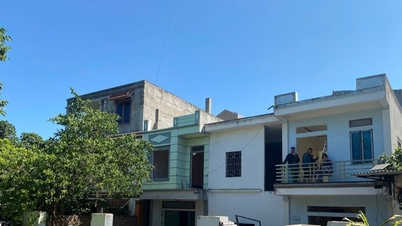
The application was rejected due to a lack of "residential land".
Some administrative procedures related to investment are cumbersome and create obstacles; market segments remain unbalanced; and investment credit in this market still carries many risks. Due to these difficulties, real estate businesses have to halt investment and construction projects, which also creates difficulties for contractors, material suppliers, and many other industries. "Legal obstacles regarding land, such as determining land prices, land use fees, land clearance, or regulations on selecting investors that overlap with regulations on investment, bidding, and land... are major barriers to the recovery and development of the housing market," the reviewing agency assessed.
In Ho Chi Minh City, in addition to over 100 real estate projects facing obstacles that are currently being studied for resolution, the Department of Planning and Investment recently reported to the City People's Committee on the status of approving investment policies for real estate projects in the area.
Accordingly, out of 117 project dossiers requesting approval of investment policies that this agency is currently processing, 62 projects do not meet the conditions to be the investor of a commercial housing project because they do not own residential land or have not acquired the entire residential land as stipulated in the 2014 Housing Law.
Therefore, the Department of Planning and Investment recommended that the Ho Chi Minh City People's Committee not approve the investment plan because it does not meet the regulations of the Investment Law and the Housing Law. This has caused concern among real estate businesses as it could halt the project's implementation process.
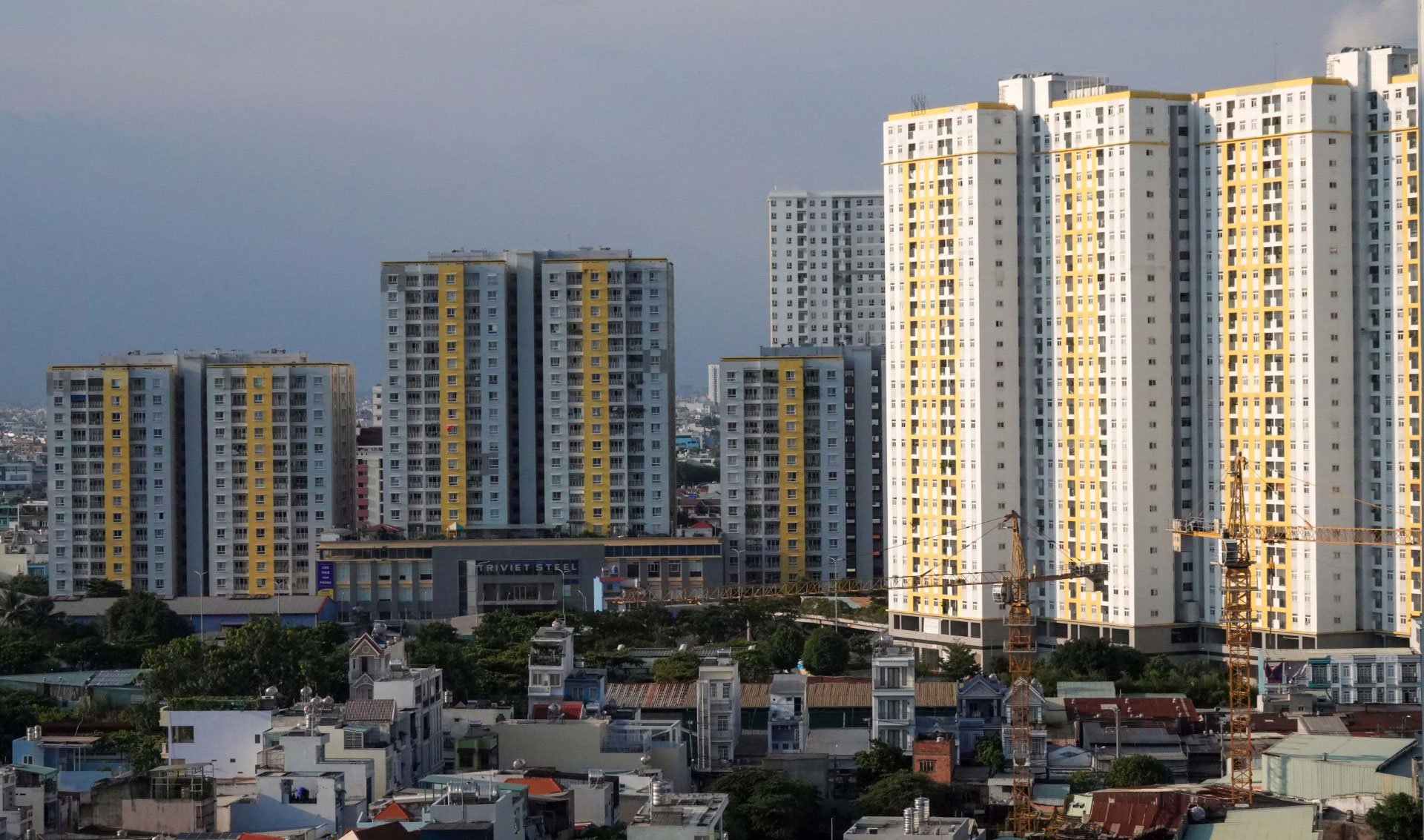
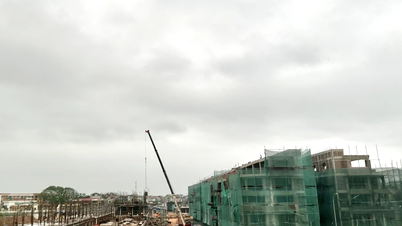
Removing legal obstacles will facilitate the implementation of real estate projects and boost market development. (Photo: HOANG TRIEU)
According to Master's degree holder Nguyen Nhat Khanh, lecturer at the Faculty of Law, University of Economics and Law (Vietnam National University Ho Chi Minh City), from a legal perspective, the refusal to approve the investment policies of these 62 projects is entirely appropriate. However, considering the economic perspective and developments in the real estate market, this decision has several aspects that are not entirely suitable.
Because implementing a commercial housing project requires businesses to have a sufficiently large land fund, but in reality, the number of projects with 100% residential land or a portion of residential land accounts for no more than 5% of the total number of commercial housing projects on the market.
Therefore, the strict regulations regarding land use types mentioned above create many difficulties for businesses proposing to build social housing projects. If these obstacles are not removed, hundreds of thousands of billions of dong invested in these projects could be "stuck," resulting in wasted investment capital and failing to solve the housing supply problem.
To resolve the aforementioned projects, according to Master's degree holder Nguyen Nhat Khanh, both legal and managerial solutions are needed. From a legal perspective, the National Assembly should promptly study and amend the regulations on land use forms for implementing social housing projects in the Housing Law, moving towards not limiting land use forms for projects instead of only residential land as currently, but ensuring compliance with local land use and construction planning.
"From a management perspective, the Ho Chi Minh City People's Committee can initially support the investors of these 62 projects by organizing land-use project bidding to select investors who meet the conditions to implement the social housing project (if they win the bid, the state will allocate or lease land to them to implement the social housing project) or converting the purpose from social housing to social housing so that they are not bound by land use regulations," Ms. Khanh stated.
Many regulations need to be amended.
In the official letter "Proposal to amend point b, clause 1, point a, clause 4 and clause 6 of Article 128 of the draft Land Law (amended) to create conditions for investors to agree on the acquisition of land use rights for land types that conform to planning to implement social housing projects" sent to the National Assembly, Mr. Le Hoang Chau, Chairman of the Ho Chi Minh City Real Estate Association, proposed amending point b, clause 1, point a, clause 4 and clause 6 of Article 128 of the draft Land Law (amended) to create conditions for businesses and investors to agree on the acquisition of land use rights or existing land use rights for land types that conform to land use planning, urban planning, and construction planning to implement social housing projects.
Mr. Chau also pointed out that the regulation in point b, clause 1, article 128 of the draft amended Land Law only allows agreements on receiving land use rights for residential land, or requires existing land use rights for residential land or residential land and other land. Therefore, its scope is narrower than the current regulations in the 2013 Land Law, thus failing to facilitate investors' access to land and failing to ensure the legitimate rights and interests of current land users.
According to Mr. Chau, if this regulation is passed, in the next 10 years, investors will no longer be allowed to "negotiate on the acquisition of land use rights for residential and other land" to implement social housing projects, and therefore no investor will be able to meet the condition of "having existing land use rights for residential and other land" as stipulated in Clause 6, Article 128 of the draft amended Land Law.
Regarding the difficulties related to housing projects under construction, at a recent workshop on the draft amendments to the Law on Real Estate Business organized by the National Assembly's Economic Committee and the Ministry of Construction , Vice Chairman of the Ho Chi Minh City People's Committee Bui Xuan Cuong stated that in the city, many problems have arisen when putting housing projects under construction into business. Specifically, authorities must issue written approvals for projects that meet the conditions for selling housing under construction, leading to many complications, especially regarding the issuance of certificates of ownership to buyers of commercial housing when referencing the provisions of the Land Law.
According to Mr. Bui Xuan Cuong, Clause 2, Article 25 of the draft Law on Real Estate Business (amended) stipulates the conditions for future housing and construction projects to have one of the following types of land use documents (decision on land allocation, land lease; land lease contract; certificate of land use rights; certificate of ownership of housing and land use rights; certificate of land use rights, ownership of housing and other assets attached to the land...).
Meanwhile, according to the current Land Law, land users are entitled to transfer, lease, sublease, donate, mortgage, and contribute land use rights as capital when they have a land use certificate.
In cases where land users are granted a delay in fulfilling their financial obligations or have their financial obligations recorded as debt, they must fulfill these obligations before exercising their rights. This means that if an investor is allocated land but fails to fulfill their financial obligations regarding land use fees, they cannot exercise the rights of a land user as stipulated by land law, including the right to transfer land use rights.
Therefore, the Ho Chi Minh City People's Committee proposes that the drafting committee research and adjust the content regarding land conditions for the procedure of approving housing and construction projects under construction for business purposes to state that "the investor must have fulfilled all financial obligations and possess a land use right certificate." This aims to limit the occurrence of legal issues in the subsequent steps, especially in issuing certificates to residents.
Allows for adjustments to the planning after the transfer of ownership.
Ho Chi Minh City People's Committee Vice Chairman Bui Xuan Cuong stated that the draft Law on Real Estate Business, which stipulates that the principle for transferring real estate projects—that the transfer of all or part of a project must ensure that the project's objectives and planning remain unchanged—is "unfavorable." He argued that many investors, after acquiring a project, need to make adjustments to the planning to improve it. According to Mr. Bui Xuan Cuong, project adjustments aim to optimize the project, ultimately increasing the land use coefficient and complying with the Urban Planning Law. Investors make adjustments according to regulations, incurring additional financial obligations. The Ho Chi Minh City People's Committee proposed amending this regulation to avoid conflicts with the Urban Planning Law during implementation, as it would negatively impact the project's progress after acquisition.
Seminar "Removing Legal Obstacles for Real Estate"
On November 9th, the Nguoi Lao Dong newspaper organized a seminar titled "Removing Legal Obstacles for Real Estate" to listen to and gather opinions from guests, thereby finding solutions to remove bottlenecks, unblock the flow of the real estate market, and promote stable and sustainable economic growth.
(*) See Nguoi Lao Dong Newspaper, issue dated November 8th.
Source: https://nld.com.vn/kinh-te/tap-trung-go-kho-cho-bat-dong-san-go-vuong-ve-phap-luat-dat-dai-20231108212955903.htm

























![[Image] Hanoi's urban life under the challenge of a "scorching hot" environment](https://vphoto.vietnam.vn/thumb/1200x675/vietnam/resource/IMAGE/2026/05/25/1779706979265_nang-nong-t5-2026-minh-duy-7-4636-jpg.webp)
























































Comment (0)