

The word "Cover" may have been localized as "Cu Vơ" in English, meaning shelter, bunker cover, or outer shell. According to the people of Huong Hoa, there are three "Cu Vơ" hills in the area: two in Huong Linh commune and one in Huong Phung commune. In the past, when American soldiers controlled the high points, they often placed "Cu Vơ" hills in these places for shelter. Although the area has many "Cu Vơ" hills, whenever they are mentioned, people immediately think of Huong Linh commune.

Cu Vo Peak attracts many tourists who come to chase clouds and watch the sunrise - Photo: MINH HIEN
Cu Vơ Hill in Huong Linh, over 800 meters above sea level, is located in Miet Cu village. The village of Cu Vơ was originally founded by the Van Kieu ethnic group living near the Rao Quan River. When the Rao Quan hydroelectric dam was built, they had to relocate, and some residents of Miet village settled on Cu Vơ Hill.
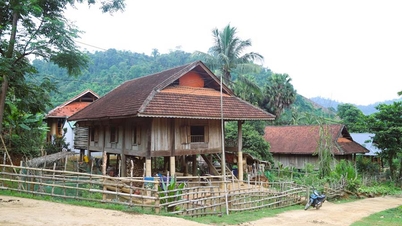
However, after the Phong Lieu wind farm was built, nearly 100 households in Cu Vo had to relocate once again. Currently, Cu Vo is surrounded by wind turbines, and structures such as schools and community centers remain largely as evidence of the existence of a small village that once existed there. The rest is under the management of the Phong Lieu wind farm.
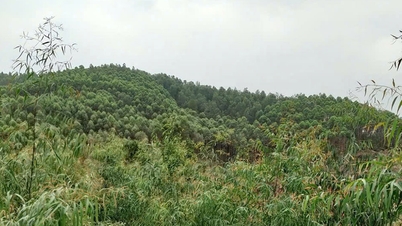
From the Khe Sanh Victory Monument, head towards Huong Phung commune for about 10 km, then turn left for another 2 km to reach the center of Mien Cu village. From there, it's about a 2-minute motorbike ride to Cu Vo hill. Cu Vo is a barren hill with only shrubs, myrtle, and fragrant trees growing on it. From here, you'll have a million-dollar view, as young people say. A 360-degree view with clouds and wind in all directions.
The concrete road branching off from the western section of the Ho Chi Minh Highway towards Cu Vo was constructed by Phong Lieu Wind Power Joint Stock Company, resulting in a smooth surface. Trees on both sides provide refreshing shade. The road winds and slopes steeply, with a sheer cliff on one side and a deep ravine on the other. Looking out into the distance, you can see the emerald green waters of the Rao Quan hydroelectric reservoir. It feels as if you're crossing the Hai Van Pass and gazing out at the East Sea, experiencing the perspective of someone standing at the point where earth and sky meet.
After crossing the pass, we found a fairly wide "plain." The relatively flat terrain with moderate slopes made me think of a peaceful, secluded village nestled atop the Truong Son mountain range, beautiful and mysterious amidst the vast wilderness. The village still had many houses and buildings, but no inhabitants. Only curious visitors from afar remained, wanting to come here to chase the clouds and watch the sunrise. Mr. Pham Van Tu, Director of Phong Lieu Wind Power Plant, told us that to make Cu Vo even more beautiful and attractive, Phong Lieu Wind Power Plant had planted thousands of peach blossom trees and hundreds of cherry blossom trees. In the near future, the unit will propagate myrtle bushes and purchase native varieties to plant on the hills where the wind turbines are located.
In early spring, we had the opportunity to come here. Both sides of the road were covered in white blossoms of the tung tree, their petals falling to form a thick carpet on the ground. Some stretches of road were lined with pink cherry blossoms under the golden sun. Along the cliffs, orchids with their red and white flowers added to the beauty of this land at the "gateway to heaven." Amidst the vast expanse of green grass, clumps of myrtle and rhododendron bushes with their deep purple flowers stood out, making everyone feel as if they were lost in a poem by Huu Loan on a desolate afternoon: "The purple of myrtle flowers, the purple of the desolate afternoon..."
According to Mr. Pham Van Tu, many organizations have come here to plant trees in recent times. For example, the Quang Tri Provincial Flower Road Development Fund has planted rows of red Osaka trees along the road from the top of the pass upwards; Buddhist families in Huong Hoa district have also planted nearly 100 ancient cherry blossom trees to contribute a touch of color to beautify this land of clouds. All of them seem to want to cultivate this place into an ideal destination for cloud viewing and immersing oneself in nature.
Journalist Lam Chi Cong, Chairman of the Quang Tri Province Flower Road Development Fund, after several visits to Cu Vo to admire the scenery, was amazed by this prime hilltop. It's the ideal location to explore the natural beauty of Huong Hoa by seemingly reaching out to touch the clouds. Then, journalist Lam Chi Cong met people who shared his love for beauty and wanted to do something to develop tourism in their homeland. They shared the idea of building this place into a destination that would attract visitors from all over. The idea of building a tower for tourists to climb and admire the clouds, and a bell that, when rung, would... call the clouds, took shape and was nurtured. This project is expected to boost the development of tourism in Huong Hoa, funded through social mobilization, with the Quang Tri Province Flower Road Development Fund taking the lead.
I've climbed to the summit of Cu Vơ countless times, but each time I'm delighted by the breathtaking scenery, well worth the effort. Architect Lê Văn Thành, who accompanied us on numerous surveys to design the initial architecture on this mountaintop, shared the same sentiment. "It truly is a place as beautiful as paradise. On this mountaintop, I remember one beautiful day, we exclaimed that from here we could see Cửa Việt beach, the horizon stretching across the deep blue East Sea. And it wasn't difficult to identify the two tallest buildings in Đông Hà City: the Saigon-Đông Hà Hotel and the Mường Thanh Hotel, rising from the plains."
Looking down from the summit of Cu Vơ, you see the old-growth forest, further in the distance the Rào Quán hydroelectric reservoir, and even further still the Hướng Linh wind farm. Standing here, you can understand why Hướng Linh is considered the cradle of wind. With mountains on either side blocking the way, only a narrow gap in the middle, which is Hướng Linh commune, passes through. This gap receives wind year-round. But if you consider the wind blowing inland from the East Sea, reaching Hướng Hóa via that gap, then the summit of Cu Vơ acts like a natural screen in western Quảng Trị.
During this time, groups of tourists flock to Cu Vơ, eager to experience its beauty. They camp and light bonfires overnight, waiting to greet the dawn in the cold, regardless of whether it's summer or autumn. A wind farm caretaker told us that you only truly understand the cold and wind when you come here.
Here, the air is blanketed with mist year-round. The weather changes rapidly. Clouds envelop the hilltop, but in an instant, they vanish, giving way to sunshine. And sometimes, light, gentle showers, like springtime in the lowlands, come and go. Leaving travelers with a lingering feeling, a desire to build a simple house on the slopes to satisfy their need for seclusion amidst the hustle and bustle of everyday life.
Amidst the howling wind on the high hills, as on one occasion when we went to the summit of Sa Mu with writer Hoang Cong Danh of Cua Viet Magazine, he exclaimed: "I long for the sound of a bell!" Indeed, amidst the solemnity and sacredness of the mountains and forests, sometimes the ringing of a bell awakens the human heart, inspiring a yearning for goodness, a love for nature, and a love for all living things.
Soon, on this hilltop, lovers of beauty, travel, and homeland will meet in the Cu Vơ region, ringing a long bell to summon the clouds. And through binoculars, they will locate the Cua Viet sea, the Trieu Phong plain, and Dong Ha city in the distance...
Yen Ma Son
Source: https://baoquangtri.vn/goi-may-tren-dinh-cu-vo-187841.htm




























































































Comment (0)