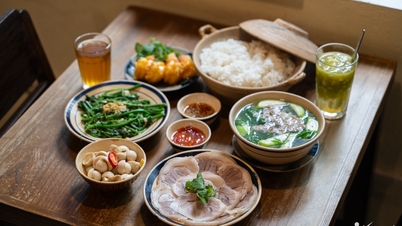
As evening falls in Xa Xia neighborhood, Ha Tien ward, the small kitchen of Ms. Thi My Loan's family is filled with laughter and conversation. The evening meal isn't yet served, but the aroma of food fills the cozy space. Some prepare the meal, others set the table, and the children, after school, help their mother with small chores around the house. This shared meal is not just a habit, but also a "meeting point" for family bonds. There, stories of the day are recounted, worries are shared, and even weariness is somewhat eased.

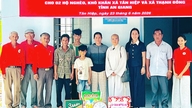
The joy of Ms. Thi My Loan's family upon being recognized as a model family. Photo: DANH THANH
According to Ms. Loan, the most important thing to maintain a happy family is unity among its members. She and her husband manage living expenses, care for their elderly parents, and raise their children's education. The pressure is considerable, but it's compensated by the sharing and support of everyone in the family. She especially remembers the afternoons after school when her children proactively helped her clean, cook, and care for their grandparents. These seemingly small tasks, over time, became habits and gradually formed a way of life for the whole family.



In Loan's family, the generational gap seems to be narrowed by shared meals and conversations after a day of work and study. This closeness keeps the house warm, even as life outside changes. "Every family faces difficulties, but the important thing is whether husband and wife, and children, truly share them together. For me, happiness is having well-behaved children and the whole family gathering around the dinner table in the evening. When the whole family tries together and looks in the same direction, everything will eventually work out," Loan confided.
While Loan's family maintains happiness through sharing within a two-generation household, in Minh Tan hamlet, U Minh Thuong commune, Mrs. Thi Hong's family has a different rhythm of life – three generations living under one roof. Her mother-in-law, her husband and wife, son, daughter-in-law, and grandchildren each have their own personality, lifestyle, and perspective on life. Living with multiple generations, the most difficult thing is harmonizing the differing viewpoints among family members. The older generation is accustomed to traditional, meticulous, and restrained ways of life, while the younger generation is more dynamic, open-minded, and has a more modern approach to life.
Therefore, within the family, each person has their own role but they are not separate from one another. The older generation maintains the family traditions, takes care of the grandchildren, and reminds their children and grandchildren of basic necessities. Young couples manage finances while sharing household chores when they have time. Children and grandchildren grow up in a multi-generational environment, gradually learning to live harmoniously and care for others. "You can't expect everyone to be the same, so what's important is understanding each other. Adults must listen to their children and grandchildren, and children and grandchildren must respect their elders and be considerate of those younger. If there's a problem, the whole family sits down and talks it out clearly to avoid prolonged misunderstandings," Mrs. Hong shared.
Danh Hieu Nghia, Mrs. Hong's son, said that living together across generations initially caused minor conflicts due to differences in daily routines, but gradually everyone learned to adjust to each other. "Everyone has their own habits, so sometimes clashes occur. But then the whole family chooses to compromise and offer gentle suggestions to each other. Living together is very enjoyable; the important thing is always having loved ones by your side," Nghia said.
The multi-generational family model may no longer be as common as it once was, but the values it brings remain just as meaningful. These include love, responsibility, and the way each person learns to listen and support each other under one roof. According to the Director of the Department of Culture and Sports , Nguyen Khanh Hiep, for generations, the family has always been considered the foundation of society, the place where character is nurtured, traditions are preserved, and beautiful cultural values are passed down through generations. Families have played a core role, spreading positive values and becoming active catalysts in building grassroots cultural life; contributing to building a more civilized, prosperous, and sustainably developed An Giang province.

RENOWNED CITY
Source: https://baoangiang.com.vn/hanh-phuc-tu-nhung-bua-com-chung-a490079.html


![[Image] Paris's oldest bridge goes viral after transforming into a giant cave.](https://vphoto.vietnam.vn/thumb/1200x675/vietnam/resource/IMAGE/2026/06/24/1782283441197_ndo_br_dsc05314-jpg.webp)
![[Photo] Opening Ceremony of the 13th National Congress of the Ho Chi Minh Communist Youth Union](https://vphoto.vietnam.vn/thumb/1200x675/vietnam/resource/IMAGE/2026/06/24/1782286753905_ndo_br_1-8510-jpg.webp)
![[Photo] Overview of the renovation and upgrading of the Ho Chi Minh Museum - Ho Chi Minh City Branch](https://vphoto.vietnam.vn/thumb/1200x675/vietnam/resource/IMAGE/2026/06/24/1782287051250_ndo_br_01-jpg.webp)