

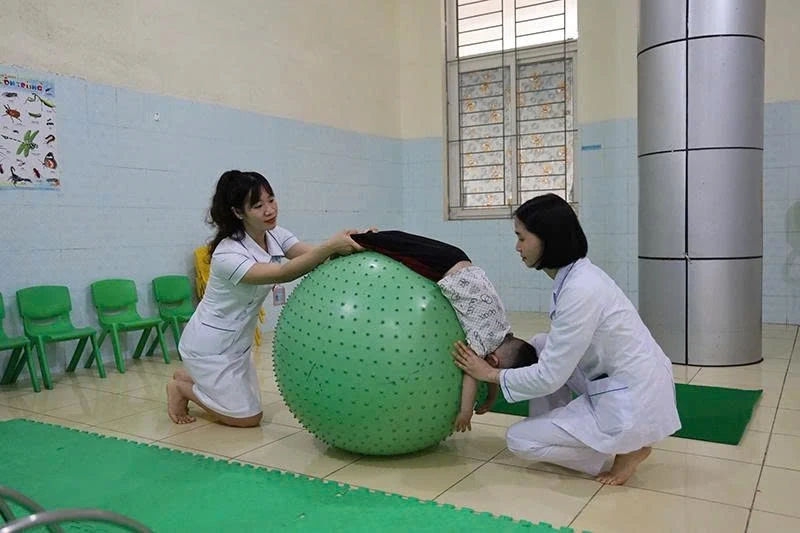
Intervention classes for children at the Mental Health Unit ( Thanh Hoa Pediatric Hospital).
In the familiar corridors of Thanh Hoa Pediatric Hospital, the Psychiatry Unit begins its day in its own unique way. Unlike the usual rush of acute care wards, this area maintains a slower, quieter pace, but it is by no means easy.
Stepping through the intervention room door, the space opens up with small tables and chairs, and neatly arranged picture and word cards. Each room is dedicated to a different activity: where children practice motor skills, where they develop language skills, and where they hone their interaction skills. The sounds are quiet, just the teacher calling names, gentle instructions, sometimes interspersed with crying or reactions from children who are not yet adapting.
In the speech therapy room, nurse Nguyen Thi Tung Lam bends down to eye level with a child of about 4 years old, gently and patiently guiding them. The child turns away. She doesn't rush, only repeats slowly. After many attempts, the child's gaze finally settles. There's no commotion, but for those in the profession, it's a step forward. Ms. Lam explains: "Each child has a different personality and level of difficulty. Some children don't speak or look, while others react very strongly. To teach them effectively, you must first make the child feel secure and trust you. Only then can you begin to intervene and teach them."
In the next room, picture and word cards are brought out and put away, repeating in a familiar sequence. Nurse Le Thi Lan patiently guides a child in identifying objects. Each time the child gets it right, she gently nods and encourages them. Some lessons last for weeks, even months. Nurse Lan shared: "Children with autism have limited concentration and memory abilities, so we have to be patient and teach them many times. Some skills seem simple but take a very long time to develop."
This space is not just for children, but also a place where many families place their hopes. It's no coincidence that many parents call it a "special classroom"—a place where they not only bring their children to learn, but also learn to understand them. Once a week, families are allowed to directly observe the intervention sessions. They stand silently behind the scenes, watching their children practice each movement, repeating each lesson. After these observation sessions, parents learn how to teach their children; they communicate directly with the nurses, sharing changes in their children at home, their difficulties, anxieties, and even unspoken expectations. These stories extend beyond professional matters, becoming stories of family, acceptance, and companionship.
Mr. Nguyen Viet Toan (Quang Phu ward) is one of those familiar with such sessions. For the past four years, he has brought his grandson, Nguyen H., to the Mental Health Intervention Unit almost every time. Mr. Toan shared: “When my grandson was just over a year and a half old, he didn't speak, didn't react, and only played alone. The family took him for a check-up and found out he had autism. Around the age of three, we brought him to the Mental Health Intervention Unit, and I almost never took my eyes off the classroom whenever I was allowed to observe. At that time, I only hoped he could see and hear; I didn't dare think about anything further. Now he can read and write, and is preparing to enter first grade, I'm so happy!”
In another corner of the hallway, Ms. Vu Thi Hien (Ngoc Son ward) was busy comforting her younger child while waiting to pick up her older child. Her daughter, only 3 years old, began to receive intervention when she noticed unusual signs. In the beginning, she took her daughter to and from school daily, but the long distance made the child tired and unable to keep up with the classes. She was forced to rent accommodation near the hospital. For almost a year now, accompanying her daughter, the times she gets to observe the classes are special. Ms. Hien shared: "Watching the teachers teach, I realize how much patience is needed. At home, I often feel anxious, but now I try to stay calmer to accompany my daughter."
At the Mental Health Unit, there are no rapid advancements. Only the patience of the teachers, the perseverance of the family, and the quiet efforts of each child are crucial. To ensure this journey is not interrupted, it requires not only the persistence of the family and the efforts of the doctors, nurses, and intervention technicians, but also the coordinated involvement of the school and the community. When each link understands, shares, and supports correctly, the seemingly small steps of the children will have a stronger foundation to continue, more firmly on the path ahead.
Text and photos: Quynh Chi
Source: https://baothanhhoa.vn/hanh-trinh-lang-le-phia-sau-tre-tu-ky-283291.htm

![[Photo] “Red Journey” 2026: Vietnamese Youth Continue Building the Bridge of Friendship Between Vietnam and China](https://vphoto.vietnam.vn/thumb/1200x675/vietnam/resource/IMAGE/2026/04/20/1776629730866_4055880775670638308-9618-4200-jpg.webp)

































































Comment (0)