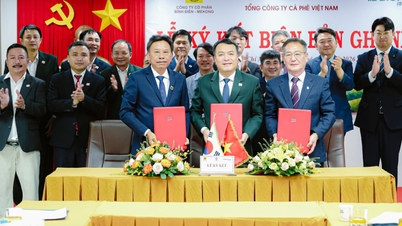
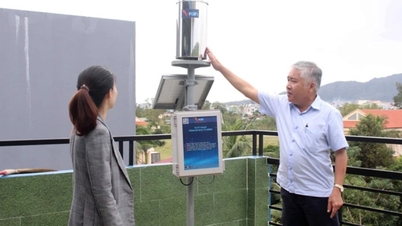
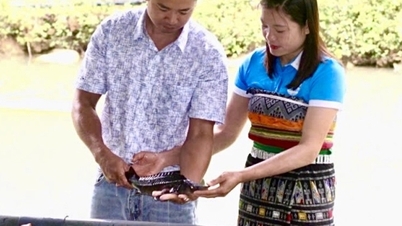
Bac Lieu University has signed cooperation agreements with localities and businesses in the field of aquaculture, demonstrating a trend of strengthening links between universities and practical production. Photo: ANH TUAN
At the recent scientific conference "The Role of Local Universities in the Innovation and Development Ecosystem of the Region" organized by Bac Lieu University, experts noted that universities need to become the nucleus connecting the government, businesses, cooperatives, communities, and the scientific community, thereby solving problems arising from local realities.
The new development space of Ca Mau province after the merger also poses new demands on higher education. With its advantageous location amidst forests, seas, shrimp farms, and rice paddies, Bac Lieu University is expected to become a bridge between knowledge and practical production, enhancing the locality's competitiveness through research, innovation, and technology transfer.
 Students from the Faculty of Agriculture and Fisheries, Bac Lieu University, are conducting a scientific research project on the production of safe organic vegetables. Photo: ANH TUAN

Following this orientation, universities are not only places of teaching but also centers of knowledge for the community, promoting entrepreneurship, innovation, supporting digital transformation for businesses and people, and providing scientific solutions for sustainable development.
Connecting training with practice.
The development orientation of Bac Lieu University in the new phase is not only to expand training programs and improve the quality of human resources , but also to build a model of a university that fosters the development of the ecological region. Accordingly, training and scientific research activities need to be closely linked to the development requirements of the locality, from marine economy and aquaculture to environmental protection and adaptation to climate change.
Instead of approaching problems from a discipline-by-discipline approach, many experts believe that universities need to develop interdisciplinary thinking to solve the practical challenges facing them. In the southernmost region, issues such as saltwater intrusion, marine economic development, mangrove ecosystem conservation, and enhancing the value of the shrimp industry all require a combination of science and technology, resource management, economics, environment, and digital transformation.
The challenges facing the southernmost region today are interconnected and integrated. The issue of saltwater intrusion is not only related to irrigation but also to people's livelihoods, environmental data, resource management, marine economics, and digital technology. Similarly, a shrimp product is not just a simple seafood product but also involves traceability, cold chain logistics, international trade, branding, and experiential tourism development. This necessitates training human resources with integrated thinking, adaptability, and innovative capabilities to meet the new development needs of the locality and the region.
Based on this practical experience, many groundbreaking training models have been proposed, such as: "classrooms between forests and seas," "schools without fences," or "living laboratories." Instead of just learning in the classroom, students can study and conduct research right in high-tech shrimp farming areas, seafood processing businesses, cooperatives, mangrove forests, or fishing communities. These spaces become environments where learners can access practical experience, hone problem-solving skills, and develop innovative thinking.
Alongside this is the orientation towards building an innovation and entrepreneurship center, connecting students, lecturers, businesses, and the community to research and apply science and technology to production and life. Areas identified with high potential include artificial intelligence in aquaculture, biotechnology, deep processing of seafood , circular economy, e-commerce, and digital transformation in agriculture.
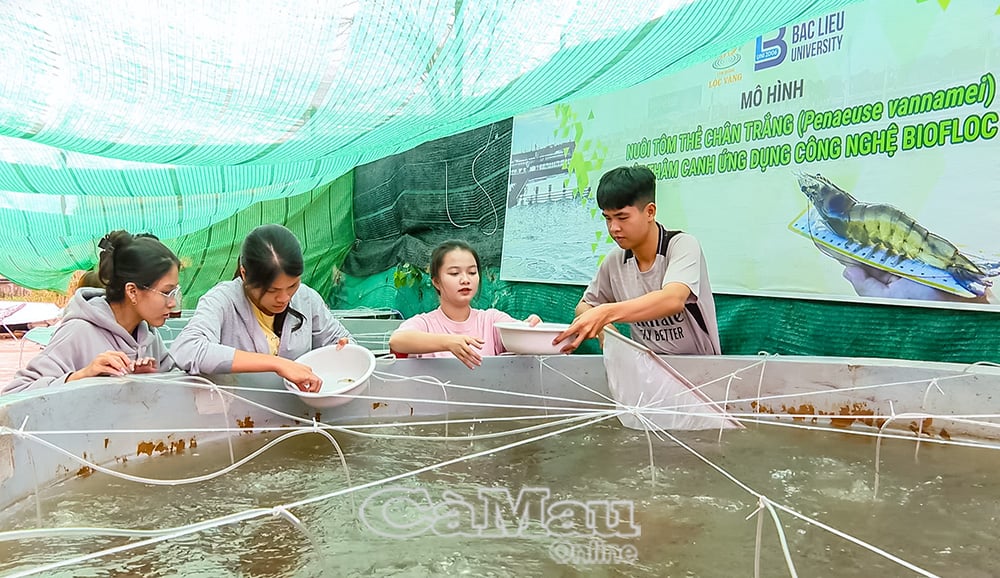 Students from the Faculty of Agriculture and Fisheries, Bac Lieu University, experiment with a high-tech shrimp farming model. Photo: ANH TUAN



To meet the demands of development in the new era, future human resources need to be equipped with more than just specialized knowledge. This includes digital skills, innovative thinking, and the ability to adapt to the green economy, circular economy , and sustainable development. This is also the foundation for transforming knowledge from the classroom into practical solutions serving the community, building an innovation ecosystem linked to the development needs of the southernmost region of Vietnam.
Kim Truc
Source: https://baocamau.vn/hat-nhan-ket-noi-sang-tao-a129986.html
![[Photo] "Hanoi Lotus Festival" honors the lotus flower that has been associated with Vietnam for thousands of years.](https://vphoto.vietnam.vn/thumb/1200x675/vietnam/resource/IMAGE/2026/06/27/1782516943048_sen-ha-noi-2026-minh-duy-1-jpg.webp)