

These sites are reliable sources for outlining the historical and cultural development of communities in Gia Lai province, making them attractive destinations for cultural tourism . However, to date, most of these archaeological sites have not been fully exploited for their inherent heritage value.
From the An Khe Paleolithic period to the subsequent prehistoric cultural sites.
Studying a system of 30 archaeological sites with thousands of artifacts, Vietnamese and Russian archaeologists have confirmed that An Khe was inhabited by an ancient community approximately 800,000 years ago. This was the culture of an upright human community, the direct ancestors of modern humans. This discovery not only confirms the presence of early human communities on the historical map of humanity in Vietnam but also serves as material evidence marking the beginning of Vietnamese history.
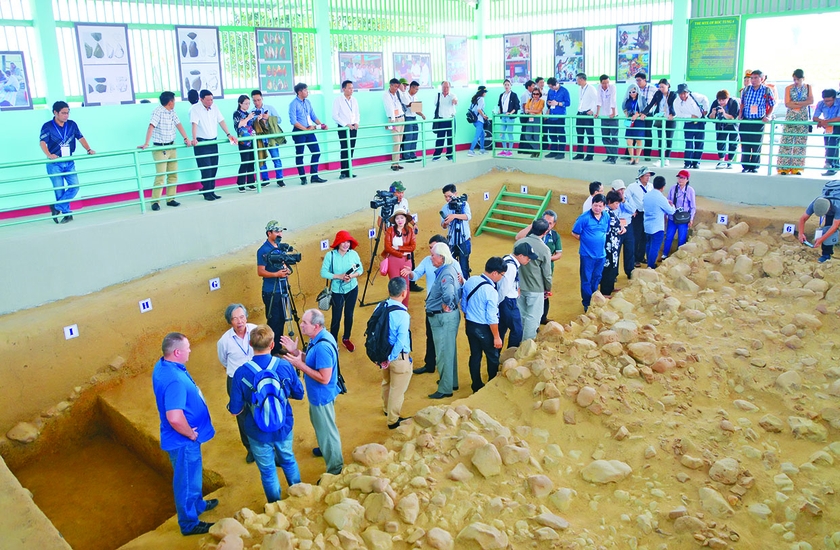 |
The excavation pits at the Roc Tung-Go Da site (An Khe town) have been covered with roofs for protection, creating favorable conditions for visitors and researchers. Photo: Hoang Ngoc |
Around An Khe, archaeologists have recently discovered a series of prehistoric cultural relics, bearing the mark of a higher level of development and a continuation of the early Paleolithic technology of An Khe. These are late Paleolithic relics, dating back several hundred thousand years, found on the ancient terrace of the Ba River, in the districts of Kbang, Dak Po, and the Phu Thien valley. Within this system of late Paleolithic relics, archaeologists have found a number of crude stone tools, such as: pointed tools, tools with horizontal and vertical edges, and quarter-piece pebbles. In Phu Thien alone, they also found triangular pointed tools, small hand axes, and tools made from petrified wood. This evidence shows that the prehistory of Gia Lai had a continuous development from the early Paleolithic technology of An Khe to a series of late Paleolithic relics along the upper banks of the Ba River. It can be said that the Ba River civilization emerged very early and developed continuously, representing an ancient prehistoric cultural foundation of humanity, a chapter marking the dawn of the nation's history.
Entering the Neolithic Age, a period when humans settled down, mastered the techniques of grinding stone tools, manufacturing pottery, and began rudimentary agriculture , dating from 7,000 to 4,500 years ago, cultural relics from this period have been found on both banks of the Ia Mơr River, such as the sites of Làng Gà 5, Làng Gà 6, and Làng Gà 7 (Chư Prông district). A distinctive feature of the inhabitants here was their settled lifestyle, combining hunting, gathering, and agriculture, but initially forming groups specializing in the crafting of rudimentary tools in the form of workshops. The traces of these workshops show that the ancient people used high-hardness basalt and chert stones to create tools with stable shapes, such as oval axes, short axes, disc-shaped scrapers, and polished axes. These tools suggest an indigenous origin, stemming from the Hòa Bình culture in Northern Vietnam.
The communities of the late Neolithic-early Metal Age in the Central Highlands, from 4,500 to 3,000 years ago, were established in Gia Lai province, forming the Bien Ho culture in Pleiku City. The inhabitants of this period were distributed from the high mountains of Chu Prong to the Pleiku plateau and extending down to the Ba River valley in the Kong Chro region. These communities had a relatively uniform level of development, consisting of settled people engaged in agriculture, animal husbandry, and the crafting and use of polished stone tools. Typical examples include large, sharp stone hoes, axes with handles (called shoulder axes), or stone adzes with distinctive buffalo-tooth shaped bodies, along with weighted stones attached to digging sticks, concave grinding stones, pestles, and grinding tables.
During this period, two centers specializing in stone tool making emerged in Gia Lai province. These were the workshop in Ia Mơr (Chư Prông district) that produced buffalo-tooth-shaped adzes, and the workshop in HLang village (Yang Nam commune, Kông Chro district). While the Ia Mơr workshop specialized in making hoes and buffalo-tooth-shaped adzes from phtanite (siltstone), primarily supplying the inhabitants of the Pleiku plateau, the HLang workshop specialized in making axes with shoulders from the semi-precious opal stone, supplying the inhabitants of the upper reaches of the Ba River and parts of the southeastern Pleiku plateau. Each workshop varied in degree of specialization, but internal division of labor was evident, supplying products to several regions and creating relatively even development in the area. This laid the groundwork for the local population to enter the threshold of civilization.
As the Metal Age progressed, archaeologists discovered several iron smelting furnaces, metallurgical furnaces, and bronze casting workshops upstream of the Ba River. A notable example is the discovery of a stone mold for casting bronze axes, specifically a two-part mold. The reverse side of the mold reveals that it was a bronze axe mold with a socket for attaching a handle, a hyperbolic axe body with two sharp corners, and a symmetrical blade – a type of bronze axe characteristic of the civilizations of the Southeast region of Vietnam.
Bronze drums, a famous type of musical instrument of the Dong Son culture, have been found throughout the Central Highlands. In Gia Lai, bronze drums have been found in An Thanh, Dak Po district. These were the largest Metal Age cultural centers in the Central Highlands at that time.
The issue of preserving and exploiting archaeological heritage.
Archaeological findings and research show that Gia Lai is a region rich in the number of relics, diverse in type, and culturally rich. This provides a reliable source of historical data for outlining the cultural history of the communities in Gia Lai, making it an attractive destination for cultural tourism. However, to date, most of these archaeological sites have not been fully exploited for their inherent heritage value. Most of the sites are located in the cultivated land of ethnic minority communities. Current farming practices, using mechanized equipment, mean that the cultural layers are not deep underground, leading to the excavation, disturbance, and damage of most sites. Furthermore, dozens of other archaeological sites lie underwater in the reservoirs of large hydroelectric power plants such as Ia Ly, Plei Krong, and An Khe-Ka Nak, posing a high risk of being wiped out.
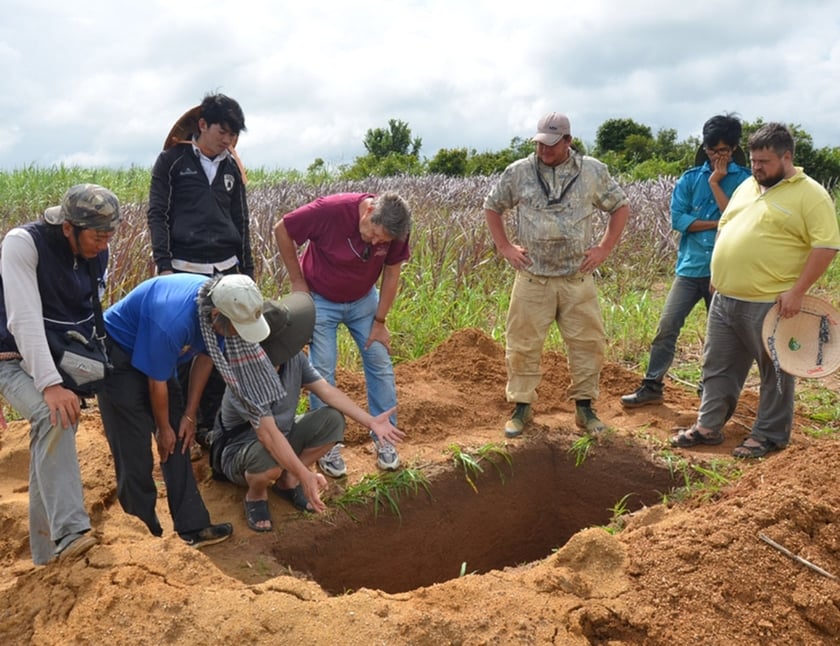 |
The preservation and utilization of archaeological heritage requires the participation of scientists, the involvement of local authorities, and the consensus of the local people. Photo: Hoang Ngoc |
In An Khe, the archaeological site, which has been excavated in conjunction with the preservation and exploitation of heritage, has achieved some initial results. Even during the excavation period, the town built on-site conservation facilities and exploited the heritage value, such as at Roc Tung 1 and Roc Tung 4. All traces of ancient human activity within the intact cultural layer are protected in sturdy shelters. Around the excavation pits are photographic guides documenting all excavation and research activities, as well as domestic and international scientific conferences on the site. Each year, these sites continue to be excavated, serving as destinations for academic exchange, experiences, and learning about the oldest ancient cultures of humankind and the excavation work of archaeologists.
Also in An Khe, a permanent museum dedicated to An Khe's technology has been built. This exhibition recreates the entire story of the settlement patterns, food exploitation strategies, toolmaking, hunting, gathering, human behavior through burial practices, the origins of the owners, and the outstanding historical and cultural value of An Khe's technology in the archaeological map of Vietnam and the world. In particular, it showcases 10 national treasures along with typical relics and artifacts of the Roc Tung-Go Da National Special Monument, which was recognized by the Government in 2023.
One challenge is how to preserve and rationally utilize the current archaeological heritage, in conjunction with the socio-economic development strategy of Gia Lai province in general and An Khe district in particular. For a long time, excavation of relics has been carried out by archaeologists, protection by local cultural officials, and the exploitation of the archaeological heritage's value by tourism businesses. This rigid separation diminishes the inherent value of the heritage. Therefore, the first solution is to simultaneously and comprehensively implement all three stages, along with extensive public awareness campaigns about archaeological heritage within the community.
For national-level special relics, it is necessary to shift from sugarcane, cassava, and other industrial crops to high-value agricultural crops suitable to the soil and climate of each region; improving the lives of the local people and protecting the integrity of the underground heritage. In the upcoming project, archaeological sites in An Khe will be linked to public welfare projects, local traditional culture, the Tay Son Thuong Dao National Special Relic, and the global geopark, and will soon become a national and international cultural and tourism center focusing on the origins of humankind.
The preservation and utilization of archaeological heritage requires the participation of scientists, the involvement of local authorities, and the consensus of the local people. Among these factors, the consensus and voluntary participation of the people is the most important element, in line with the spirit of protecting archaeological heritage.
Therefore, it is necessary to strengthen propaganda and raise awareness among the people about the value of archaeological heritage and ensure they receive legitimate benefits from its exploitation. Only then will people voluntarily participate and create appropriate forms of protection and sustainable exploitation. At the same time, it is necessary to train a team of archaeological heritage management officials who are both professionally competent and committed to their work. Only then can we scientifically exploit the cultural heritage left by our ancestors, contributing to socio-economic development in Gia Lai and the entire Central Highlands.
Source


![OCOP during Tet season: [Part 3] Ultra-thin rice paper takes off.](/_next/image?url=https%3A%2F%2Fvphoto.vietnam.vn%2Fthumb%2F402x226%2Fvietnam%2Fresource%2FIMAGE%2F2026%2F01%2F28%2F1769562783429_004-194121_651-081010.jpeg&w=3840&q=75)


Comment (0)