


Rural roads are becoming increasingly wide and clean.
Memories of the "oases"
In the final days of 2025, the spring breeze began to weave through the roads and cliffs, bringing with it the characteristic cool air of the Lam Vien plateau. Standing on the mountaintop pass and looking down at the winding strips of concrete embracing the hillsides, memories of a not-so-distant past suddenly flooded the minds of the people of Bong village, Da Chay hamlet, Lac Duong commune.
Not long ago, when talking about rural transportation in the impoverished areas of the former Lam Dong province, many people would shake their heads in dismay. That memory is tinged with the reddish hue of basalt soil. It was a series of roads dusty in the sun and muddy in the rain, slippery slopes, and journeys that took half a day to reach the villages. The memory of the rugged terrain that separated the hamlets, turning these remote areas into isolated "islands" amidst the vast and majestic wilderness.
This geographical isolation has inadvertently created barriers. Agricultural products are subjected to price manipulation by traders due to "difficult transportation routes," and knowledge and civilization hesitate and falter before the slippery slopes. Poverty thus continues to cling to the feet of farmers in remote areas like leeches in the forest.
However, the impetus from the New Rural Development program in the mountainous region of Lam Dong has changed everything. The brightest aspect of this initiative in Lam Dong is not the disbursement of thousands of billions of dong from the state budget, but the resource of "people's strength" in improving the rural transportation system.

Many rural roads are being built with asphalt instead of concrete, thanks to the people's generosity in not only donating land but also contributing money.
A revolution born from the people.
Walking along the newly completed, wide roads in Lien Bong village, Lac Duong commune, in the last days of 2025, I clearly felt the change in each garden and in the eyes of the local people. The narrow roads of the past are now wide and smooth, like a carpet welcoming spring.
In Da Chay village (Lac Duong commune), we met Mr. Bon Dong Ha Ya Binh. Mr. Binh was a pioneer in moving his fence and donating over 70 square meters of land along the village road. If converted to the market value of this area, where agro-tourism is developing and land is quite expensive, it would be a considerable fortune. But this generosity from his family helped widen the road in Da Chay village from 3 meters to 10 meters. The new, spacious road reflects the aspirations of Mr. Binh and his family, who have lived on this land for generations, hoping for the village's continued economic and cultural development.
Not far away, in Liêng Bông village, the story of Mr. Kơ Să Ha Tin's family is equally moving. Mr. Tin not only voluntarily demolished a solidly built 15-meter-long boundary wall and donated 60 square meters of land, but also persuaded both of his children to willingly hand over the cleared land to the State.
When I asked him if he regretted losing the land, Mr. Kơ Să Ha Tin smiled gently, his eyes sparkling with joy as he pointed to the new road: "Look, journalist, if we had kept those few dozen meters of land to ourselves, the trucks carrying agricultural products and coffee would still be moving slowly, and the village wouldn't be able to develop. We lost a little land, but the whole commune is happy because a big road has been opened, and our minds will be enlightened. This road is now not only for smooth driving, but also for people to come and transport coffee, vegetables, and flowers to big cities and even abroad."
Similarly, in the southern communes, the donation of land for road construction has become a widespread movement. Dozens of rural transportation projects here have been built thanks to the voluntary land clearance and donation by the people. Not only do they donate land, but the people also directly participate in land clearance and construction supervision to ensure the projects are completed quickly. In many communes, such as Da Huoai, instead of building rural roads according to the minimum standard of 3-5 meters, people proactively donate land to widen them so that cars and large trucks can easily pass each other.
This spirit also spreads to suburban areas where land is extremely valuable. In Lang Biang ward, Da Lat, the example of Mr. Luu Hong (78 years old) and Mr. Nguyen Van Toan (Dinh Cong Trang street) is a beautiful example of the spirit of development. They donated hundreds of square meters of "golden" land along the Mai Xuan Thuong stream, valued at 30-40 million VND/square meter, to build a road and address flooding in the area along the stream. They transformed the rural road into a shared joy for the entire region.
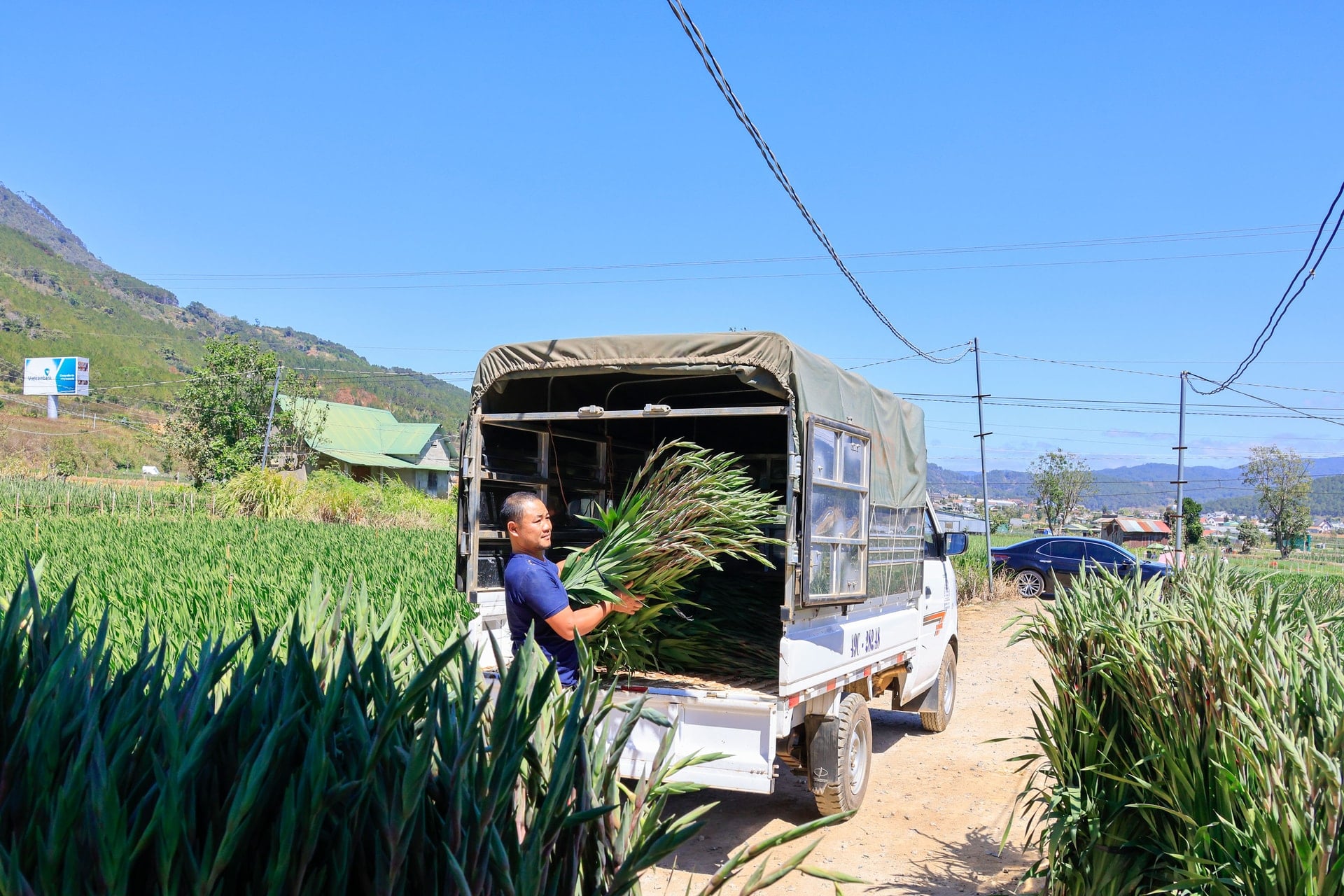
Thanks to rural roads, trucks can reach the gardens to collect vegetables and flowers.
Rural roads - a dual mission
When a road is built, it carries a dual mission: economic and cultural. Economically, the larger the road, the more open the "passenger space," allowing agricultural products to easily reach consumers everywhere.
The specialty Arabica coffee beans of Lac Duong region, the high-tech vegetable and flower shipments from Lang Biang ward - Da Lat, and the remote Don Duong commune no longer face price manipulation by traders. A seamless logistics system shortens the distance from farms to agricultural processing plants and stores in Hanoi , Ho Chi Minh City, Central Vietnam, and even to seaports and airports for export to other countries. Coffee, vegetables, flowers, and fruits are now not only sold to local purchasing agents, but farmers are also exporting them to Europe, Japan, South Korea, and China.
The road also serves as a "channel" for knowledge, dispelling prejudices about remote, culturally impoverished areas. Children go to school on clean, beautiful roads, and young people can easily interact with and learn about new cultures, modern technology, and new trends to develop the economy.
In Ta Nang commune or the Da Tong and Dung K'no areas (in Dam Rong 4 commune), along both sides of the road today are rows of vibrant yellow wild sunflowers and dancing cosmos flowers heralding the arrival of spring, and shops selling all kinds of goods. Culture and tourism reaching the villages have helped the sound of gongs and drums resonate further, and the traditional brocade weaving has become a valuable tourism product. The road helps tourists find their way, while also helping the people find a way to preserve their cultural identity.
The fact that over 80% of rural roads have been paved is proof of the consensus between the Party's will and the people's aspirations in recent times. The journey of building new rural areas will continue, and this consensus will be a solid foundation for Lam Dong's rural areas to continue to develop.
Source: https://baolamdong.vn/hien-dat-mo-duong-cuoc-cach-mang-tu-long-dan-415110.html
![[Photo] My Son at night: A thousand-year-old heritage site amidst the Milky Way](https://vphoto.vietnam.vn/thumb/1200x675/vietnam/resource/IMAGE/2026/04/15/1776261039184_ndo_br_chon6-jpg.webp)
![[Photo] National Assembly Chairman Tran Thanh Man attends the opening session of IPU-152](https://vphoto.vietnam.vn/thumb/1200x675/vietnam/resource/IMAGE/2026/04/16/1776277863731_ctqh5-jpg.webp)
![[Photo] Mrs. Ngo Phuong Ly meets and exchanges views with Mrs. Peng Li Yuan](https://vphoto.vietnam.vn/thumb/1200x675/vietnam/resource/IMAGE/2026/04/16/1776277858080_phu-nhan-1-jpg.webp)

![[Photo] The General Secretary, President and his wife meet with Vietnamese-Chinese friendship leaders.](https://vphoto.vietnam.vn/thumb/1200x675/vietnam/resource/IMAGE/2026/04/15/1776264829725_vna-potal-tong-bi-thu-chu-tich-nuoc-to-lam-gap-mat-nhan-sy-huu-nghi-viet-nam-trung-quoc-8703641-3130-jpg.webp)




























































Comment (0)