

While strongly supporting the North-South high-speed railway project, National Assembly representatives and experts still have many concerns about the planning and location of the stations…
Why not extend it to Lang Son and Can Tho ?
According to the plan submitted by the Government to the National Assembly, the North-South high-speed railway line will start in Hanoi (Ngoc Hoi station) and end in Ho Chi Minh City (Thu Thiem station), passing through 20 provinces and cities with a total length of approximately 1,541 km. During the discussion at the session on the afternoon of November 20th, many National Assembly deputies suggested expanding the investment scope of the North-South high-speed railway line to include Lang Son as the starting point and Ca Mau as the end point. Before submitting the plan to the National Assembly, the Government also commissioned the Ministry of Transport to consider and study the option of extending the high-speed railway line from Mong Cai (northernmost point) to Ca Mau (southernmost point).
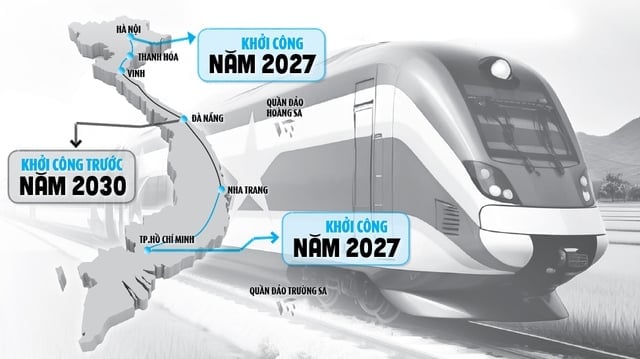
The Ministry of Transport aims to complete Vietnam's "high-speed rail dream" within 10 years.
GRAPHICS: TRG.T.NHI – PHAT TIEN
The Ministry of Transport has announced that the high-speed railway route on the North-South axis has been calculated to connect with the international intermodal railway system between Asia and Europe. Specifically, in the northern region, from the Ngoc Hoi complex and Thuong Tin station, the high-speed railway on the North-South axis will connect internationally with China via the eastern ring road (connecting Ngoc Hoi station with Kim Son station); Kim Son station will connect the Lao Cai - Hanoi - Hai Phong railway line to Hekou - China and connect with Yen Thuong station to Nanning - China via the Hanoi - Lang Son line.
In the central region, the high-speed railway line on the North-South axis will connect internationally with Laos at Vung Ang station via the Mu Gia - Vung Ang - Vientiane route.
In the southern region, the high-speed railway line on the North-South axis will connect to Trang Bom station via a branch line. From Trang Bom station, a planned railway line will connect to An Binh station to travel to Cambodia via the Ho Chi Minh City - Loc Ninh railway line and the Ho Chi Minh City - Moc Bai railway line.
Responding to delegates, Minister of Transport Nguyen Van Thang stated that, in addition to the North-South high-speed railway line, two separate projects to build railway lines from Hanoi to Lang Son and Ho Chi Minh City to Can Tho are currently being implemented vigorously, using standard gauge. Due to the high demand for freight transport on these routes, both lines will have the capacity to transport both passengers (at speeds of 160-200 km/hour) and freight (at speeds of 100-120 km/hour). The Hanoi-Lang Son project is expected to receive loans from China, while the Ho Chi Minh City-Can Tho project has completed pre-feasibility studies and secured funding. Therefore, if these railway lines are simultaneously implemented, they will form a double-track high-speed railway with a standard gauge of 1,435 mm running continuously from Lang Son to Can Tho.
Delegates want the high-speed railway to extend from Lang Son to Ca Mau.
Financial and economic expert, Associate Professor Dr. Dinh Trong Thinh, noted that high-speed rail is a project with superior technology, distinct engineering, and a large total investment. Unlike expressways, which can be extended wherever needed, the general view for the trans-Vietnam high-speed rail line is to prioritize the main, vital route with the highest demand, namely the Hanoi-Ho Chi Minh City line. Therefore, this line will be invested in with high train speeds, calculating the level of passenger and freight transport – the current plan prioritizes passenger transport. Meanwhile, the lines from Hanoi to Lang Son or from Ho Chi Minh City to Can Tho and Ca Mau have shorter lengths and lower demand, so investment projects have been approved with lower speeds and lower costs. These lines will be designed to combine freight transport with a higher proportion than the Hanoi-Ho Chi Minh City line. According to Associate Professor Dr. Dinh Trong Thinh, the overall planning of these component railway projects is reasonable.
However, besides the differing train speeds, the placement of the main stations on these lines is also inconsistent and considered inconvenient for interconnectedness. For example, while Ho Chi Minh City's main station in Thu Thiem is the end point of the North-South line, the starting station of the Ho Chi Minh City-Can Tho line is An Binh station (in Binh Duong province). These two stations are about 20 km apart. Meanwhile, the proposed Hanoi-Dong Dang (Lang Son) railway line, currently undergoing a major overhaul, starts in Hanoi from Gia Lam station, about 23 km from Ngoc Hoi station, the planned starting point of the North-South line.
Engineer Vu Duc Thang, a bridge and road expert, assessed this as a major drawback because the North-South high-speed railway line has a very strong transport capacity, which will concentrate a huge amount of passengers and goods at the terminal stations. Many passengers and goods along the route from Hanoi need to go to Can Tho; conversely, those traveling from the South to the North need to go to Lang Son. These passengers will have to disembark at the terminal stations of the North-South line, then find transportation to the connecting station and wait for the train schedule to depart. At the same time, cargo owners on this route will have to transfer goods, unload, transship, wait for numerous procedures for cargo inspection and payment of freight charges, then hire trucks, buy new tickets, wait for trains to be assembled, and only when there are enough trains can they hire carriages to transport the goods to the warehouse.
“The numerous costly and inconvenient surcharges for customers are causing them to choose not to travel by train, but instead switch to traveling by car on expressways connecting directly to their homes. Connecting them into a single route would allow passengers to sit comfortably in one seat and sleep peacefully in one bed; a sealed freight car could be towed directly to the warehouse without needing to be unloaded or transferred. The Ministry of Transport and its consulting unit should study the shortest connection options for these ‘mega’ projects,” engineer Vu Duc Thang observed.
Should train stations be moved to the suburbs?
Similarly, the proposal to locate the North-South high-speed railway station far from the city center has also received mixed opinions.
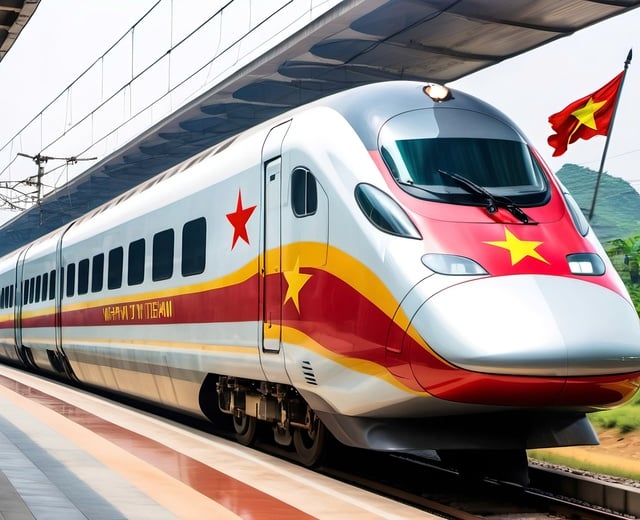
The North-South high-speed railway project is facing a historic moment.
PHOTO: PROGRESSING THE USE OF AI
Any mode of transportation that prioritizes passenger service must be located near residential areas. For example, Paris in France has five train stations within its city limits. In Japan's capital, Tokyo High-Speed Rail Station, located in the Marunouchi commercial district east of the Imperial Palace, is currently the largest and busiest station in all of Japan. Part of the Shinkansen high-speed rail network, Tokyo Station directly connects the capital to many popular destinations such as Kyoto, Osaka, Nagoya, and Hiroshima, and is also conveniently connected to Narita International Airport.
Expert Vu Duc Thang
According to the North-South high-speed railway route plan, many stations will not be located in the city center. For example, Ngoc Hoi station will be located in Lien Ninh and Ngoc Hoi communes, Thanh Tri district, Hanoi, about 11 km from the current station in the city center; Ninh Binh station will be located in Khanh Thuong commune, Yen Mo district, 7.5 km south of Ninh Binh city center and the current Ninh Binh station; Dong Hoi station will be located in Nghia Ninh commune, about 4.5 km southwest of Dong Hoi city center; Hue station will be in Phu My commune, Phu Vang district, Thua Thien-Hue province, about 20 km from the city center; Dien Khanh station will be located in Dien Thanh commune, Dien Khanh district, about 11 km west of Nha Trang city center…
The Ministry of Transport explained: Experience worldwide shows that some stations are located in the city center, while others are located in suburban areas. Each option has its own advantages and disadvantages, but the choice must be based on urban planning. Stations located in the city center are usually in particularly large cities with existing infrastructure and sufficient space to accommodate all functions, especially avoiding traffic congestion in the central area and being convenient for passengers. However, land acquisition will be extensive and the potential of the land will not be fully exploited. Meanwhile, in large cities today, land for stations is often scarce, making land acquisition difficult. Stations located in suburban areas require less land acquisition, have the potential for development and exploitation, mobilize land resources, and do not put pressure on urban infrastructure. However, the government must invest in a public transport system connecting to the city center.
Given Vietnam's low urbanization rate and the long-term goal of 50% urbanization, exploiting new development space is crucial. The high-speed railway route is being studied and selected to be "as short as possible," adhering to principles such as alignment with sectoral, national, and local planning. Stations are strategically positioned to ensure adequate spacing, meet technical requirements, suit the terrain of the route, avoid areas sensitive to natural and social environments, historical sites, and scenic spots, minimize land acquisition, and avoid densely populated areas.
Agreeing with the above proposal, urban planning expert Nguyen Minh Hoa analyzed: In theory, when wanting to stimulate the economy of an underdeveloped area, one should build a large infrastructure or transportation project there. For large cities and developing urban areas, the core is already too cramped and crowded; it's not advisable to add more high-volume transportation hubs like railway stations. Not to mention that major stations, which will attract a large number of passengers in the future, will form business complexes, commercial areas, restaurants, parking lots, etc., occupying a huge amount of space. High-speed trains running 4-5 trips a day at high speed will also significantly impact the lives of residents and the flow of other vehicles in the inner city.
Meanwhile, many suburban districts and counties are still lagging behind in their transformation. Therefore, the option of locating railway stations away from the inner city not only reduces traffic congestion in the core but also contributes to activating the outskirts into bustling areas. However, for smaller cities and towns, railway stations should be located in the central area to boost the economy and create favorable conditions for people living and doing business along the railway.
The North-South high-speed railway solves the logistics problem.
The high-speed, modern train must enter the city center.
However, the aforementioned viewpoint of the Ministry of Transport seems self-contradictory, as in the draft Railway Law (amended), the Ministry's functional agencies are proposing that Type 1 cities and special cities must have passenger stations located in the center or in convenient locations. The drafting committee explains that the location of national railway passenger stations needs to be added to the law to serve as a basis for guiding urban spatial development. Practical experience from developed countries shows that the number of passengers transported by national railways is very large, and bringing all of them into the urban center will significantly reduce the burden on transportation and improve connectivity between railway transport and other modes of transport. Passengers can travel directly from the center to the suburbs without changing trains and there will be no congestion at transfer stations between urban and national railways. This is a very effective solution to address the current urban traffic problem.
Many National Assembly deputies also argued that passenger terminals should be located in the city center; if they are in the suburbs, additional investment in connecting transportation routes would be required.
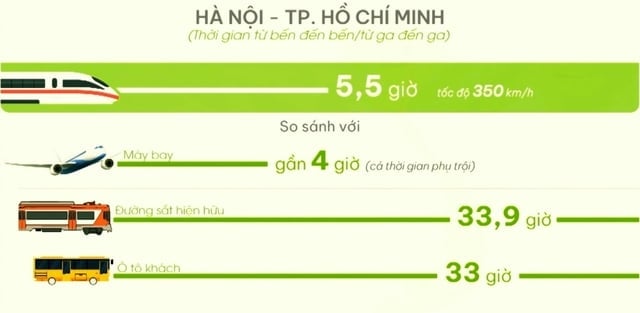
Estimated travel time for the Hanoi – Ho Chi Minh City leg of the North-South high-speed railway.
Road and bridge expert Vu Duc Thang believes that the idea of "pushing" train and bus stations to deserted areas will fail because all modes of transport must prioritize serving passengers. Bus and train stations, as places to pick up and drop off passengers, must be located in densely populated areas with convenient and quick connections. Passengers will prefer to travel directly from their starting point to their destination. Especially for rail transport, which carries a very large volume of passengers, the priority should be to attract as many passengers as possible.
According to Mr. Thang, around the world, even if airports and train stations are built outside the city center, every city still needs a train station in the city center. These stations are not only transportation hubs but also cultural centers, iconic architectural landmarks, and tourist destinations.
"To 'rescue' Vietnam's railway system, we can't just invest a lot of money; we also need to bring railway stations closer to customers to increase operational efficiency. Nowadays, trains run at high speeds, are polite and luxurious, so bringing them into the city center is logical," Mr. Vu Duc Thang emphasized.
Sharing the same view, architect Khuong Van Muoi, Chairman of the Ho Chi Minh City Architects Association, believes that while the plan to move bus stations, train stations, and passenger transport hubs out of the inner city is theoretically ideal, it will lead to many negative consequences if the transportation system does not keep pace with population growth. People will still have to use private vehicles, and may even have to use more types of transportation, which is inconvenient and causes further traffic congestion. Therefore, consideration should be given to moving the main transport hub to the city center but only to handle passenger transport, developing various types of services, and connecting well with the public transport network. All depots, locomotive and carriage repair areas, etc., should be moved outside.
Thanhnien.vn
Source: https://thanhnien.vn/hien-ke-duong-sat-cao-toc-bac-nam-185241125003016707.htm
![[Photo] Prime Minister Pham Minh Chinh receives the Chinese Ambassador to Vietnam](https://vphoto.vietnam.vn/thumb/1200x675/vietnam/resource/IMAGE/2026/04/05/1775397481797_ndo_br_dsc-5512-jpg.webp)
























































































Comment (0)