


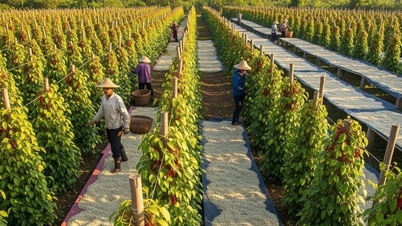
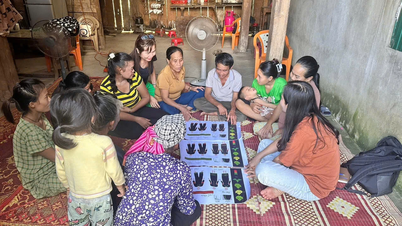
The model of growing black glutinous rice is being replicated in A Ngo commune - Photo: MT
Regarding the One Commune One Product (OCOP) program, in 2024, three OCOP products were recognized as achieving 3 stars (Doi Preng purple sticky rice, A Bung brocade weaving set, and Thien Phu peanut oil). To date, the district has seven 3-star products and three 4-star products. The District People's Committee has directed communes such as A Bung, A Ngo, Mo O, Ba Long, Ta Long, Ba Nang, and Dakrong to focus on developing OCOP products.
In addition, the digital transformation program in building new rural areas, aiming towards smart new rural areas, has been emphasized. The entire district has established 13 community digital technology groups at the commune level and 71 community digital technology groups at the village level, comprising 564 members. Currently, these community digital technology groups in the district are carrying out extensive information and propaganda activities on the Party's guidelines and policies, and the State's laws and regulations on digital transformation and building new rural areas to households and individual citizens.
At the same time, we will promote and guide people to install and master the skills to use basic digital platforms and applications such as: electronic personal identification, social insurance, electronic health records, mobile money accounts, performing public services on the online public service portals of the province, the country, and local governments, and creating social media groups for support and interaction.
Currently, the district has 10 commune post offices, 1 central post office in the town, 1 public internet and electronic game service business, 3 postal delivery points (district post office, Viettel branch, and economical delivery point), and 7 points providing mobile telecommunications equipment. Regarding telecommunications infrastructure in the district, there are currently 3 network operators: VNPT, Viettel, and Mobifone . To date, all communes have 4G and 5G BTS stations (a total of 82 stations across 13 communes and towns). 76 out of 78 villages have fixed broadband internet access.
The provincial and district post offices have supported the listing of the district's agricultural products on e-commerce platforms such as Vosco and Postmart. The products listed on these platforms are key products and OCOP-certified products, diverse in design and packaging, and complying with regulations on labels, tags, and product traceability, thus gaining the trust of customers.
People's online activity has seen growth in both the number of users and the duration of use. The number of individual transaction accounts opened at credit institutions in the area is 14,081. The number of electronic payment accounts is 6,838. The number of people with digital identities/electronic identification accounts is 12,573. The estimated percentage of the population with information and communication technology skills is 40%.
Furthermore, the program to enhance environmental protection, food safety, and clean water supply in rural areas during the New Rural Development program has yielded practical benefits for the people. Dakrong district has built a value chain for supplying safe and high-quality food; prioritized the development of specialized farming areas, producing clean and safe agricultural products, building brands, geographical indications, and traceability systems in conjunction with the New Rural Development program and the One Commune One Product program.
The dissemination of information has been actively implemented by relevant agencies through campaigns such as the Food Safety Action Month, training courses, and the issuance of food business licenses to establishments, as well as communication sessions held in villages and hamlets, and the signing of commitments by agricultural, forestry, and aquatic product production and business establishments, achieving a high rate (over 94%).
The entire district has 72 centralized and small-scale rural water supply projects, providing hygienic drinking water to 89% of rural households. Household waste collection and treatment activities are maintained and expanded to communes such as Mo O, Huong Hiep, Trieu Nguyen, and Ta Rut. The rate of solid waste collection and treatment in rural areas is estimated at 31%.
Efforts to promote household waste sorting have been intensified. Awareness campaigns and training sessions on household waste sorting and plastic waste collection are conducted on occasions such as World Environment Day and the Clean Up the World campaign.
Residents continue to sort organic household waste for animal feed or fertilizer, while recyclable waste is collected and sold to scrap collection facilities. Centralized plastic waste collection models are being replicated in villages and communes. It is estimated that over 50% of households in the communes are practicing solid waste sorting at source.
The achievements clearly demonstrate the effectiveness of the thematic programs in building new rural areas in Dakrong district; not only improving material living standards, but also transforming the appearance of mountainous rural areas, bringing confidence and a will to strive for progress to the people here.
Minh Tri
Source: https://baoquangtri.vn/hieu-qua-cac-chuong-chuyen-de-trong-xay-dung-nong-thon-moi-tai-dakrong-193426.htm


![[Photo] Prime Minister Pham Minh Chinh presides over a meeting on private sector economic development.](/_next/image?url=https%3A%2F%2Fvphoto.vietnam.vn%2Fthumb%2F1200x675%2Fvietnam%2Fresource%2FIMAGE%2F2025%2F12%2F20%2F1766237501876_thiet-ke-chua-co-ten-40-png.webp&w=3840&q=75)











































































Comment (0)