

Bringing songs to construction sites and border areas.
Artist Nguyen Van Anh (born in 1946), residing in Cao Xanh ward, was a worker at the Hon Gai Mechanical Factory in the past, belonging to Hon Gai Coal Company (the predecessor of the current Vietnam Coal and Mineral Industry Group ). He participated in many performing arts troupes of the coal industry, the Provincial Military Command, and the Quang Ninh Provincial Youth Union during the years of American bombing of the mining region and in the 1979 Northern border war.
As he chatted with us about his memories of the past, he was sometimes enthusiastic when recounting performances he gave without hesitation, despite the hardships and difficulties of war, and about the camaraderie of the soldiers. At other times, he became choked with emotion, shedding tears when mentioning his comrades from the past who are no longer with us…

Mining region artist Nguyen Van Anh (third from the right) with the Provincial Youth Union's mobile arts troupe performing at Po Hen in 1979. Photo: Photographer Truong Thai
He said that the Coal Industry's Mobile Arts and Culture Team consisted of core performing arts talents from various agencies and enterprises, similar to a semi-professional team within the coal industry. The team was established around the late 1960s and maintained for many years, with many notable members including: Văn Tuất, Phan Cầu, Vũ Đạm, Mai Đình Tòng, Đặng Xuyên, Văn Anh, Quang Thọ, Đào Cường, Đức Nhuận, Ngọc Diện, Trọng Khang, Hồng Hải, Trần Câu, Thanh Việt, Kim Oanh, Thuý Hơn, Mai Lan, Minh Chính, Quý Sinh, Minh Nguyệt, Thanh Xuân, Văn Sông, Thanh Vân, Vân Quý… The team typically maintained around 20 members, including musicians, singers, dancers, and those who independently staged short plays.
During the American bombing of the mining region, the troupe served the workers, climbing the artillery hills and performing in three shifts, about an hour before the workers' shift began. They performed at 4 a.m. for the first shift, at 12 noon for the second shift, and at 10 p.m. for the third shift. Therefore, the troupe didn't perform in auditoriums but usually performed live at the mine entrances, on the construction sites, in the Cọc Sáu open-pit mine, the Cửa Ông and Hồng Gai screening plants, and at key locations frequently bombed by the American forces in the coal industry. On one occasion, the troupe had just returned from a performance when American planes arrived.
Artist Van Anh from the mining region recalled: "That day, after our performance in Cua Ong, we were walking back to Cam Pha when American planes started bombing the area around Bridge 20 and the Cua Ong screening plant. Our performing arts group had to evacuate to the riverbank. We were quite scared, but after we were safe, we continued walking, carrying our instruments and performance equipment. Such incidents became a habit for us performing arts shock troops. Later, when we went to the front lines on the border, it was the same."
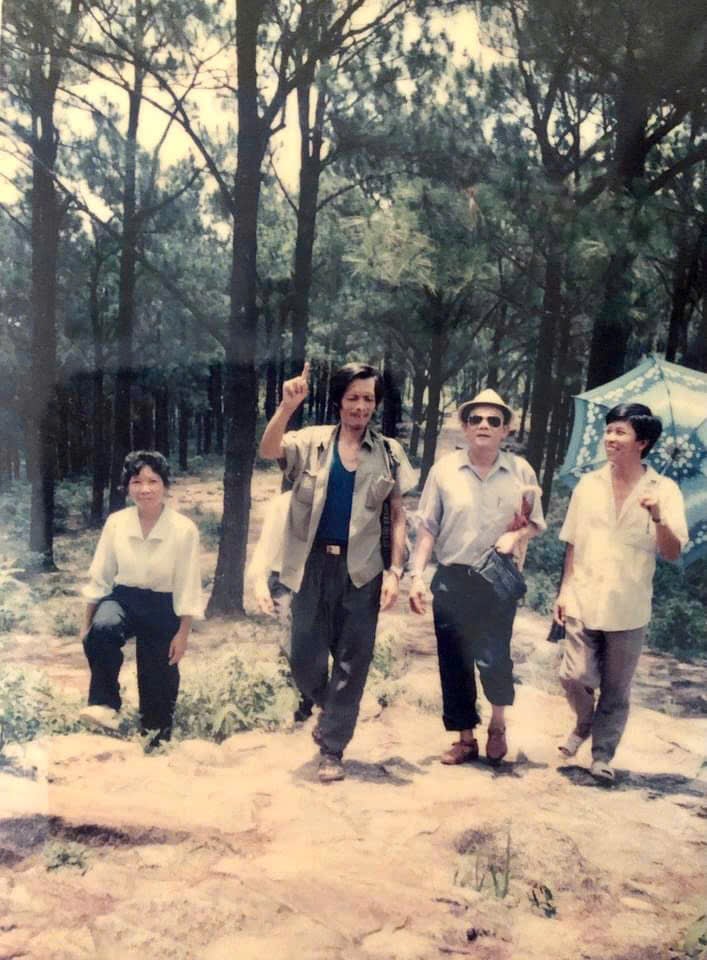
Artists Thuy Hon (far left) and Van Anh (far right) with several other artists during a performance tour on the border in 1979. Photo: Provided by the artist.
Besides performing at coal mining units, the coal mining industry's performing arts troupe also participated in performances for military units along the border, such as the 369th Division, the 323rd Division, and the 395th Division. When the border war broke out, some coal mining artists joined the performing arts troupe of the Provincial Military Command and the youth performing arts troupe of the Quang Ninh Provincial Youth Union, continuously performing on the border fronts, from Dinh Lap, Lang Son to Mong Cai...
Artist Van Anh from the mining region was part of both teams. He recounted: "The youth volunteer arts team of the Quang Ninh Provincial Youth Union was the largest, with nearly 20 people, mostly key figures in arts from coal, education , waterway, and food industries, such as Huy Do, Van Anh, Thuy Hon, Thanh Kim, Bien Hoa, Thanh Hoa, Xuan Tu, Tran Dung..." This trip lasted about a month. We arrived right after Mong Cai was bombarded, with the goal of serving the troops in border areas, coastal regions, and islands. From Mong Cai, we traveled to various places, including Tien Yen, Cao Ba Lanh in Binh Lieu, Ba Che, and the islands of Vinh Trung and Vinh Thuc (old place names in the eastern part of the province - PV ). Due to wartime conditions, life was quite difficult for us. We were transported from Hon Gai to the military unit by vehicle, and then we had to walk to the performance points, carrying the radios and loudspeakers ourselves. We would climb to the performance point in the morning, but the performance times weren't fixed, so sometimes we didn't get to eat lunch until 1 or 1:30 because the unit members took turns watching the performances while on duty. At the military unit, we ate whatever was available, only occasionally getting a better meal…
He said the most touching memory for the team was the performance on Cao Ba Lanh. The soldiers were stationed on a high point, where the air was humid year-round, and their clothes never dried. They even had to dry their clothes by roasting them in a pan. That day, during the performance, we noticed soldiers sitting and watching for one or two hours before going inside, only to see others come out still wearing the same clothes. Later, we learned that they didn't have any dry clothes and had to take turns wearing them to watch the performance.
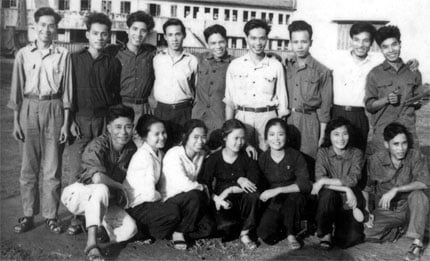
The mobile performing arts troupe poses for a commemorative photo at the Logistics Department before departing for the battlefield, November 23, 1968. (Archival photo from the Quang Ninh Art Troupe.)
Back then, artists like Van Anh, a miner from the mining region, were deeply connected to the workers and soldiers, while their material lives were impoverished. He said that during those difficult times, the people worked hard but were selfless. Now, recounting the story to us, despite his advanced age, he still remembers the details vividly; the proud and sacred memories flow like an inexhaustible stream, truly moving the listeners.
Marching with the soldiers
During the period 1968-1972, when the resistance war against the US for national liberation entered its most arduous and intense phase, Quang Ninh province directed its culture and information sector to send two mobile performing arts teams directly to serve the Southern battlefield. Each team consisted of 16 people, mainly professional performing arts troupes from the province and core performing arts groups from several sectors such as coal, postal services, health, commerce, and education. Hong Hai (Ha Tu Mine) and Quang Tho (Coc Sau Mine), artists with backgrounds in the coal industry, successively joined these two teams.
Thus, not only did they bring their songs and melodies to serve the fighting forces in the province, but the artists of the coal industry, along with other artists from the mining region, packed their bags and headed to the southern front lines, using their songs to drown out the sound of falling bombs, carrying the longing, love, faith, and hope of the home front to the front lines; alleviating the hardships, suffering, and sacrifices of the soldiers; inspiring willpower and giving strength to their comrades so that each step into battle was more steadfast, and each victory more glorious.

Playwright Tat Tho (fifth from the right) with artists from the former provincial performing arts troupe, during a reunion and visit to the Quang Ninh Museum. Photo: Pham Hoc
Playwright Tat Tho (from Bai Chay ward), who participated in the 1971 expedition, is now 80 years old, but his memories remain as vivid as if it were yesterday. He recounted: "The selected cultural and artistic groups all had beautiful voices and talents, both professional and amateur. Before going to the battlefield, the whole team trained for a month at the Party Hall in Bai Chay, covering drama, choral singing, solo singing... During the day, we studied arts, and early in the morning and late in the evening, we carried backpacks loaded with bricks and practiced walking several kilometers through the pine hills of Bai Chay, preparing for the march south."
The performances were comprehensive, serving the diverse needs of the soldiers. We could perform musical instruments from flutes, guitars, and two-stringed fiddles, as well as sing folk songs from various regions, perform traditional opera, modern songs, act in short plays, and recite poetry... In addition to the performances prepared at home, wherever we went, the team would immerse themselves in the reality of the units and create works about them and their work, such as pipeline soldiers, female liaison officers, wounded soldiers, and those transporting ammunition and weapons... to boost morale and praise the officers and soldiers. The artists were also very versatile; for example, Quang Thọ specialized in modern songs but also participated in plays and traditional opera when needed; the members of the traditional opera troupe also participated in male vocal groups...
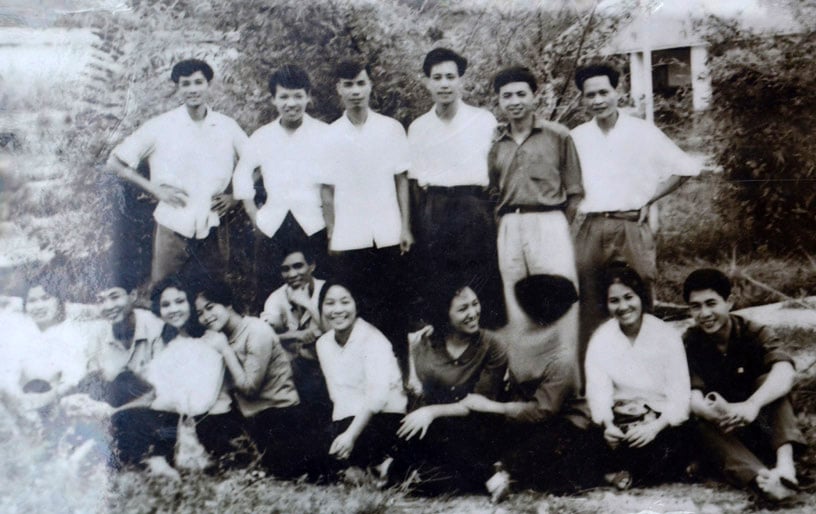
Members of the Quang Ninh Mobile Performing Arts Team entering the Southern battlefield in 1971. Archival photo from the Quang Ninh Art Troupe.
The troupe's performances were mostly during the day to avoid aircraft and the lights that might alert the enemy. The battlefield stage was usually a patch of forest, by a stream, or under a tree. Besides the standard military uniforms, the costumes included some specially designed outfits for the specific act or character. Nighttime performances required them to be in underground shelters, using tin cans filled with oil to provide light. He jokingly said, "The oil burned, leaving black soot clinging to the soldiers and the performers; everyone looked like furnace workers after their shift. But seeing that made us feel homesick. Or when we passed through the forest, the fresh breeze was so cool, just like when a furnace is broken through, making everyone feel great and refreshed."
The performing arts troupe that went to the battlefield back then was highly appreciated by the soldiers. Mr. Tat Tho said that the troupe could perform 3-4 songs a day. Sometimes, they would encounter a unit of soldiers on the march along the way, and the soldiers would be delighted to see the troupe and request a performance. The artists would then stop, prepare their costumes and acts immediately. They were always in that spirit of readiness, responding to the demands of the battlefield and the realities of the situation. Everyone was selfless, everyone was ready; no one thought about danger or death, and no one calculated any personal gain.
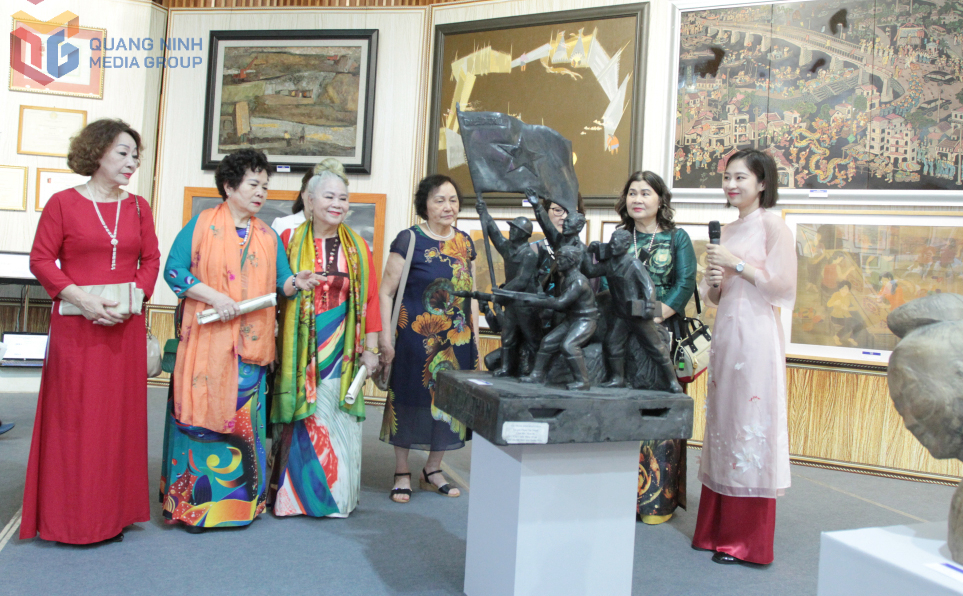
Former members of the provincial performing arts troupe admire the sculpture depicting a coal miner enlisting to contribute to the liberation of South Vietnam and the reunification of the country, at the Quang Ninh Museum. Photo: Pham Hoc.
That strength enabled the mobile performing arts troupe to overcome many difficulties, stay close to the battlefield, and ignite the spirit of the soldiers. Most members of the troupe were resilient and adaptable, but the harsh wartime conditions and mountainous terrain caused many to fall ill with malaria, sometimes having to stay at military outposts. However, upon recovery, they would rejoin the army units to catch up with the troupe. He jokingly said: "In our troupe, Tat Tho always went first, Quang Tho brought up the rear. Everyone said that with two Mr. Tho, everyone was safe and no one died. There were times when the men were buried under a cloud of dust and debris from falling bombs, but once they were cleared away, they were all unharmed."
According to incomplete statistics, the first team, serving in the B2 and B3 battlefields of the 559th Regiment in 1968, performed at 7 military stations, with 350 performances for over 3,500 viewers. The team was awarded the Third Class Resistance Medal. The second team, serving in the B, C, and K battlefields of the 559th Regiment in 1971-1972, performed 185 official shows and numerous smaller performances. This team was awarded the Second Class Resistance Medal.
After returning, these artists continued to dedicate themselves to the arts of the mining region and the country, becoming People's Artists, Meritorious Artists, artists of the mining region, artists of the province's art troupes, and renowned singers on the music stages of the province and the country. Now they are all elderly, many artists have passed away according to the law of time, but those who remain and the present generation still remember their companionship and contributions to the nation's history. Through their songs, their voices, and the courage from their hearts, they ignited the spirit of miners and soldiers on many fronts through the difficult and fierce stages of war, contributing to regaining independence, freedom, and unity for the homeland and the country today.
Phan Hang
Source: https://baoquangninh.vn/ho-da-cat-cao-loi-ca-tieng-hat-trong-khoi-lua-dan-bom-3369614.html
![[Photo] “Red Journey” 2026: Vietnamese Youth Continue Building the Bridge of Friendship Between Vietnam and China](https://vphoto.vietnam.vn/thumb/1200x675/vietnam/resource/IMAGE/2026/04/20/1776629730866_4055880775670638308-9618-4200-jpg.webp)

















































Comment (0)