

As strategic partners, the European Union (EU) and Canada have much to discuss at their summit, taking place on November 23-24 in Canada. However, raw materials are a particularly important issue.
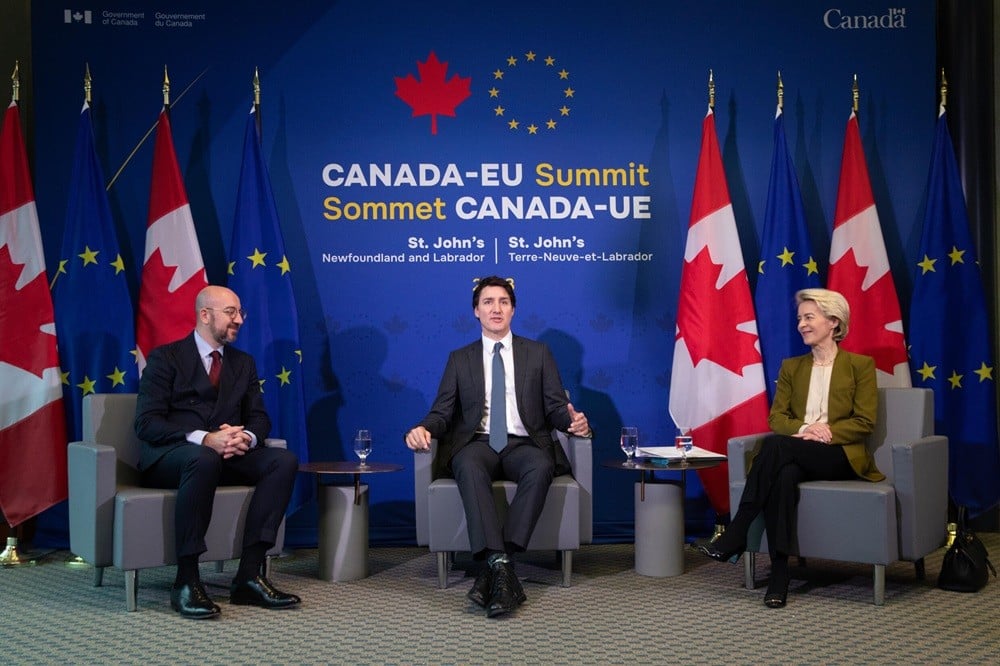 |
| From left to right: European Council President Charles Michel, Canadian Prime Minister Justin Trudeau, and European Commission President Ursula von der Leyen on November 24. (Source: AFP) |
In early November, the EU approved a provisional agreement on legislation identifying 34 raw materials that are important to Europe, 17 of which are considered to be of strategic importance.
However, the EU has long been dependent on external sources of supply, making raw materials its "Achilles' heel," reducing Europe's competitiveness and strategic autonomy. This becomes even more urgent as China, which supplies 98.5% of the EU's rare earth minerals, plans to restrict exports.

To ensure a stable supply chain, the EU's Raw Materials Act stipulates the need to find reliable partners. As the country with the longest-standing official relationship with the EU among developed industrial nations, Canada naturally became the preferred choice.
The advantage here is, first and foremost, that the EU-Canada strategic partnership has a solid foundation based on two important agreements: the Comprehensive Economic and Trade Agreement (CETA), which coordinates economic relations, and the Strategic Partnership Agreement (SPA), which defines the framework for political , foreign policy, and security cooperation between the two sides.
Furthermore, Canada is a leading trade and investment partner of the EU. In 2022, trade in goods and services between the two sides reached US$147 billion. As of 2022, Canadian direct investment in the EU was valued at US$248.8 billion, accounting for 12.5% of Canada's total outbound foreign direct investment (FDI).

Solving the raw materials problem will give the EU and Canada the confidence to move towards the goal set by Canadian Prime Minister Justin Trudeau: "developing a middle class, improving the quality of life, and building a clean economy on both sides of the Atlantic."
Source






































![[Video] Sunset at Lap An Lagoon – Where the sun sets over the fishing nets](https://vphoto.vietnam.vn/thumb/1200x675/vietnam/resource/IMAGE/2026/05/31/1780192137701_beach-landscape-sea-water-nature-grass-745871-pxhere-com.jpeg)





















Comment (0)