

He experienced the brutal days in Quang Tri and was part of the 203rd Tank Brigade that advanced into the Independence Palace on April 30, 1975, contributing to the resounding victory of the historic Ho Chi Minh Campaign.
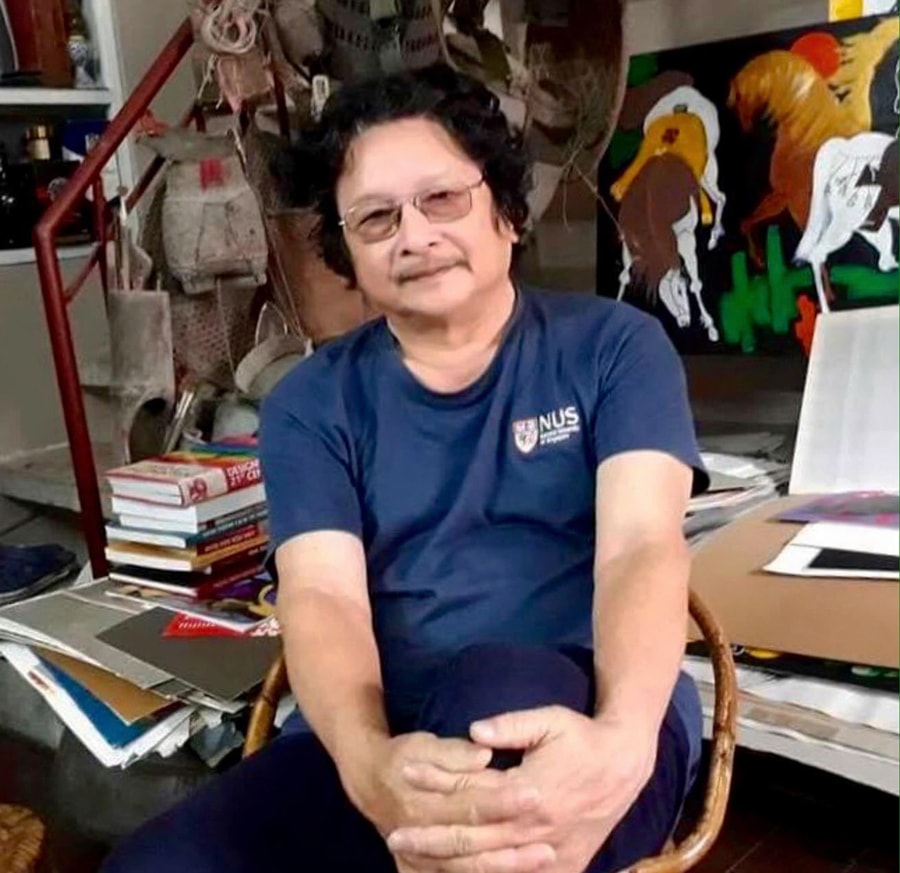
Priceless battlefield sketches
In artist Le Tri Dung's studio, the most prominently displayed are war relics arranged in an impressive manner: a bullet-riddled steel helmet, a canteen, a metal jug, a hammock, a leather belt, canvas poles, a brick brought back from Quang Tri Citadel... All are vivid pieces of evidence, preserved by him as part of his memories of military life, marking the places he fought or traveled through.
Artist Le Tri Dung recounts that when he first enlisted, he was an infantry soldier in the 338th Division of the Capital Military Region, a unit tasked with reinforcing the Southern front. When the unit reached the northern bank of the Thach Han River, the Quang Tri campaign began. The fighting was fierce, and our troops suffered unavoidable losses. In this situation, the superiors ordered soldiers who were university lecturers, final-year students, etc., to retreat to the rear to reinforce technical branches such as Air Defense - Air Force, Tanks - Armored Vehicles... At that time, Le Tri Dung was assigned to the 10th Tank - Armored Vehicle Battalion to learn to drive a tank.
.jpg)
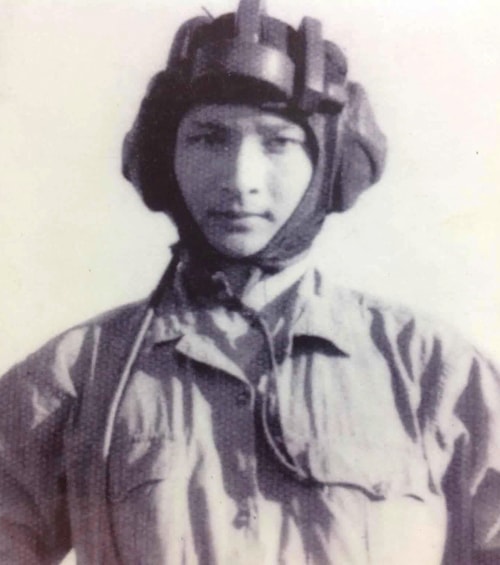
By chance, his superiors learned that Le Tri Dung was a final-year student at the University of Fine Arts, and he was transferred to work as a propaganda officer in the Armored Corps. From there, he worked as a war correspondent, taught art to the soldiers, and also oversaw the opening of a screen printing workshop to produce propaganda posters.
In September 1972, Le Tri Dung was assigned the task of painting a large poster (5m x 3m) to commemorate the 13th anniversary of the Corps' establishment, with the requirement to depict the attacking spirit and coordinated combat tactics. He immediately created an image of three soldiers, one commander, one driver, and one gunner forming the main group, with tanks advancing behind them under the liberation flag... This first poster made a strong impression on his superiors and comrades.
Shortly afterwards, Le Tri Dung was assigned to print 2,000 propaganda posters using screen printing techniques, praising the lightning-fast offensive power of the tank troops. Many of these works were rolled up and sent to combat units, pasted onto the turrets, contributing to boosting the morale of the soldiers in defeating the enemy.
After the screen printing operation, Le Tri Dung received a brief but reliable instruction from his superiors: "You will accompany the task force to Quang Tri, and once you arrive, separate and go independently. Bring your camera and several rolls of film, go into the battlefield to take pictures, and open a drawing class for the soldiers. Remember to sketch a lot, the soldiers really need artistic performances!"
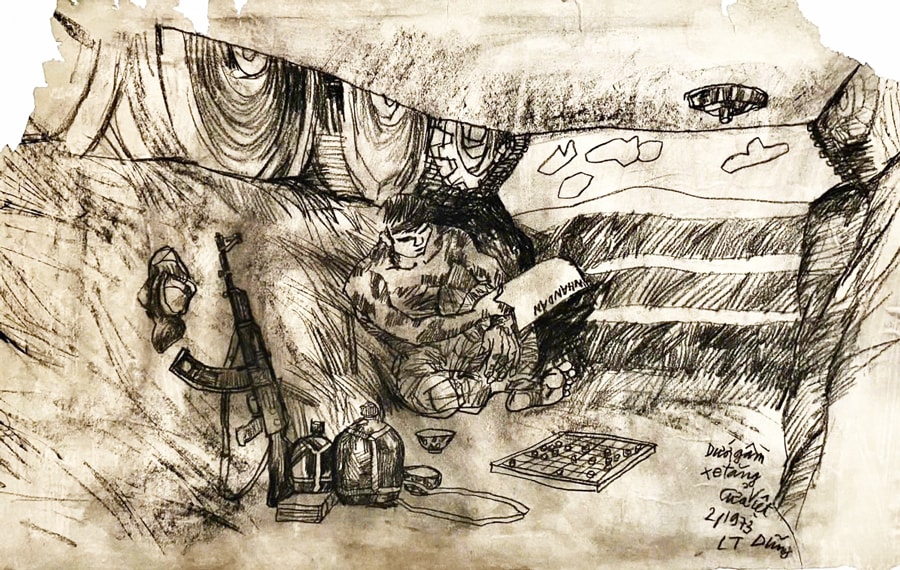
From then on, artist Le Tri Dung traveled across various battlefields, capturing hundreds of photographs and sketching hundreds of drawings on all sorts of materials: newspaper, packaging, notebooks, the backs of document pages... His subjects ranged from moments of preparing for battle, clearing the battlefield, the close bond between soldiers and civilians, battle planning meetings, to scenes of bandaging wounded soldiers after battle.
While fighting, artist Le Tri Dung simultaneously painted, depicting the places he traveled and the people he met – from courageous artillerymen, combat engineers, and female messengers, to newly enlisted privates. For him, each sketch was not just a work of art but also a memory, sometimes a poignant pain – because some paintings were completed only to be followed a few days later by news that the comrade depicted had been killed.
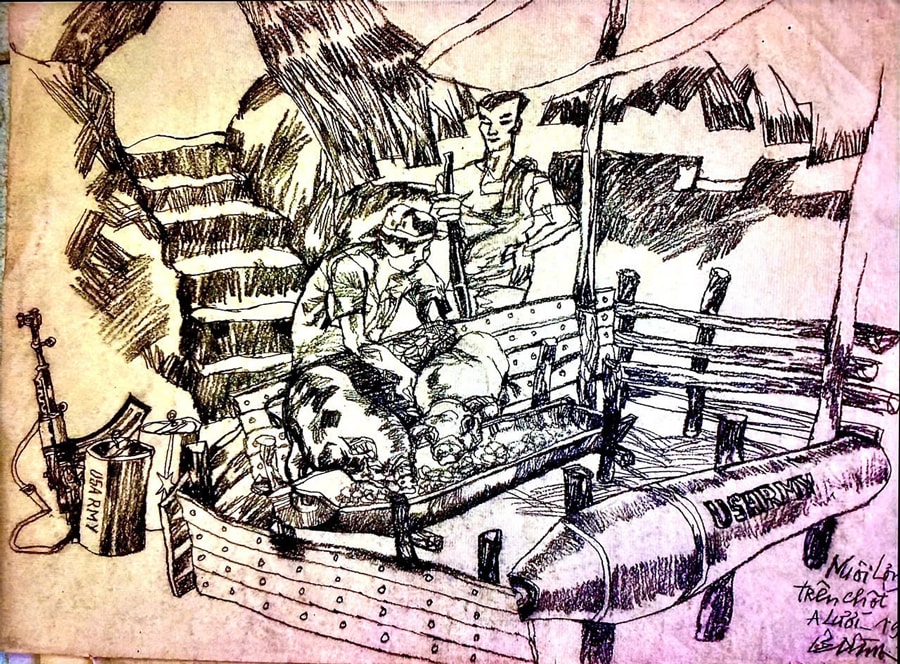
Flipping through old sketches, he slowly introduced them, his eyes filled with nostalgia: "This is a drawing of a soldier raising pigs at an outpost, showing optimism amidst hardship. The pigsty is made from wooden ammunition crates left by the enemy, and the pig trough is repurposed from a bomb cut in half lengthwise. And this is a painting of a soldier cleaning an anti-aircraft gun, with a cluster of cacti nearby; the soldier has to crawl under the gun to clean it. This one depicts a forest devastated by enemy bombs and bullets, but our tanks still proudly advance, showing the indomitable spirit and resilience of our soldiers."
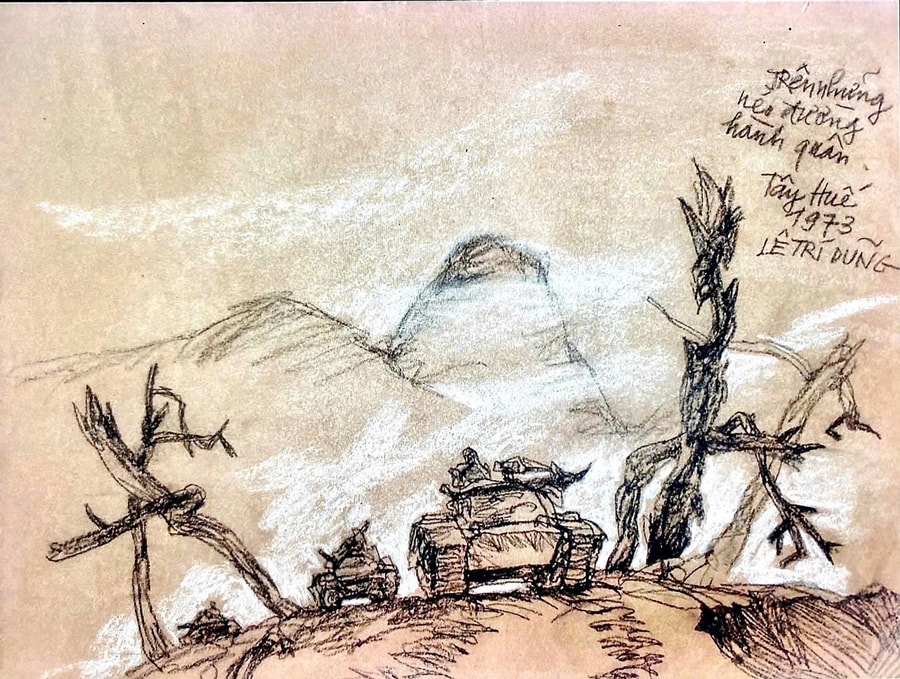
He sketched many things, but deep down, the artist still harbored a burning desire to create a grand masterpiece, one that would clearly express the heroic spirit of the Tank and Armored Vehicle Corps. One day, while marching through an area that had just experienced a fierce bombing raid, he suddenly felt a chill run down his spine when he saw a tank abruptly surging around a bend under the fiery red glow of the sunset. The tank, like a ferocious tiger, its camouflage flapping wildly, its tracks tearing up the road, its proud cannon barrel turning against the jagged cliffs. He quickly sketched this image amidst the smoke of bombs and the burnt trees, along with the image of young female volunteers with parachute scarves around their necks, standing beside ancient trees as if about to leap from the abyss...
"That moment inspired me to paint the famous lacquer painting 'Overcoming the Critical Point,' which is now on display at the Vietnam Fine Arts Museum," shared artist Le Tri Dung.
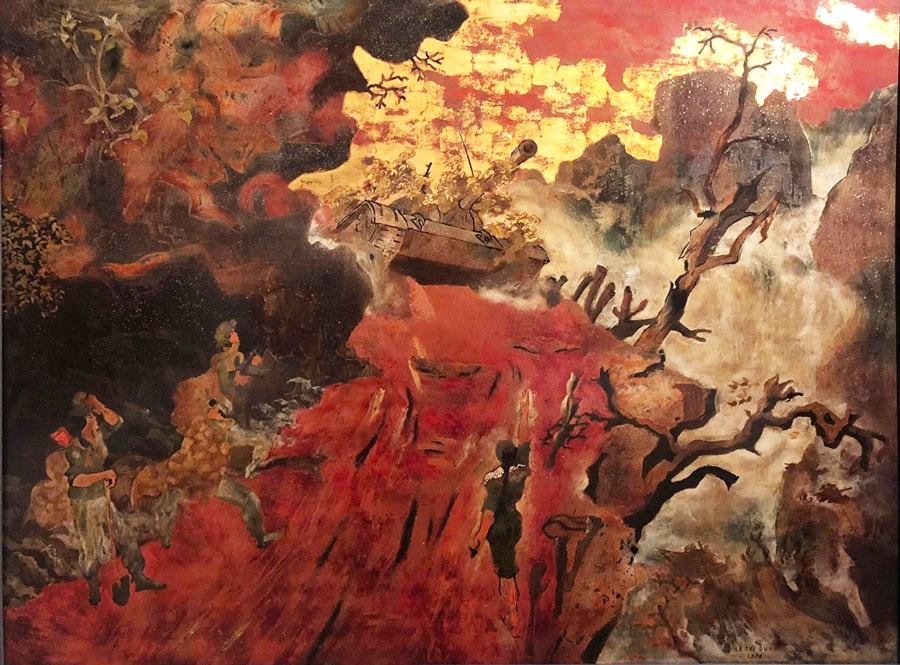
Proud of a time of fire and glory.
In April 1975, Le Tri Dung received orders from the Armored Corps to participate in the Ho Chi Minh Campaign. When he arrived in Saigon on the afternoon of April 30, 1975, the city had already been completely liberated. The sketch "The April Escape," drawn by Le Tri Dung during that historic moment, has become a priceless memento.
During his stay in Saigon, the artist was assigned a special task: to paint and photograph documentary scenes at the Independence Palace – where the tanks of the Armored Corps had advanced, marking the victorious conclusion of the historic Ho Chi Minh Campaign. For him, this task held particularly profound significance, because his unit, Company 4 of the 203rd Tank Brigade, was the first force to capture the Independence Palace, contributing to putting an end to the nation's long and arduous war.
After laying down his arms and returning to civilian life, Le Tri Dung became a renowned painter of modern Vietnamese art. Two themes deeply connected to him are war and horses – also the two major areas of his artistic creation that he dedicated his entire life to.
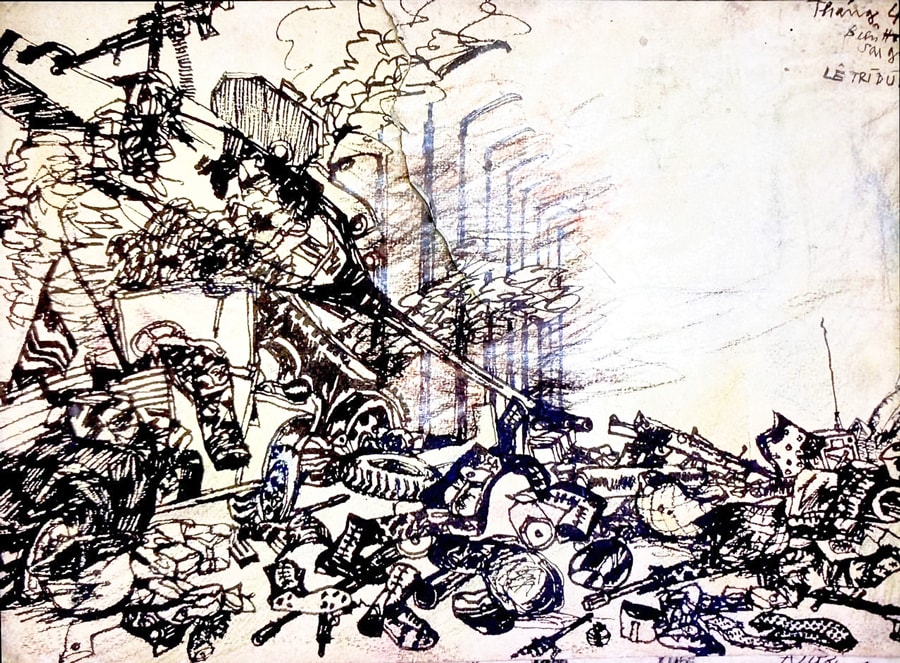
The battlefield sketches, drawn amidst bombs and bullets, have become famous and widely known works of art. Besides "Crossing the Key Point" (lacquer, 1974), other works such as "Crossing the River" (lacquer, 1976), "Dioxin Forest" (silk, 1989), "Mother of the Soldiers" (oil painting, 1999), "Borderland" (awarded at the 2000 National Fine Arts Exhibition), "Portrait of a Soldier" (oil painting, 2004), "Post-War" (2005, currently housed at the Vietnam Fine Arts Museum), "Behind the Battle" (C Prize at the 2009 National Fine Arts Exhibition)... all reflect the brutality of war and the courage of the soldiers. He also participated in many major international exhibitions on the theme of war, such as the "Two Sides" exhibition (Boston, USA) and the "Southern State" exhibition (Sydney, Australia). In 1992, he was invited by the American Veterans Association to participate in an exhibition in the United States and made a profound impression with his series of works on the theme of Agent Orange.
Later, besides themes of war and horses, artist Le Tri Dung also became famous for his paintings of the zodiac animals, lotus flowers, and characters from "The Tale of Kieu". And regardless of the subject matter, Le Tri Dung always painted with pride, passion, and the determination of a soldier who had experienced war.
Fifty years after the reunification of the country, recalling each battle, he couldn't help but feel emotional thinking about the sacrifices of his comrades just before the moment of peace . He felt fulfilled to have lived and fought in a glorious era, and then returned to continue his profession. "I will always be a soldier wielding a brush!" - artist Le Tri Dung shared, his eyes sparkling with pride.
Source: https://hanoimoi.vn/hoa-si-le-tri-dung-toi-mai-la-nguoi-linh-cam-co-700919.html































![[Image] Close-up view of the 10-lane road connecting to Long Thanh Airport](https://vphoto.vietnam.vn/thumb/402x226/vietnam/resource/IMAGE/2026/04/04/1775291871988_ndo_br_1-resize-5690-jpg.webp)

















Comment (0)