Students in Tuy Duc border region revive M'nong heritage.
Amidst the M'nong village landscape, the sound of gongs blends with the wind, evoking memories of the mountains and forests. The experiential journey and activities of the "Sounds of the Great Forest" Club not only help the children connect with the ethnic heritage but also ignite the flame of preserving cultural identity, bringing the sound of gongs back into contemporary life.
Báo Lâm Đồng•02/12/2025
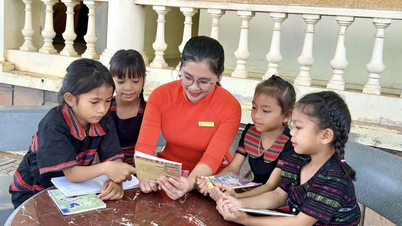
Members of the "Sounds of the Great Forest" Club from Tuy Duc Ethnic Boarding Secondary and High School visited Dien Du hamlet, Quang Tan commune, to participate in activities celebrating the new rice harvest.
Experience the heritage through every encounter.
On a peaceful morning at the end of the rainy season, we followed Ly Y Van and the members of the "Sounds of the Great Forest" Club from Tuy Duc Ethnic Boarding Secondary and High School to Dien Du village. These M'nong children grew up surrounded by the sound of gongs, but some admitted they "only see them as display items."
This field trip, therefore, is like a return to the roots of sound, to the cultural essence that still lingers in every home, every wisp of smoke from the kitchen hearth.
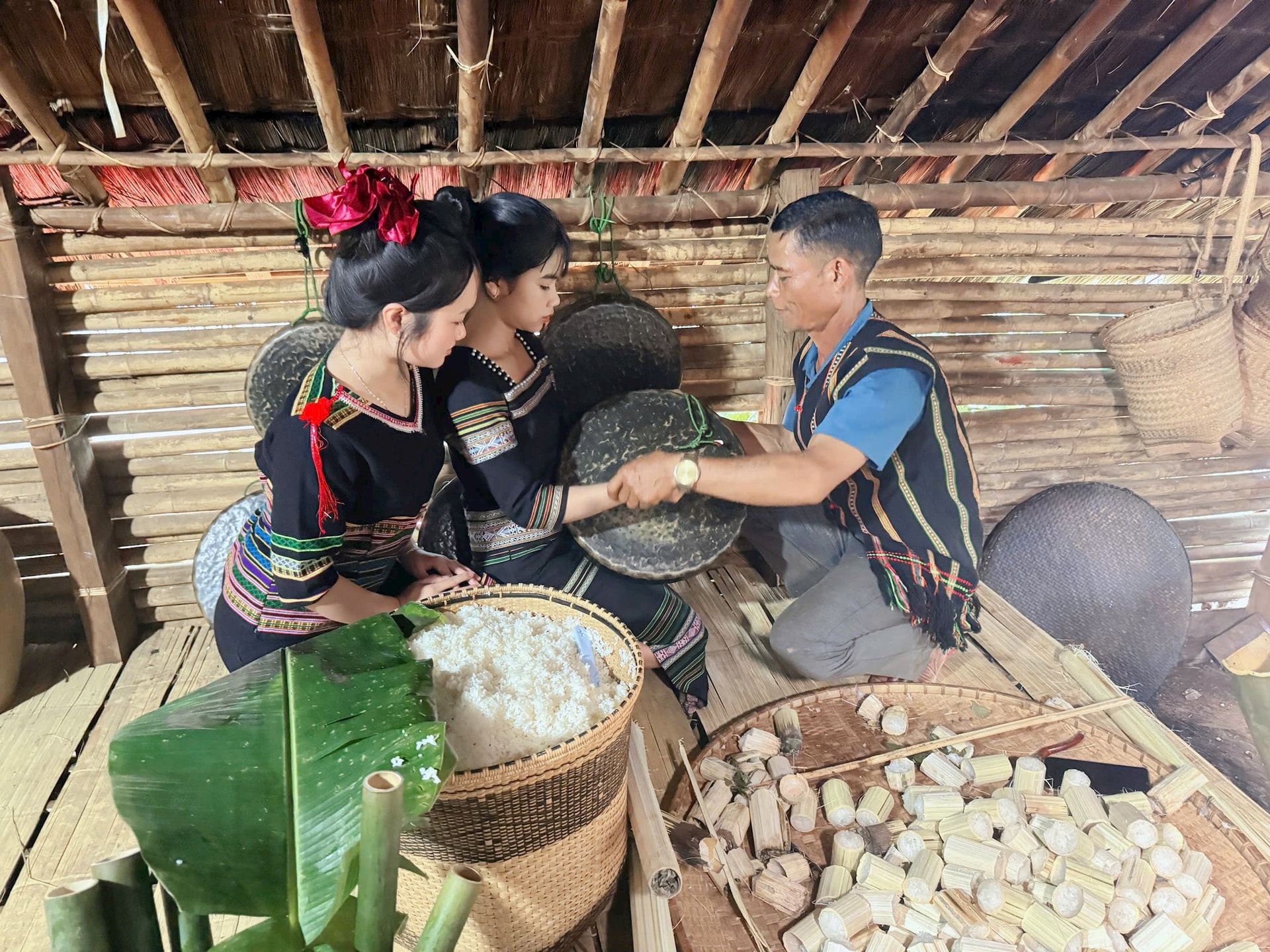
Bon Dien Du is celebrating the new rice harvest. In the traditional house of artisan Dieu Gie, the flickering firelight illuminates his gentle face. Amidst the eager anticipation of his students, he quietly opens a cupboard and takes out a set of gongs that have been passed down through generations of his family. The bronze gongs, tarnished and polished black, bear the marks of time, speaking volumes about the age of this heritage.
Members of the "Sounds of the Great Forest" Club not only came to Dien Du village to observe, but also truly experienced the harvest festival with the local people.
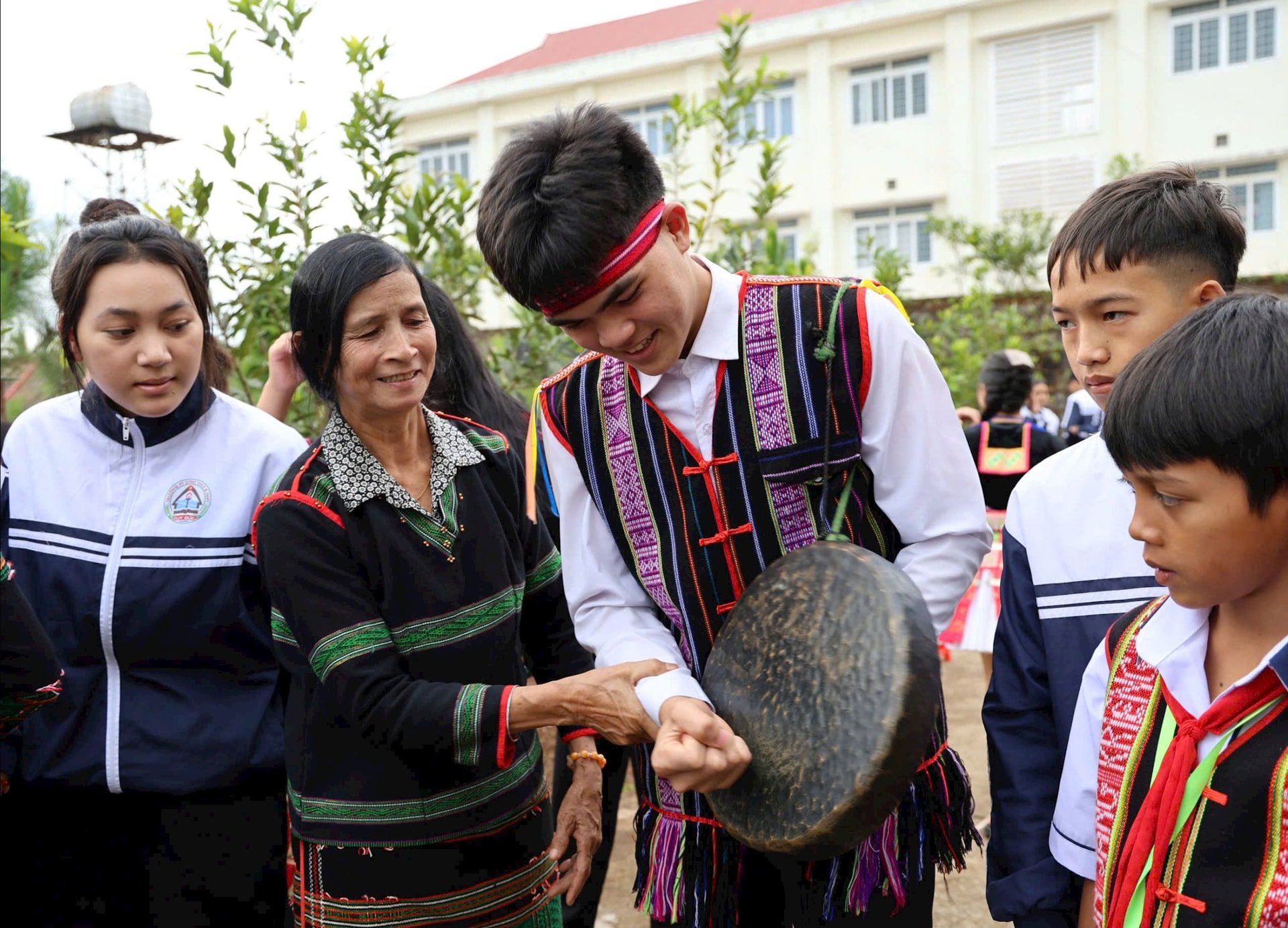
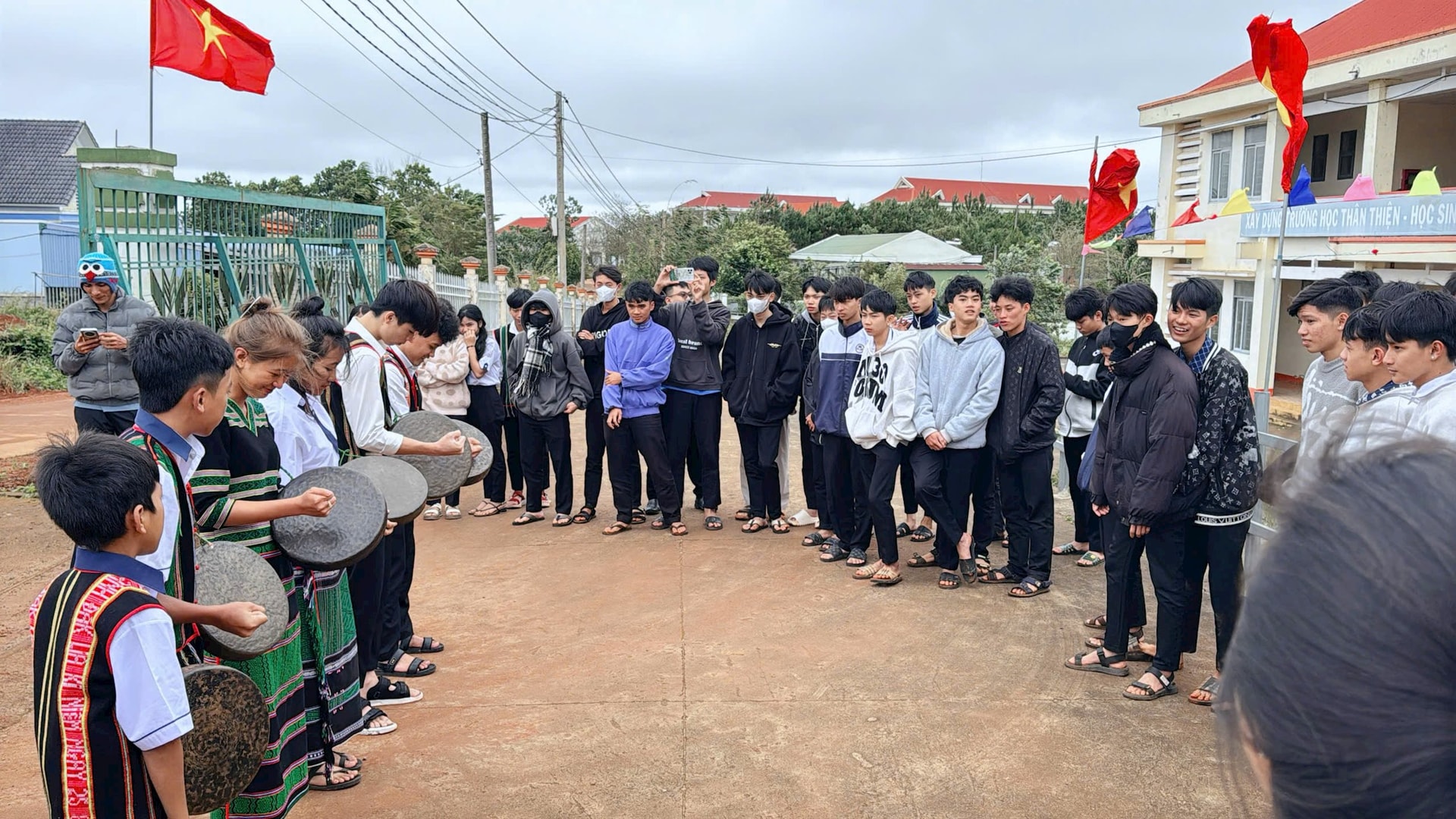
Without textbooks, projectors, or presentation slides, artisan Dieu Gie begins his gong-playing lessons in the most accessible way. He meticulously guides his students through each movement, from how to wear the gong, where to place the points of contact, the rhythm of the strokes, and how to combine the movements...
When the first sound rang out under Y Vân's clumsy hands, the whole group of students burst into laughter. The gong's sound was not only in rhythm but also perfectly captured the emotion.
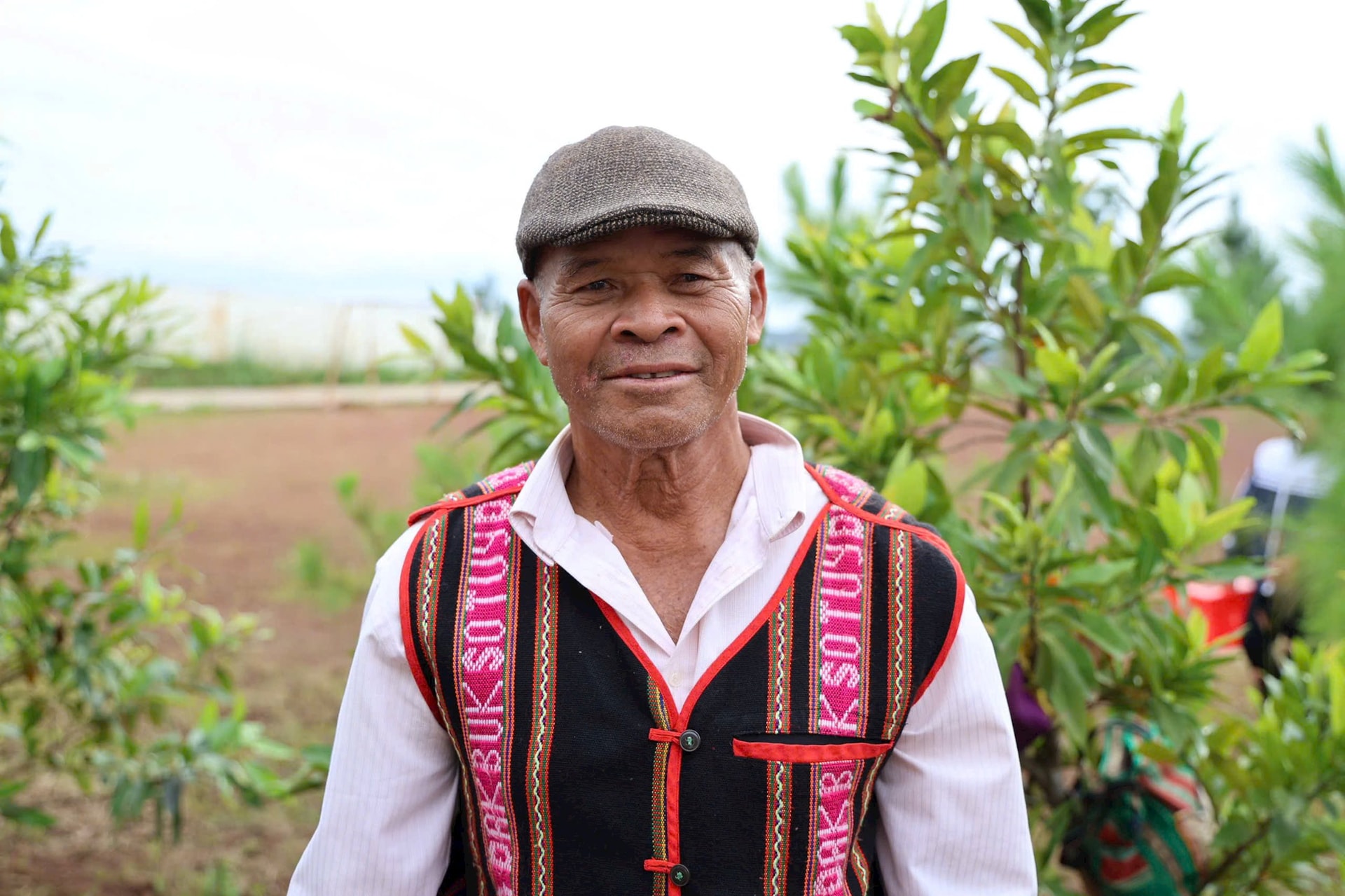
Artisan Điểu Gié, from the Điêng Đu hamlet, Quảng Tân commune, Lâm Đồng province, personally guides students in playing the gong.
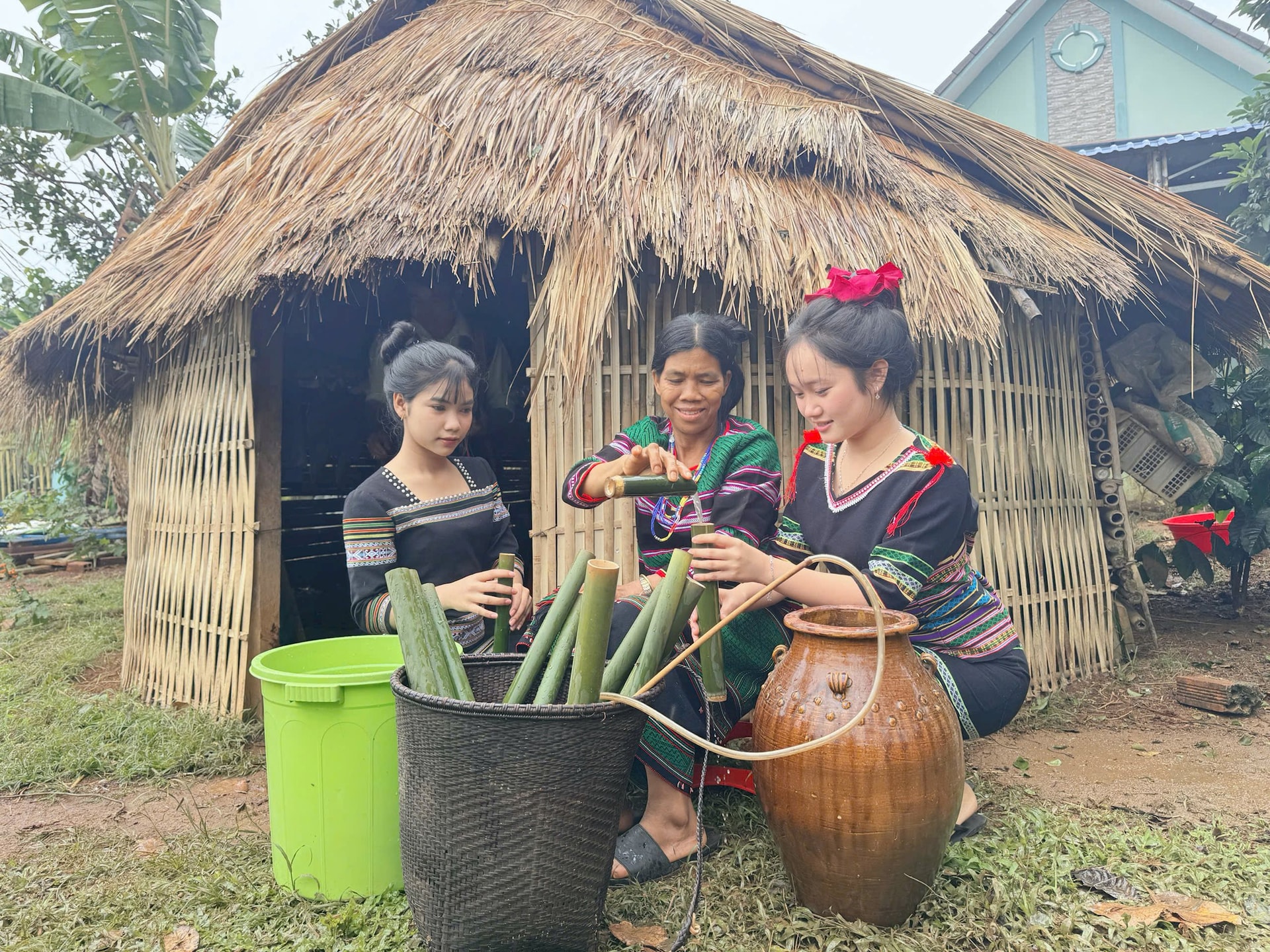
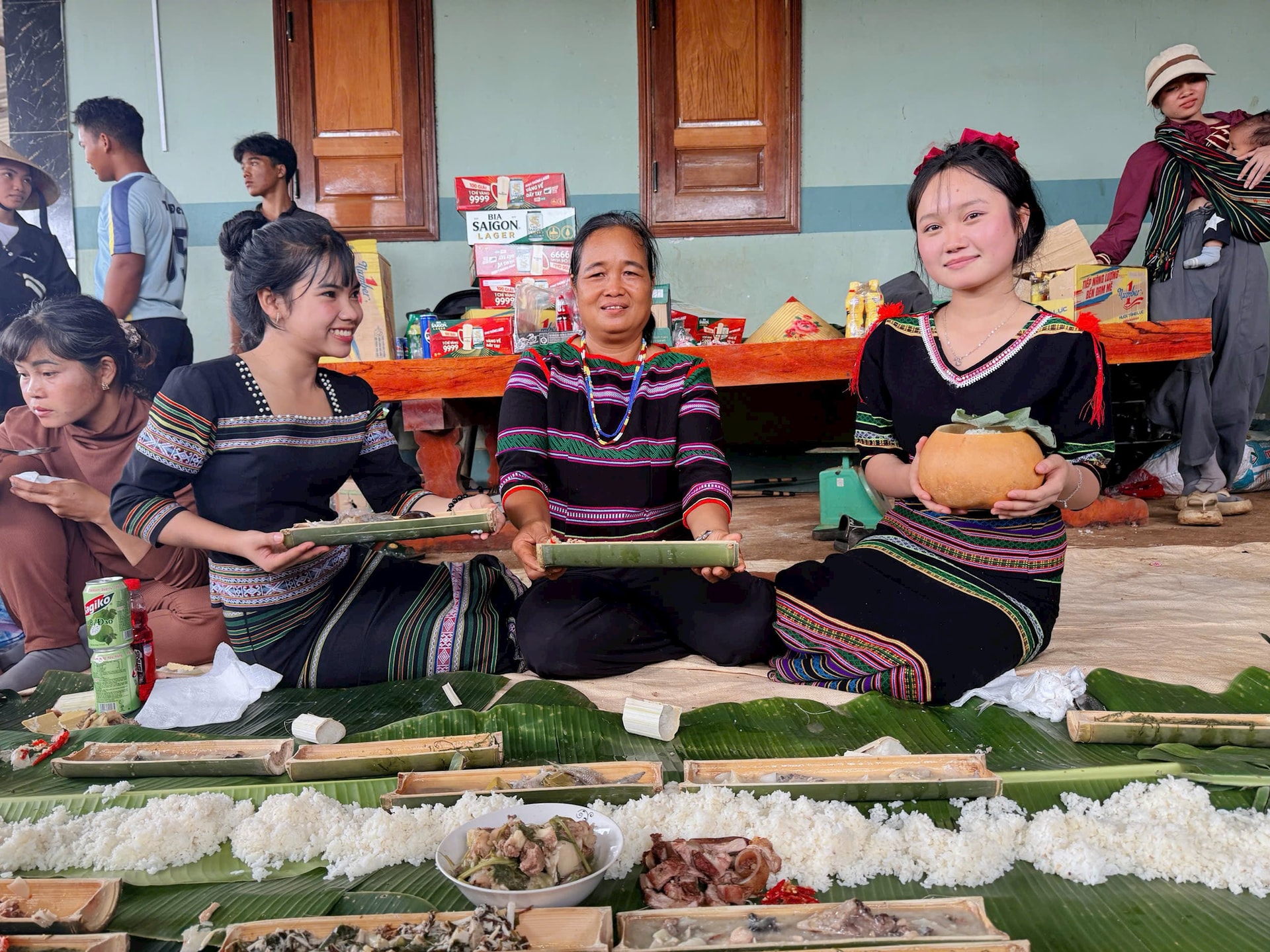
The members of the "Sounds of the Great Forest" Club not only came to Dien Du village to observe, but truly lived through the new rice harvest festival with the locals. They ate, stayed, and participated in all the festival activities with the artisans and villagers. From cooking rice porridge and making rice wine to grilling meat over an open fire… they experienced everything with their own hands and eyes.
Thanks to this, traditional culture is no longer abstract concepts found only in textbooks. It becomes a taste on the tongue, through the smoke from the kitchen fire that makes everyone's eyes sting, through the joyful laughter of the elderly and children around the fire, and the warmth of the village community during festivals.
Amidst the rhythm of village life, the children experience the culture with all their senses: the aroma of sticky rice cooked in bamboo tubes over a charcoal fire, the clacking of cooking utensils, the fluttering traditional costumes of M'nong women, and even the rhythmic gongs emanating from the corner of the stilt house.
Each moment becomes a vibrant piece of the puzzle, helping the children to understand more deeply the origins and meaning of the new rice harvest festival in the lives of the M'nong people.
It's not just an extracurricular activity, but a journey to connect with heritage through real-life experiences, allowing a love of culture to naturally blossom in the hearts of young people.
Y Vân said that they used to think of gongs as something old-fashioned and distant. But after listening to the elders and artisans explain them, and getting to play the gongs themselves in the village, they truly felt proud.
Extending the rhythm of the gongs in the vast forest.
What makes this club special is the participation of many local artisans. These artisans are people who have dedicated their lives to gongs and stone xylophones. Artisan Dieu Dyang from Bu N'rung village said that in each club meeting, he not only teaches playing techniques but also tells students stories about festivals and the sound of the gongs as a prayer to their ancestors.
A unique feature of the club is the collaboration with many local artisans.
Artisan Điểu Dyăng from Bu N'rung village shared his thoughts, saying, "The sound of gongs and stones is the voice of the mountains and forests. Losing the sound of the gongs means losing the voice of our ancestors. Now, hearing the sound of gongs echoing in the schoolyard, I am very happy. The tradition is still being preserved by someone."
Artisan Điểu Dyăng, from Bu N'rung village, Tuy Đức commune, Lâm Đồng province
"
Hearing the sound of gongs echoing in the schoolyard today made me very happy. It means there are still people preserving the tradition.
The collaboration between artisans and schools helps students properly understand the heritage, grasping the rhythm of the gongs and the true spirit of traditional musical instruments. These lessons are not just found in textbooks but come alive through the hands of the artisans and the passion of the students.
Many students expressed pride in learning about their nation's heritage.
Many students expressed pride in learning about their ethnic heritage in school. Dieu De Me Trieu, an 11th-grade student, shared that she wants to practice diligently so that she can play the gongs in her village's festivals in the future.
Dang Thi Ut Nhi shared that she was impressed by the sound of the stone xylophone, which sounds like a stream. She hopes to learn to play this instrument and that more young people will participate so that traditional musical instruments are not forgotten.
Heritage, which once existed only in arts competitions, has now become a source of pride.
Dang Thi Ut Nhi is a 11th-grade student at Tuy Duc Ethnic Boarding Secondary and High School, Tuy Duc commune, Lam Dong province.
"
I hope more young people will participate so that traditional musical instruments will not be forgotten.
According to Mr. Vu Tien Dung, Secretary of the school's Youth Union, the club's activities are forming a "circle of transmission" within the school. Accordingly, artisans directly instruct students in gong playing and stone xylophone performance skills; after a period of training, the students become teaching assistants, supporting teachers in activities, and this core group of students continues to pass on the knowledge to the younger students.
This approach helps preserve gongs and stone xylophones not just as an experience, but as a regular practice that spreads more widely among students throughout the school. As a result, the heritage is not "learned and then forgotten," but is practiced weekly during extracurricular activities at school.
The club also interacts with other schools.
The club also filmed their experiences of weaving, performing gong music, and celebrating the new rice harvest. These authentic videos became source material for the TikTok channel "GenZ_YeuChieng," where many videos garnered significant views, bringing culture closer to young people in a very natural way. More importantly, the footage will serve as an online tour for students throughout the school.
Furthermore, the club also engages with other schools, invites artisans to perform during extracurricular activities, and builds a repository of related materials to "bring traditional culture from villages into the classroom" in a modern way.
The "Sounds of the Great Forest" Club not only creates a cultural playground but also awakens dormant traditional cultural identities. From the schoolyard, the rhythm of the gongs enters daily life, passing through the faces of the students, extending the identity of the M'nong people in a new, youthful, vibrant, yet proud form.
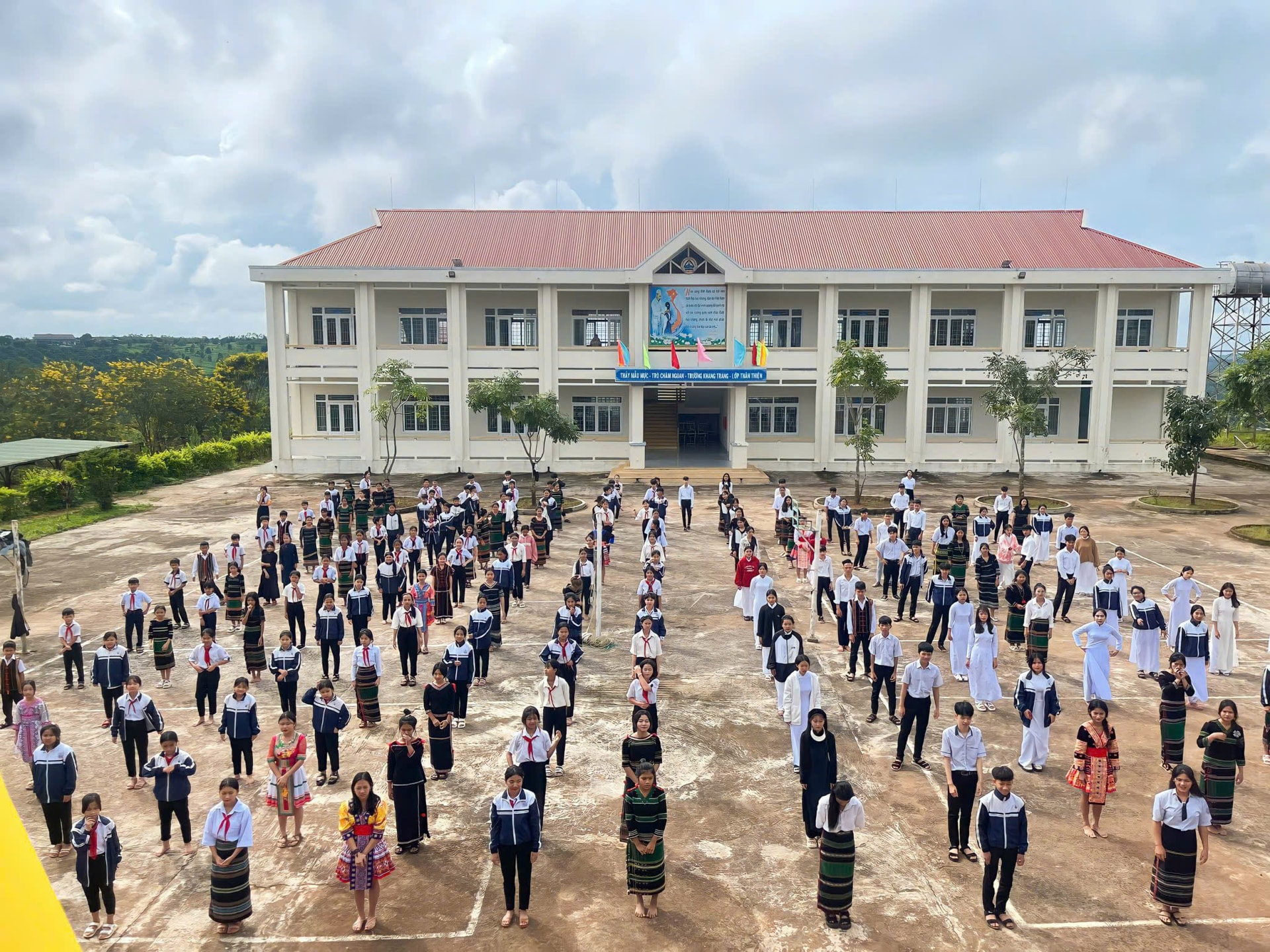
Tuy Duc Ethnic Boarding Secondary and High School, Tuy Duc commune, Lam Dong province, is home to many students from the M'nong ethnic minority.
Children growing up in this land are learning to communicate with their ancestors through the music of their own ethnic group. As evening falls and shadows fall on the courtyard of Tuy Duc Ethnic Boarding Secondary and High School, the sound of gongs resonates, blending with the wind blowing through the border forests.
The "Sounds of the Great Forest" Club was established in the 2025-2026 school year, maintaining regular classes with guidance from artisans and teachers, aiming to build a performance team to participate in cultural events of the commune and the school. This is not only an extracurricular activity, but also becomes a content of ethnic cultural education in the school, linked to the goal of forming a successor generation that understands and practices the community's heritage.



.jpg)




![[Image] Shipbuilders exposed to steel and record-breaking heat.](https://vphoto.vietnam.vn/thumb/1200x675/vietnam/resource/IMAGE/2026/06/04/1780545781745_ndo_br_img-5402-4683-jpg.webp)




![[Podcast] Capital City Law 2026: Increased penalties for violations in the fields of culture and advertising](https://vphoto.vietnam.vn/thumb/402x226/vietnam/resource/IMAGE/2026/06/03/1780487283783_4522222.png)












































![[Video] Sunset at Lap An Lagoon – Where the sun sets over the fishing nets](https://vphoto.vietnam.vn/thumb/1200x675/vietnam/resource/IMAGE/2026/05/31/1780192137701_beach-landscape-sea-water-nature-grass-745871-pxhere-com.jpeg)








































Comment (0)