

Crop conversion to adapt
Currently, Tuyen Hoa commune has 7 villages directly and indirectly affected by mineral exploitation activities, mainly concentrated in the Tien Hoa cluster. Dust released from the stone quarrying process reduces the yield of many crops, leading to a significant decrease in people's income. In this context, achieving sustainable economic development, especially agriculture linked to the value chain, is a difficult challenge.
To overcome these difficulties, the Center for Rural Research and Development has piloted a biomass corn cultivation model on an area of 10 hectares. According to Mr. Tran Duc Tinh, head of Cuong Trung C village, biomass corn has the advantages of a short cultivation time, superior yield, less labor-intensive care, and especially provides significantly higher income compared to growing corn for grain. Therefore, the model not only solves the livelihood problem for the people but also opens up an effective way to transform areas of land that have long been low-productivity.
 |
| A model of growing Four Seasons bamboo for shoots in Truong Son commune - Photo: LC |
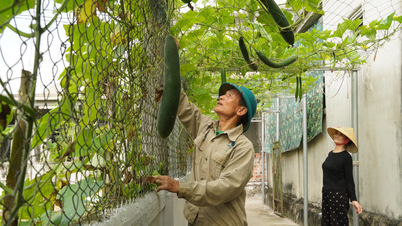
In Truong Son commune, where the majority of the population are Van Kieu ethnic minorities whose livelihoods are closely tied to agriculture and livestock farming, recent mining activities have degraded the soil quality, making production increasingly difficult. To help people increase their income, a model of cultivating four-season bamboo on an area of 30 sao (approximately 360 square meters) has been implemented by a group of Van Kieu women.
Ms. Ho Thi Tuong, from Khe Ngang village, Truong Son commune, shared: “My family planted 8 sao (approximately 0.8 hectares) of four-season bamboo, receiving support from seedlings and fertilizers to cultivation techniques. Currently, the plants are developing very well. We are very reassured because the Truong Xuan Bamboo Cooperative has committed to purchasing our produce.”
Towards sustainable agriculture
Beyond simply crop diversification, the project supports improved livelihoods for people in mining areas by promoting the development of agricultural product value chains, focusing on commercialization and standardization of local products. Cooperatives are being strengthened and operated more systematically; distinctive products are receiving investment in improved packaging and labeling to enhance competitiveness.
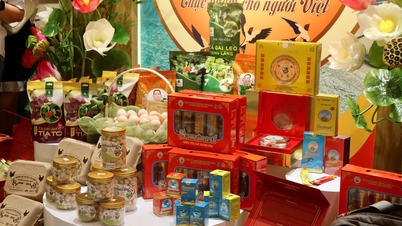
From a fragmented, artisanal production method, the Khiên village sugarcane molasses cooperative (Tuyên Hóa commune) has received support to renovate its workshop, standardize its processes, and build a brand identity. The application of food safety and hygiene standards and the pursuit of OCOP certification have helped Khiên village sugarcane molasses products reach a wider market.
According to Tran Van Cong, Director of the Khien Village Sugarcane Syrup Cooperative, standardizing the process from raw material sourcing to processing has helped people feel secure in their production, creating stable jobs for many households. In addition, people have received training and guidance on digital sales methods, helping Khien Village sugarcane syrup reach more customers inside and outside the province.
For many years, the Truong Xuan Bamboo Cooperative (Truong Son commune) has become a reliable partner in linking and purchasing bamboo shoots from local people. According to the cooperative's director, Nguyen Viet Tam, the project not only guides members in cultivating four-season bamboo but also supports the cooperative in improving production quality and efficiency, and expanding market access for local bamboo products. These results have directly improved the livelihoods of the community, especially ethnic minority households affected by mining activities, creating a foundation for them to confidently develop a sustainable economy in their homeland.
Scaling up green livelihood models not only contributes to improving people's economic lives but also creates a positive shift in awareness within the community, helping people become more proactive in protecting the environment, adapting to climate change, and moving towards sustainable development.
According to Pham Mau Tai, Deputy Director of the Center for Rural Research and Development, the project supporting the improvement of livelihoods for people in mineral-mining areas through promoting the development of agricultural product value chains, implemented in Tuyen Hoa and Truong Son communes, has contributed to raising people's awareness of developing agricultural product value chains; building livelihood models to improve income through a value chain approach; and developing and implementing solutions to mitigate environmental impacts and livelihood impacts in mineral mining. The project has reached and supported more than 2,500 beneficiaries in Tuyen Hoa and Truong Son communes, including 159 ethnic minorities. The replication of these models not only improves the economy but also brings about positive changes in awareness of environmental protection and adaptation to climate change.
Lan Chi
Source: https://baoquangtri.vn/kinh-te/202602/hoi-sinh-vung-dat-kho-7de17a2/







































































Comment (0)