

Illustration: BH
It was a thick, blue stone slab, about the diameter of a small bowl, roughly carved into a circle. The underside was flat, the top slightly convex, with a shallow indentation in the center formed by prolonged handling. The stone, originally a grayish-blue, had turned a light brown after dozens of seasons, mottled with faint white streaks of salt that had seeped deep into the stone's texture.
It was an item my grandfather made himself. About forty years ago, he picked up a flat, thick stone from the stream behind the mountain and brought it home. On sweltering summer afternoons, he would sit under the betel nut tree in front of the yard, meticulously carving and shaping it with a hammer and chisel. He polished it with sand and well water until it was smooth. In the same way, he also made a small stone mortar and pestle set.
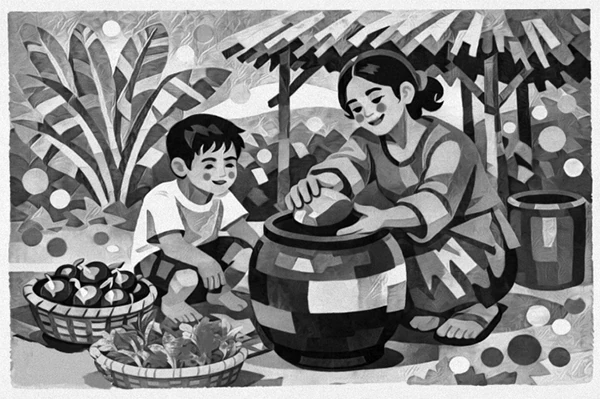
Then, the stone began its work. He also wove a round bamboo mat for her, slightly smaller in diameter than the mouth of the jar. The mat's purpose was to create a wide, flat surface that evenly pressed down on the entire surface of the melons without needing a large stone. The widely spaced bamboo slats allowed the brine to seep through, but not a single melon or tomato stem could float to the surface and escape. Thanks to it, the small stone still fulfilled its task of tightly compressing the melons and tomatoes underneath.
In winter, when the sun shone faintly, she would pickle mustard greens. She would pickle the greenest, thickest-stemmed greens. She spread them out on a large bamboo tray in front of the house, drying them in the sun until they wilted slightly. She would soften the leaves, losing their initial crispness and becoming pliable. She would wash them thoroughly and let them dry. Then, sitting on the porch, she would meticulously arrange each green leaf in a ceramic jar. A layer of greens, a layer of fine white salt. She would gently press and lightly knead them to allow the salt to penetrate. When the jar was full, she would pour in enough rice water to cover the greens, then place a bamboo mat on top, and finally a stone to press the pickles down. With a soft "gurgle," the water would rise, seep through the gaps in the mat, and soak evenly.
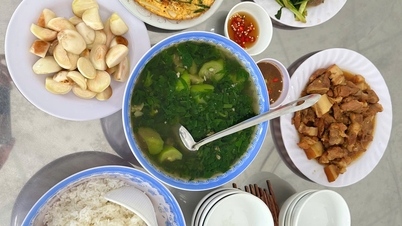
I remember summer holidays spent in the countryside. In the mornings, my grandfather would take me to the fields behind the village to catch crabs. He would wade into the ditch, part the clumps of water grass, and skillfully reach his hand into the crab burrows along the bank. After a while, he would pull his hand out, gripping a struggling field crab. The basket tied around his waist would gradually fill up, the sound of crab claws rubbing against each other echoing. At noon, my grandmother would wash the crabs, remove the shells and undersides, and then pound them in a stone mortar. She would strain the liquid, add some of the thick, golden crab roe, and use it to make crab soup. The vegetables for the crab soup weren't fixed; whatever was readily available in the garden was used: a handful of jute leaves, a few sprigs of amaranth, or a hastily picked bunch of purslane, water spinach, young shoots of bottle gourd, watercress, or young fragrant gourds. Sometimes it was just a handful of hibiscus leaves growing by the fence. That simple lunch consisted of a rich, creamy crab soup, vibrant green vegetables, and a side of crunchy, white pickled eggplant. The salty and sour taste of the eggplant, combined with the sweet and refreshing flavor of the crab soup, evokes the taste of a childhood summer.
Then he passed away. The house by the river became too big. She sold it, only managing to buy a few taels of gold, which she divided equally among her sons and daughters. She left her hometown and moved to the town to live with my family, carrying very little luggage. In her trunk were a few sets of clothes she still wore, neatly folded, along with a pair of wooden clogs wrapped in a plastic bag. In her basket, under a layer of cloth, she carefully arranged an old lime pot, a small stone mortar and pestle, a betel nut grinder covered in green mold, a pickle-pressing stone, and a round bamboo mat.
***
Now, she's gone too. My family kept the pickle-crushing stone and placed it on a bookshelf.
Every time I see it, I'm reminded of my grandmother. I remember her hunched over, drying cabbage on a bamboo tray in the pale yellow winter sun. I remember her calloused hands pressing each layer of cabbage into the brine. And then, the flavors of a whole era come flooding back. It's the mild sourness and saltiness of the pickled cabbage, the pungent spiciness that stings the nostrils before it's fully fermented. It's the refreshing aroma of a bowl of crab soup cooked with various garden vegetables, served with pickled eggplant on a scorching hot midday. It's the authentic, rich flavor of a bygone era.
I picked up the stone. The heavy, cool feeling was familiar. The veins, the indentations, the patches of color from time. It was just a stone used to press pickles. But it held a whole sky of memories: my grandfather's meticulousness, my grandmother's hard work, and the rustic charm of a beloved countryside.
I will continue to keep that stone, as a reminder of my roots. So that every time I touch the deep indentation on its surface, I feel like I'm back in my childhood, running around behind my grandmother, under the dry, golden sunlight of a time of poverty but sparkling with love.
Essays by Truong Xuan Thien
Source: https://baothanhhoa.vn/hon-da-nen-dua-281643.htm


![[Photo] Memorable moments at the 10th Vietnam-China Border Defense Friendship Exchange](https://vphoto.vietnam.vn/thumb/1200x675/vietnam/resource/IMAGE/2026/03/20/1773986226876_giao-luu-bien-gioi-vntq-lan-10-ben-tq-9737-4225-jpg.webp)








































































Comment (0)