

Compared to industrially packaged rice paper, Phu Yen rice paper is simple and unpretentious in appearance. The sheets are large, thick, sun-dried, and tied with white nylon string. A stack of just 20 sheets feels substantial in your hand, still fragrant with the scent of flour, mingled with the aroma of sun, wind, and dew. Just smelling it makes you want to run to the market to buy some pork belly, add some herbs, and make a bowl of garlic and chili fish sauce. After dipping it in water, Phu Yen rice paper doesn't stick together but becomes soft, chewy, and more flavorful the more you chew. A large sheet of rice paper, when broken into 5-7 smaller pieces, is enough to wrap up a roll.
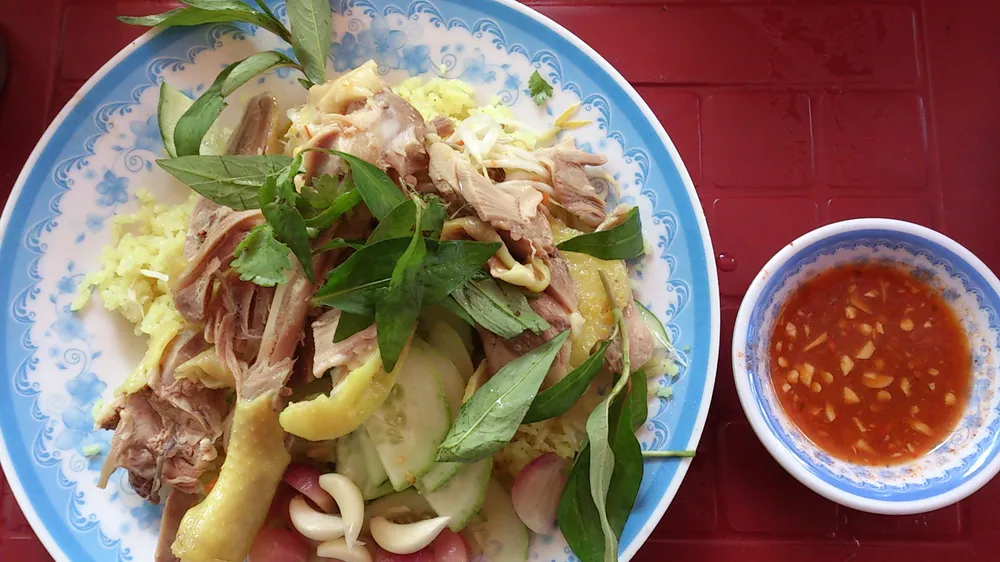
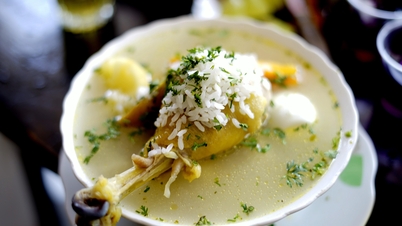
My first trip to Tuy Hoa was over a decade ago when a colleague invited me to visit her hometown. The three-day trip was truly a " culinary tour" of the Nẫu region (referring to the former Binh Dinh and Phu Yen provinces). Because she was a local, my friend took me to only high-quality restaurants. There were some very famous places that everyone had to visit. One of them was Tuyet Nhung's chicken rice restaurant, with its golden, glossy rice grains and a sauce that captivated me so much that when I got home, I insisted on persuading the owner to sell me a bottle.
Because it's a unique recipe, and customers love it so much, the owner gives it away for free, repeatedly telling them not to sell it. Or the steamed rice cakes in small bowls at the foot of the Nhạn Tower – I was surprised because the owner brought out a whole tray of 10 small bowls for each person. The white, soft, and chewy rice cakes are served with shredded pork floss, pork cracklings, and of course, spicy fish sauce and scallion oil. I also vividly remember stepping out right next to the bus station gate in the morning to eat street-side rice pancakes for just a few thousand dong, and feeling completely full. A stroll around Tuy Hòa market is like entering a world of street food.
My favorite is sticky rice in various colors: white, green, purple, yellow, and brocade; between the layers of sticky rice is a layer of soft, smooth mung bean paste—just thinking about it makes my mouth water. Or, those pink cakes—they feel as delicate as a baby's cheek, soft and chewy with a sweet, refreshing bite.
To truly appreciate the authentic flavors of the Nẫu region's cuisine, you have to eat it in the land itself. It's imbued with the warmth of the sun, the sea breeze, and even the local dialect. I remember the first time I heard a local pronounce "a" as "e" and "ê" as "ơ," it took me a while to figure it out. That distinctive dialect and intonation are captivating. I remember once, craving chicken rice so much, I went to the branch in Ho Chi Minh City, but still couldn't find the same old taste. Or sometimes, a friend would send me a bag of sticky rice or various kinds of pink cakes, from my usual stall in Tuy Hoa market, but the taste was completely different. My friend said that to find the old taste, you have to go to Tuy Hoa city to truly experience it.
How can one possibly list all the culinary specialties of the Nẫu region? There's tuna eye soup, chive noodle soup, monitor lizard patties, grilled spring rolls, jackfruit and palm seed sweet soup... These are memories that linger, and even just recalling them in my mind still brings back fond recollections. I tell myself I must return to the Nẫu region to satisfy my cravings and longing for more.
Source: https://www.sggp.org.vn/huong-vi-am-thuc-xu-nau-post808775.html
![[Photo] General Secretary and President To Lam meets with National Assembly delegates from ethnic minorities.](https://vphoto.vietnam.vn/thumb/1200x675/vietnam/resource/IMAGE/2026/04/20/1776696701056_a1-bnd-8331-3342-jpg.webp)



![[Image] National Assembly discusses the implementation of the socio-economic development plan.](https://vphoto.vietnam.vn/thumb/1200x675/vietnam/resource/IMAGE/2026/04/20/1776696707422_ndo_br_img-20260420-185419-jpg.webp)



















































Comment (0)