

On the evening of April 1st, the Bac Giang Provincial Police announced that following the fire at Ve Pagoda, numerous fake pages impersonating the abbot appeared on social media, aiming to scam Buddhist followers both domestically and internationally into transferring money for restoration.
According to the Bac Giang Provincial Police, the Facebook page "13 Hanh Dau Da" posted information calling for donations to repair and rebuild the temple after the fire, along with many images from the fire. The account receiving donations was named Nguyen Thanh Luan, account number: 19074094467017.
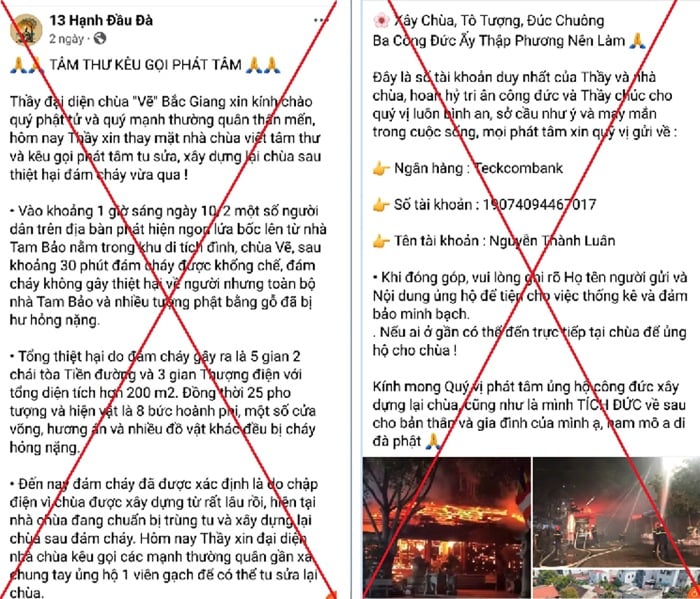
Fake information on the Facebook page "13 Hạnh Đầu Đà". Screenshot.
This led many people to mistakenly believe that this was a Facebook page created by the temple to gain trust and exploit people's sympathy in order to transfer money into the accounts of these individuals.
Meanwhile, working with authorities, the abbot of Vẽ Pagoda affirmed that the pagoda does not use social media accounts and has never made any online fundraising appeals.
The Bac Giang Provincial Police Department advises citizens, organizations, and religious followers to be vigilant against fake information and not to transfer money to accounts of scammers. If you detect any suspicious activities that show signs of fraud, please promptly notify the nearest police station for coordinated handling in accordance with the law.
Earlier, in the early morning of February 10, 2025, Ve Pagoda – a 300-year-old pagoda located in Tho Xuong ward, Bac Giang city (Bac Giang province) – caught fire. The fire did not cause any damage to the building, but the pagoda's roof and many valuable artifacts were completely destroyed.
Vẽ Pagoda, built in the 17th century, was recognized as a national historical and cultural relic in 1994. Inside the pagoda is a large bell (1.5m high, 66cm in diameter) cast during the reign of Emperor Lê Cảnh Hưng.
In addition, Vẽ Pagoda also houses many other valuable religious artifacts, documents, and relics such as incense burners, wooden gongs, incense stands from the Nguyen Dynasty, bronze bells from the Tay Son Dynasty, and especially a stone incense stand from the Le Dynasty during the Vinh Thinh era (1705-1720)... In 2018, during the pagoda's renovation, local people discovered three lotus-shaped stone pedestals in the Tran Dynasty style (13th-14th centuries) beneath the foundation of the main hall.
The Vu
Source: https://www.congluan.vn/ke-gian-loi-dung-viec-chua-ve-bi-chay-de-lua-dao-post341049.html







































































Comment (0)