

TP - Tuition fees are just one of the sources of revenue for education. But now, with tuition fees becoming the primary source of revenue for schools, this burden is shifting from the State to the people.
TP - Tuition fees are just one of the sources of revenue for education. But now, with tuition fees becoming the primary source of revenue for schools, this burden is shifting from the State to the people.
By default, autonomy means self-sufficiency.
Currently, public universities' training costs come from sources such as the state budget, scientific research activities, technology transfer, and tuition fees. Thus, tuition fees are only a part of the training costs. However, tuition fees currently account for 70-90% of the universities' revenue. In the World Bank's report " Education for Growth" in August 2022, WB experts stated that the Vietnamese state budget allocation for higher education currently only reaches 4.33-4.74% of the total budget for education and training.
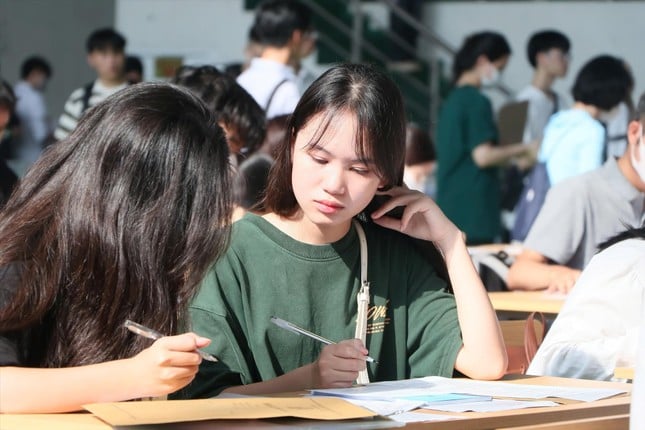 |
Students enrolling in 2024. Photo: Nghiem Hue |
Dr. Le Truong Tung, Chairman of theFPT University Council, shared that, in the conditions for autonomy, and within the context of financial autonomy, nowhere in the 2018 Higher Education Law does it require universities' autonomy to be linked to self-sufficiency and not receiving funding from the state budget. However, in practice, the implementation of this law is applying autonomy linked to self-sufficiency and not receiving budget funding to public universities. This is due to two objective reasons. Firstly, when piloting autonomy since 2017, participating universities were selected only those that were performing well and had ample financial capacity to balance their income and expenses. Ideally, the pilot program should have included good, average, and weak universities to assess the impact of autonomy on their development before widespread application. Because the sample selection was not standardized, it created the default model of autonomy as self-sufficiency, as is currently the case. The second reason is the confusion between "autonomy of higher education institutions" and "autonomy of public service units" applied to public service agencies in general. For public service units, the State regulations stipulate that the level of autonomy is linked to the level of financial self-sufficiency. Therefore, Mr. Tung proposed that when the Ministry of Education and Training amends the Law on Higher Education, it should clarify this: autonomy of higher education institutions is not the same as autonomy of public service units.
To make tuition fees not a burden
"High tuition fees are not wrong. Tuition fees must ensure the quality of education. What's lacking here is a mechanism for supporting students from the State."
Mr. Pham Hiep - Director of the REK Institute for Educational Research and Knowledge Transfer, Chengdu University.
Dr. Pham Hiep, Director of the REK Institute for Educational Research and Knowledge Transfer at Chengdu University, argues that tuition fees must be considered from two perspectives. Firstly, tuition fees must be sufficient to ensure the quality of education. Calculations show that a reasonable tuition fee to ensure quality education is approximately 100-120% of the average GDP. In Vietnam, this would be around 50-80 million VND per year per student. This level is equivalent to the tuition fees for high-quality programs or autonomous universities. Secondly, it's about the educational opportunities for the people. The above figures are based on average calculations, but a large number of people in rural and mountainous areas are facing significant hardship. Dr. Hiep explains that students in remote and rural areas already face difficulties accessing specialized entrance exams to increase their chances of entering top universities. Once admitted, tuition fees become a second barrier to accessing higher education. Currently, some universities allocate a percentage of tuition fees to provide scholarships. “But this approach is illogical. It's like taking money from one parent to give to another parent's child to go to school,” Mr. Hiep said. He asserted that this is not a fundamental solution. According to Mr. Hiep, the most reasonable and long-term solution is state investment. For autonomous universities, if the state cuts regular spending, that budget should be converted into scholarships for disadvantaged students. The scholarship amount must be substantial. In addition, the loan amount should be increased. Mr. Hiep calculated that, on average, families from outside Hanoi invest 10 million VND per month for their children to study at universities in Hanoi or Ho Chi Minh City. The current loan amount of 4 million VND per month per student is insufficient to cover living expenses.
Mr. Hiep assessed that the current tuition fee issue will have an impact for the next 15-20 years if appropriate policies are not implemented. The problem is not the quality of higher education, but rather inequality and disparities between different professions. While tuition fees are increasing, student loan programs remain limited and do not meet the actual needs of students. The increase in tuition fees also needs careful consideration because high fees will hinder access to higher education for students with limited financial resources. Furthermore, with high tuition fees, parents and students see it as an investment in the future, so choosing majors and fields that offer good job prospects and high incomes after graduation becomes the goal. This leads to the consequence that some fields essential for socio-economic development and sustainable development, such as basic sciences, have high tuition fees and struggle to attract students.
“High tuition fees are not wrong. Tuition fees must ensure the quality of education. What is lacking here is the mechanism for supporting students from the State,” Mr. Hiep said. He cited the example of autonomous universities in the North, such as Hanoi University of Science and Technology and Foreign Trade University. They have to collect tuition fees to pay their master's degree lecturers 20-25 million VND/month for working 40 hours/week at the school. This is different from non-autonomous universities, where lecturers only work 2-3 sessions/week and earn 6-7 million VND/month, being full-time lecturers but working part-time. Only when lecturers' income is sufficient to live on can they be assured of working with peace of mind and not neglecting their professional work. But conversely, where is the State support program when universities become autonomous? To date, autonomous universities do not have a regular budget for expenditures, and the slogans for key investments are nowhere to be seen, so tuition fees have become a burden for parents and students.
Based on the above analysis, Mr. Hiep suggested that the State should properly fulfill its role of state management and have specific policies to support students. Without budgetary involvement, Mr. Hiep predicted that the inequality gap in higher education would widen, starting with tuition fees.
Source: https://tienphong.vn/hoc-phi-dai-hoc-cao-tang-thuong-xuyen-keo-rong-bat-binh-dang-post1705114.tpo


![OCOP during Tet season: [Article 4] Elevating local products](/_next/image?url=https%3A%2F%2Fvphoto.vietnam.vn%2Fthumb%2F402x226%2Fvietnam%2Fresource%2FIMAGE%2F2026%2F01%2F29%2F1769652810578_2935-z6982071462129_649e82db06fb2f2ea701388b1f5f5b0b-173322_176-185229-202804_457.jpeg&w=3840&q=75)


![OCOP during Tet season: [Part 3] Ultra-thin rice paper takes off.](/_next/image?url=https%3A%2F%2Fvphoto.vietnam.vn%2Fthumb%2F402x226%2Fvietnam%2Fresource%2FIMAGE%2F2026%2F01%2F28%2F1769562783429_004-194121_651-081010.jpeg&w=3840&q=75)

![OCOP during Tet season: [Part 2] Hoa Thanh incense village glows red.](/_next/image?url=https%3A%2F%2Fvphoto.vietnam.vn%2Fthumb%2F402x226%2Fvietnam%2Fresource%2FIMAGE%2F2026%2F01%2F27%2F1769480573807_505139049_683408031333867_2820052735775418136_n-180643_808-092229.jpeg&w=3840&q=75)



Comment (0)