

On October 29th, according to information from the Mong Cai International Border Gate Management Board, Mong Cai City, Quang Ninh Province, preparations for launching self-driving car tourism services between Mong Cai City, Quang Ninh Province, Vietnam and Dongxing City, Guangxi Zhuang Autonomous Region, China via the Bac Luan 2 Bridge have been completed.
Specifically, at the Mong Cai International Border Gate, a service area and a system of 300 benches have been set up to serve the needs of tourists while they wait to complete immigration procedures. Traffic warning lines have also been repainted at the vehicle entry and exit control lanes.
At the same time, the two units proactively coordinated with the Dongxing Border Gate Management Board to advise the two localities on preparing the necessary plans and conditions to soon put self-driving tourist vehicles into operation. Given the unique characteristics of the border gate area with a high volume of import and export goods, the two units have prepared a plan to appropriately and effectively separate self-driving tourist vehicles from vehicles transporting import and export goods, ensuring smooth and quick traffic flow and preventing congestion.
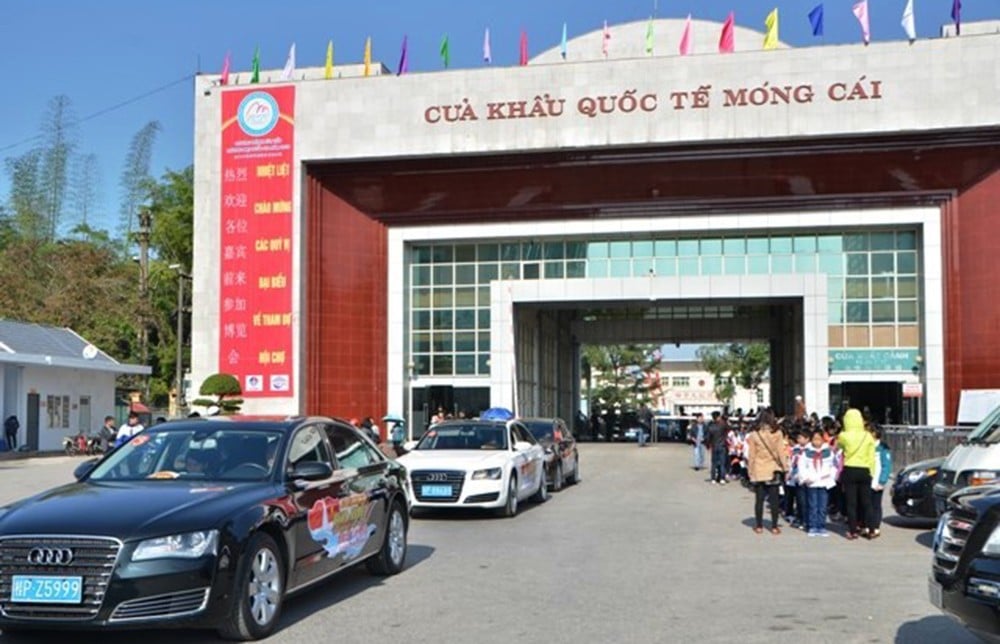
Chinese tourists drive through the Mong Cai International Border Gate into Vietnam (Photo: Quang Ninh Newspaper).
Previously, in March 2023, the authorities of Mong Cai City and Dongxing City developed, proposed, and received approval to implement a plan to promote tourism development between the two localities. Accordingly, from October 30th, Vietnamese tourists were allowed to drive their own cars to Nanning City in China (600 km from Mong Cai City), and Chinese tourists could travel further to Ha Long City in Vietnam (150 km from Mong Cai City) via two border gates: Mong Cai International and Dongxing.
Self-driving car services for tourists crossing the Mong Cai International Border Gate and the Dongxing Border Gate were piloted in 2016 and 2018. Specifically, in 2016, self-driving cars from China into Quang Ninh province were piloted with a limited operating area, confined to Mong Cai City.
Each entry is limited to a minimum of 5 vehicles and a maximum of 20 vehicles per group. The total number of self-driving vehicles from China in Vietnam must not exceed 100 vehicles per day, and permits must not be issued more than once every three days. After one year of implementation, 93 vehicles carrying 256 tourists from China passed through Mong Cai City. Conversely, 38 vehicles carrying 110 tourists from Vietnam traveled to Dongxing City.
By 2018, the central government agreed to allow Quang Ninh province to expand the scope of self-driving car services from China to Ha Long City. At the same time, Vietnamese tourists driving to China were also allowed to travel further into Guilin City, Guangxi (about 600km from Mong Cai), with the route Dongxing - Fangcheng - Nanning - Guilin.
According to statistics, from June to November 2018, 44 tour groups from China entered Ha Long City by car (a total of 289 vehicles and 988 passengers). From Vietnam, 35 vehicles with 108 passengers entered China. After the COVID-19 pandemic broke out, the aforementioned self-driving tourist car services have been temporarily suspended until now .
Source




















































![[Video] Sunset at Lap An Lagoon – Where the sun sets over the fishing nets](https://vphoto.vietnam.vn/thumb/1200x675/vietnam/resource/IMAGE/2026/05/31/1780192137701_beach-landscape-sea-water-nature-grass-745871-pxhere-com.jpeg)






























Comment (0)