

The fastest waiting time for applicants to receive a Japanese e-visa is 5 working days, as Japan has implemented a new policy for Vietnamese tour groups.
The Japanese Embassy in Vietnam confirmed to VnExpress this morning that Japan has decided to issue e-visas to Vietnamese tour groups within a minimum of 5 working days from the date the application is received, without requiring any additional documents.
"The application submission date is the standard date for calculating the required number of days, and only the travel company and the Japanese embassy in Vietnam know this. Therefore, we do not widely publicize the 5 working days on our website," the Japanese side confirmed.

Vietnamese tourists admire the autumn foliage in Japan in late October. Photo: Tran Anh Tuan
Japan will implement e-visas for Vietnamese tourists traveling in groups starting November 1st, and only travel companies on the list of authorized agents and designated companies (published on the Japanese embassy's website) are eligible to submit applications. Study abroad consulting companies, internship placement agencies, and organizations applying for e-visas for their staff will submit their applications through authorized agents instead of directly.
Ms. Vu Bich Hue, Head of Communications at Flamingo Redtours, one of the authorized tour operators, said that issuing e-visas for package tours will bring convenience and shorten visa processing time for tourists. "With good tour prices, all-inclusive packages starting from only 18,900,000 VND, diverse products, and simplified visa procedures, this is the ideal time for tourists to visit Japan."
According to the Japan National Tourism Organization (JNTO) in Vietnam, Japan welcomed over 17 million international visitors in the first three quarters of the year, representing 72% of the figure for the same period in 2019. Nearly 440,000 Vietnamese tourists visited Japan in the first nine months of the year, a 17% increase compared to the same period in 2019, placing Vietnam among the top seven largest source markets for tourists to the country. The remaining six markets are South Korea, mainland China, Taiwan, the United States, Hong Kong, and Thailand. Conversely, Japan is the fifth largest source market for tourists to Vietnam, after South Korea, mainland China, the United States, and Taiwan, according to the Vietnam National Tourism Administration.

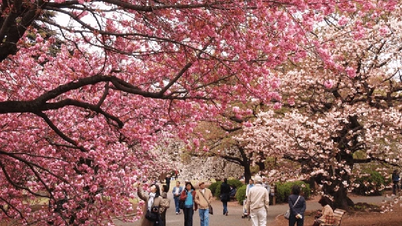
Autumn in Japan. Photo: Nguyen Minh Ngoc
According to Mr. Nguyen Van Dung, Director of Asia Gate Travel, a company with 10 years of experience in the Japanese tour market in Hanoi , Vietnamese tourists have two advantages after the e-visa policy was implemented: shorter visa waiting times and no need to submit original passports. Not needing to submit original passports allows tourists to apply for visas in multiple countries simultaneously or to submit applications even while traveling abroad. "Tourists only need to scan their passports," Mr. Dung said.
The e-visa policy also helps travel companies "extend the tour sales period," gathering more customers. Paper visas have a processing time of 9-10 days. If a tour departs on November 20th, travel companies must stop accepting tour bookings from November 8th-9th to allow sufficient time for visa applications. With e-visas, which take a minimum of 5 days to issue, travel companies can still accept bookings until November 13th-14th.
Vnexpress.net
![[Photo] General Secretary and President To Lam meets with National Assembly delegates from ethnic minorities.](https://vphoto.vietnam.vn/thumb/1200x675/vietnam/resource/IMAGE/2026/04/20/1776696701056_a1-bnd-8331-3342-jpg.webp)



![[Image] National Assembly discusses the implementation of the socio-economic development plan.](https://vphoto.vietnam.vn/thumb/1200x675/vietnam/resource/IMAGE/2026/04/20/1776696707422_ndo_br_img-20260420-185419-jpg.webp)















































































Comment (0)