

Since the end of 2023, Triem Tay village in Dien Ban district, Quang Nam province, has gradually become a frequent destination for tourism businesses to bring tourists to. The village's distinctive feature is that it still retains the pristine, rustic charm of a rural village. Every week, several groups of foreign tourists are brought here to visit, experience the lives of the local people, and learn about traditional crafts.
| Promoting the potential and strengths of rural tourism; transforming OCOP products into rural tourism resources. |
Great potential, plenty of room for growth.
Analyses show that while Asian tourists from countries like South Korea, China, Taiwan (China), and even Vietnam often choose entertainment and recreational services, European, Australian, and American tourists tend to explore rural areas, culture, and traditional crafts. Besides familiar rural destinations in Hoi An such as Tra Que vegetable village, Cam Thanh mangrove forest, and Cham Island, Triem Tay is gradually becoming a new space that better meets the growing demands of this tourist group. Experiencing culture and exploring rural areas is increasingly being chosen by international tourists as part of their travel itineraries. This is considered a new trend, contributing to the development of diverse and sustainable green tourism in Quang Nam.
According to the Quang Nam New Rural Development Coordination Office, 12 out of 18 districts, towns, and cities in the province have implemented the rural tourism development program as part of the new rural development program. The goal is that by 2025, each district, town, and city with potential and strengths in agricultural and rural tourism development will have developed at least one community-based tourism product and tourist destination. In 2023 alone, the province implemented three pilot models under the rural tourism development program: Community-based tourism development linked to the preservation of indigenous cultural values and natural ecosystems in Kim Bong carpentry village (Hoi An); Community-based tourism development linked to the preservation and promotion of cultural values in Muong village (Bac Tra My); and Community-based tourism development linked to the preservation and promotion of cultural values in the traditional fish sauce making village of Cua Khe (Thang Binh).
In recent years, Quang Nam province has implemented many plans for rural tourism development and has recorded positive results. Rural tourism products have contributed to job creation, promoted economic restructuring, increased labor productivity in rural areas, and contributed to the preservation and dissemination of unique natural and cultural values, as well as environmental protection in rural areas with tourism activities. However, overall assessment shows that the linkages between stakeholders are still quite fragmented, which is a hindrance to promoting rural tourism in depth. Rural tourism has great potential and is being strongly encouraged to develop, but it requires a rational development strategy.
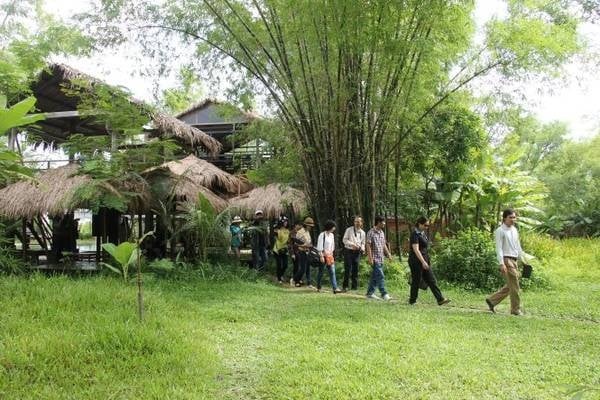 |
| Rural tourism has become a place for tourists to explore and experience the lives of local people. |
To exploit it effectively
According to Mr. Van Ba Son, Deputy Director of the Quang Nam Department of Culture, Sports and Tourism, developing rural tourism is identified as one of the key tasks of the local tourism industry in 2024. Many activities and initiatives to promote this type of tourism are being implemented, such as technical training programs, human resource development; and the promotion and marketing of rural tourism to domestic and international markets. This will enable the province to compete with tourism centers in the country and the region. To effectively and comprehensively exploit the potential of rural tourism, in addition to the support of the tourism industry, the decisive involvement of local authorities plays a crucial role. This requires not only strategy, resources, and human resources, but also determination to transform the values and culture of the countryside into attractive and sustainable tourism products. Currently, the number of rural tourism tours and destinations accounts for over 30% of the province's total tourism products, an ideal figure to promote the development of this type of tourism.
According to Mr. Vu Quoc Tuyen, representative of Amber Trading and Service Co., Ltd., it is crucial to have linkages between destinations to attract tourists. Building a network to develop rural tourism requires sharing among all parties to establish partnerships, share knowledge and skills, create opportunities for cooperation, and identify common benefits. Meanwhile, Mr. Le Hoang Ha, Director of Emic Travel, a company specializing in bringing tourists to rural areas, believes that there is still considerable potential for the development of rural tourism in Quang Nam. In Cam Phu village in Dien Ban district alone, since the beginning of 2024, dozens of tourist groups, mostly French, have been brought there by Emic in collaboration with partners. An advantage of rural tourism in Quang Nam is its relatively short distance from Hoi An ancient town, making it easy to organize tours. Expanding the tourism space not only provides more choices for tourists but also helps create livelihoods and income for rural people. The current issue is simply establishing a local hub to facilitate connections between businesses and tourists for various tours and routes.
Mr. Nguyen Xuan Ha, Deputy Director of the "Hoi An Memories" Park, shared that rural tourism is currently at an ideal stage for exploration, creating a new breakthrough for the tourism industry. However, this type of tourism also requires a well-planned development strategy. To create a good product, time is needed; at least 2-3 years, the destination needs to accept lower visitor numbers to create differentiation. Building a story in rural tourism is crucial, and tourists must experience it directly, not just hear about it. The development of rural tourism requires harmony and transparency in profit sharing and risk sharing. It is essential to avoid spontaneous development and instead focus on guidance from state tourism management agencies. Most importantly, the focus must remain on the local people, as they are the key stakeholders in rural areas.
Source link



















![[LIVE] CLOSING CEREMONY AND AWARD PRESENTATION OF THE 2026 DIGITAL TRANSFORMATION COMPETITION IN THE BANKING INDUSTRY](https://vphoto.vietnam.vn/thumb/402x226/vietnam/resource/IMAGE/2026/05/23/1779502316786_chatgpt-image-08-13-30-22-thg-5-202620260522081352.png)

































































Comment (0)