

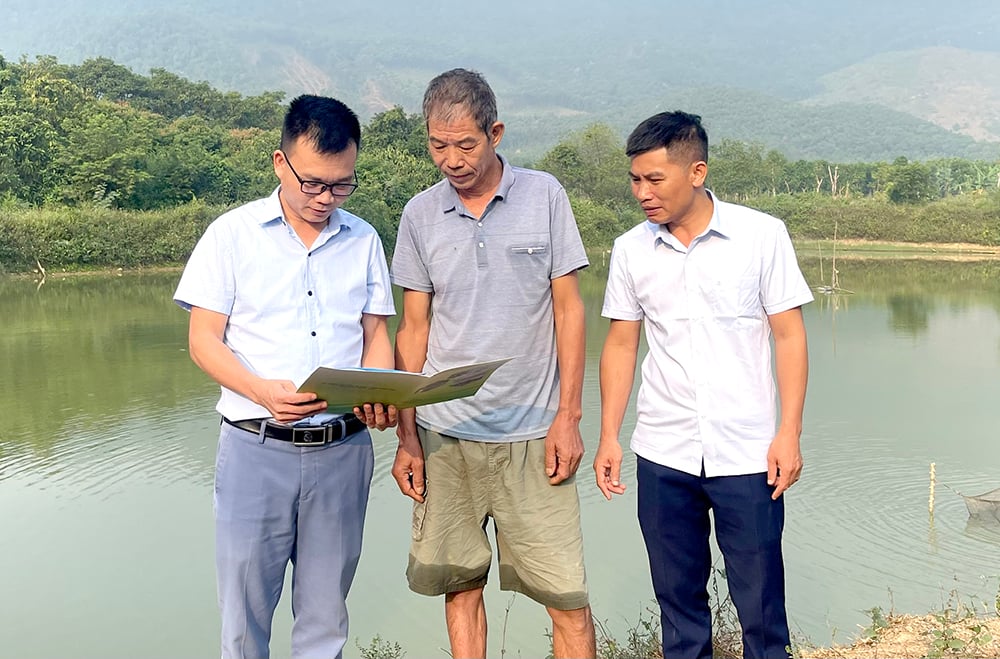
Mr. Tran Van Trong (standing in the middle) in Doc Ngat area, Chuong Xa commune, Cam Khe district, is learning about the techniques of raising giant freshwater prawns.
The province currently has over 11,300 hectares of aquaculture area, of which 5,600 hectares are dedicated to specialized farming and 5,700 hectares are used for farming in reservoirs and single-crop rice fields. With the advantage of a large water surface area, clean water environment, and abundant and nutritious aquatic resources, the province is well-suited for developing high-value aquatic species, providing a stable income for the people.
Localities in the province have implemented many aquaculture development programs linked to the transformation of agricultural production structure. Provincial and district-level specialized agencies have also actively provided technical support to people, especially in disease prevention and control, and techniques for caring for each type of aquatic species.
Through this, aquaculture households have gained more knowledge and proactively developed aquaculture with various farming methods such as: farming in ponds, lagoons, reservoirs, tanks, and cages, shifting from traditional farming methods to investing in commodity production; thereby creating a strong transformation in the field of aquaculture, contributing to increasing economic value. Cam Khe district has over 1,800 hectares of water surface for aquaculture, including 76 lakes and dams of various types with a total area of 136 hectares.
The district has many rivers flowing through it, providing abundant aquatic resources for the local people. Recognizing these advantages, the district has developed concentrated aquaculture production areas oriented towards commercial production; invested in infrastructure development to support aquaculture; and applied science and technology to aquaculture.
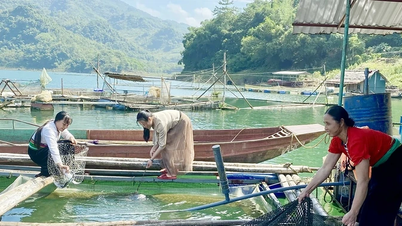
To date, the entire district has established 14 concentrated aquaculture and breeding areas with the participation of nearly 800 households, including: the Lang Chuong, Men, Ho, and Sop fields; the Son Tinh - Phu Khe - Ta Xa farming area; and the Thuy Tram red carp farming area... Many highly effective aquaculture models have been developed, such as: cage fish farming on Dam Thin Lake, red carp farming in Thuy Tram, and giant freshwater prawn farming in the communes of Van Khuc and Chuong Xa...
The agricultural sector and local authorities of the province are focusing on implementing support mechanisms and policies for sustainable aquaculture development. In particular, they are promoting the transfer of advanced technologies, information dissemination, knowledge sharing, and vocational training for aquaculture households to improve their capacity and production efficiency. Many successful aquaculture extension models, such as mudless eel farming, mudfish farming, catfish farming, and snakehead fish farming, have been implemented and are being replicated.
Along with that, the protection of water resources and the regeneration of natural aquatic resources have also been emphasized. The Fisheries and Agricultural, Forestry and Aquatic Product Quality Management Sub-Department has proactively guided aquaculture households in applying biotechnology in pond environment management in districts, cities, and towns; at the same time, it has coordinated with individuals and organizations to launch the release of fish and shrimp into natural lakes and ponds such as Ngoi Ganh Lake, Ham Ky Lake, etc.
With the right direction and effective methods, aquaculture in the province has achieved remarkable results; scale, productivity, and output have increased over the years, meeting consumption needs both within and outside the province. In 2024, the total aquaculture output of the province reached 46,700 tons, an increase of 3.9% compared to 2023, of which farmed output reached 42,100 tons; and natural fishing output reached 3,200 tons. The target for 2025 is to strive for a total aquaculture output of 48,480 tons, an increase of 3.8% compared to 2024; with a total of 1,300 cages.
Comrade Nguyen Thanh Chung - Head of the Fisheries and Agricultural, Forestry and Fisheries Product Quality Management Sub-Department, said: “To achieve and surpass the set plan targets, the Sub-Department has reviewed the entire water surface area in each region and locality to guide farmers in converting and selecting suitable breed structures, producing in a commercial direction, especially in large reservoirs and concentrated aquaculture areas; at the same time, encouraging people to exploit the potential of large irrigation works in Cam Khe, Ha Hoa, Thanh Thuy districts... to expand the area and build concentrated aquaculture zones. In addition, the Sub-Department also strengthens the management of the quality of breeds, feed and materials used in aquaculture. In particular, attention is paid to monitoring, warning, and supervising the water environment and preventing and treating some dangerous diseases in aquatic animals to maximize the economic efficiency of aquaculture in the province.”
Ha Nhung
Source: https://baophutho.vn/khai-thac-loi-the-phat-trien-thuy-san-233258.htm

![[Photo] General Secretary and President To Lam meets with National Assembly delegates from ethnic minorities.](https://vphoto.vietnam.vn/thumb/1200x675/vietnam/resource/IMAGE/2026/04/20/1776696701056_a1-bnd-8331-3342-jpg.webp)

![[Image] National Assembly discusses the implementation of the socio-economic development plan.](https://vphoto.vietnam.vn/thumb/1200x675/vietnam/resource/IMAGE/2026/04/20/1776696707422_ndo_br_img-20260420-185419-jpg.webp)




































































Comment (0)