

After traversing the winding Tam Canh pass, embracing the sprawling limestone mountain ranges, Bac Son emerges in the golden sunlight against a backdrop of a deep, azure sky.
Developing culture in conjunction with tourism.
Bac Son has changed a lot today. Along both sides of the road leading to the center of Bac Son district, interspersed with modern concrete houses with plastic, corrugated iron, and fiber cement roofs are ancient stilt houses with traditional yin-yang tile roofs dotted with green moss, a peaceful highlight of the Bac Son valley.
After descending the Tam Canh pass, right at the left turn towards Long Dong commune, we saw rows of tile-making sheds. Large and small brick kilns lined both sides of the road, and everywhere was the characteristic yellowish-brown color of clay.
The traditional craft of making yin-yang roof tiles in Long Dong commune, Bac Son district, dates back over 100 years. Currently, although market demand is not high, many households here still maintain and keep their kilns burning day and night, as a way of preserving a unique cultural feature and a valuable asset in the traditional life of the local people.
While nimbly stripping the clay and chatting cheerfully, Ms. Duong Thi Nga (Long Dong commune, Bac Son district) explained: "The main material for yin-yang roof tiles is pure clay purchased from Binh Gia district. The clay is then stripped of soil, filtered to remove impurities, soaked in water to make it pliable, then molded, and after drying, fired in a kiln. The yin-yang tiles are trough-shaped, measuring 25-30 cm each. They are called yin-yang because when laid, some tiles face down and some face up. The tiles that face down are the yang tiles, and those that face up are the yin tiles. The two rows of tiles, facing up and down, interlock to create a strong and durable structure."
Unlike in the past, the demand for yin-yang roof tiles has increased significantly due to their aesthetic appeal and their ability to keep people cool in summer and warm in winter. As a result, people's lives have improved. The tiles are sold throughout the country.
Recently, the traditional yin-yang tile-making village of Long Hung hamlet, Long Dong commune, Bac Son district, has also become an official destination in the journey to explore the UNESCO Lang Son Geopark, "A path opens up, where bricks whisper ancient secrets."
Continuing our journey, we arrived at Bac Son Valley, located in Quynh Son Cultural Tourism Village, 2 km north of the district center. Unlike the period from July to October with its golden rice paddies, in March, Bac Son Valley is lush green, dotted with the white blossoms of apricot, pear, and plum trees.
As a native of Bac Son with a passion for photography, for many years, whenever he has time, photographer Duong Doan Tuan (a member of the Vietnam Association of Photographic Artists) often travels through villages and hamlets, searching for truly beautiful and satisfying images of his homeland's scenery. His motherland, Bac Son, has nurtured him and brought him many prestigious photography awards such as "Bac Son in the Mist" (Silver Medal at the Northern Mountain Region Art Photography Festival), and "Bac Son's Golden Season" (Exhibition at the National Art Photography Competition "Proud of a Border Region in 2022").
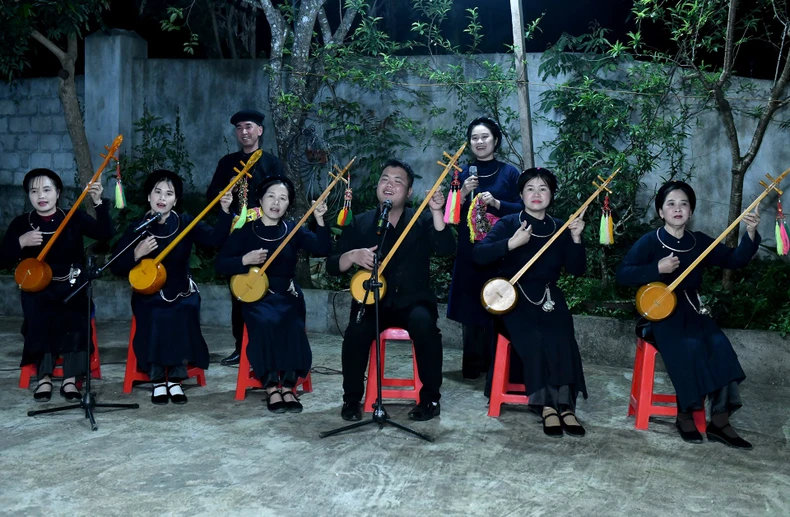 |
The performing arts troupe of Bac Quynh commune, Bac Son district, Lang Son province, performs Then singing and Tinh lute playing for tourists. (Photo: NGUYEN DANG) |
Duong Doan Tuan also holds the position of Vice Chairman of the People's Committee of Bac Quynh commune. According to him, in recent years, the community tourism (homestay) model has always been considered one of the correct and effective directions for the locality.
Connecting tourism with real-life experiences.
“In 2010, Bac Quynh commune was selected by the district to pilot the implementation of community-based cultural tourism villages. Since then, many households have registered to participate in hosting tourists in the form of homestays. These households invest in houses and accommodation, focusing on introducing tourists to the local cultural identity, the traditions of the Tay ethnic group, and how to prepare dishes suitable for visitors,” said Comrade Duong Doan Tuan.
Mr. Duong Cong Co, owner of an accommodation facility in Tham Pat village, Bac Quynh commune, shared: “After graduating from the University of Physical Education and Sports, I decided to return to my hometown to develop my family's economy. In 2022, recognizing the potential for community tourism in the area, I decided to open a homestay. With an area of over 1,200 square meters , I discussed with my family about borrowing capital from the bank, renovating the house, and building a model called "Experiential Tourism Services for Tourists".
At night, when the atmosphere of Bac Son seems to quiet down, the dances, folk songs, and the clear, melodious sounds of the Tinh lute rise up, captivating visitors from afar. The performers are young Tay men and women in their indigo-dyed traditional clothing. Currently, each commune maintains a performing group that receives regular training and instruction.
Along with music and local culinary delights, this is one of the outstanding tourist activities that allows visitors to experience and immerse themselves in the simple life and unique culture of the local people, thereby understanding and loving this heroic yet hospitable land of Bac Son even more.
Having previously worked and taught at Bac Son High School, Ms. Duong Thi Thep, Vice Chairman of the People's Committee of Bac Son District, believes that preserving cultural features associated with tourism development must be built on a foundation starting with the younger generation. Educating children through the Then dance, the Tinh instrument, and folk songs passed down from their grandmothers and mothers will help them understand and love their homeland, thereby gradually fostering a sense of responsibility for its development.
According to the inventory, Bac Son district has five types of intangible cultural heritage associated with each ethnic group: festivals, social customs, traditional crafts, folk performing arts, and folk knowledge. Based on these natural, historical, and cultural values, Bac Son district is currently focusing on developing eco-tourism, historical and cultural tourism, and community tourism. To date, there are 10 tourist destinations and accommodation facilities in Bac Son district.
Along with Bac Son, many other localities in Lang Son province have also begun to build and implement tourism models linked to cultural values and identity, initially recording growth year after year.
According to Le Hai Yen, Deputy Director of the Department of Culture, Sports and Tourism of Lang Son province: “To date, Lang Son province has 335 historical and cultural relics and scenic spots that have been ranked and included in the inventory. Lang Son is also home to a rich and diverse treasure trove of intangible cultural heritage. The province also has 9 national intangible cultural heritage sites; 2 intangible cultural heritage sites recognized by the United Nations Educational, Scientific and Cultural Organization (UNESCO) as Representative Intangible Cultural Heritage of Humanity. In addition, in September 2025, UNESCO will officially inscribe and recognize Lang Son as a Global Geopark.”
According to Duong Xuan Huyen, Vice Chairman of the People's Committee of Lang Son province: “The work of disseminating information, promoting, introducing, and applying information technology and modern scientific and technical achievements in the management and preservation of national cultural heritage associated with tourism development is being given attention and promoted. Currently, in addition to building tourism products, routes, and destinations, Lang Son province has been gradually investing in building a software system for managing and digitizing heritage; deploying a "Smart Tourism Information Portal and smart tourism application on mobile devices" to preserve, transmit, honor, promote, and introduce the beautiful traditional cultural features of the province to friends both domestically and internationally.”
Source: https://nhandan.vn/kham-pha-mien-bien-vien-bac-son-post868520.html


![[Photo] The General Secretary attends the groundbreaking ceremony for the construction of the Truong Ha Primary and Secondary Boarding School.](/_next/image?url=https%3A%2F%2Fvphoto.vietnam.vn%2Fthumb%2F1200x675%2Fvietnam%2Fresource%2FIMAGE%2F2026%2F01%2F28%2F1769604498277_vna-potal-tong-bi-thu-du-le-khoi-cong-xay-dung-cong-trinh-truong-pho-thong-noi-tru-tieu-hoc-va-trung-hoc-co-so-truong-ha-8556822-jpg.webp&w=3840&q=75)


![[Photo] Commemorating the unwavering friendship between Vietnam and Laos](/_next/image?url=https%3A%2F%2Fvphoto.vietnam.vn%2Fthumb%2F1200x675%2Fvietnam%2Fresource%2FIMAGE%2F2026%2F01%2F27%2F1769518372051_ndo_br_1-jpg.webp&w=3840&q=75)


![[Photo] National Assembly Chairman Tran Thanh Man meets with former leaders of the National Assembly from various periods.](/_next/image?url=https%3A%2F%2Fvphoto.vietnam.vn%2Fthumb%2F402x226%2Fvietnam%2Fresource%2FIMAGE%2F2026%2F01%2F28%2F1769601014034_anh-man-hinh-2026-01-28-luc-18-50-04.png&w=3840&q=75)


![OCOP during Tet season: [Part 3] Ultra-thin rice paper takes off.](/_next/image?url=https%3A%2F%2Fvphoto.vietnam.vn%2Fthumb%2F402x226%2Fvietnam%2Fresource%2FIMAGE%2F2026%2F01%2F28%2F1769562783429_004-194121_651-081010.jpeg&w=3840&q=75)


![OCOP during Tet season: [Part 2] Hoa Thanh incense village glows red.](/_next/image?url=https%3A%2F%2Fvphoto.vietnam.vn%2Fthumb%2F402x226%2Fvietnam%2Fresource%2FIMAGE%2F2026%2F01%2F27%2F1769480573807_505139049_683408031333867_2820052735775418136_n-180643_808-092229.jpeg&w=3840&q=75)
![OCOP during Tet season: [Part 1] Ba Den custard apples in their 'golden season'](/_next/image?url=https%3A%2F%2Fvphoto.vietnam.vn%2Fthumb%2F402x226%2Fvietnam%2Fresource%2FIMAGE%2F2026%2F01%2F26%2F1769417540049_03-174213_554-154843.jpeg&w=3840&q=75)




Comment (0)