

After the Lunar New Year holiday, a bustling atmosphere of work has returned to the fields. Farmers are busy heading to the fields, starting the first production season of the year with the hope of a bountiful harvest. Along with the joy of spring, farmers enthusiastically set out, starting a new season with high spirits.
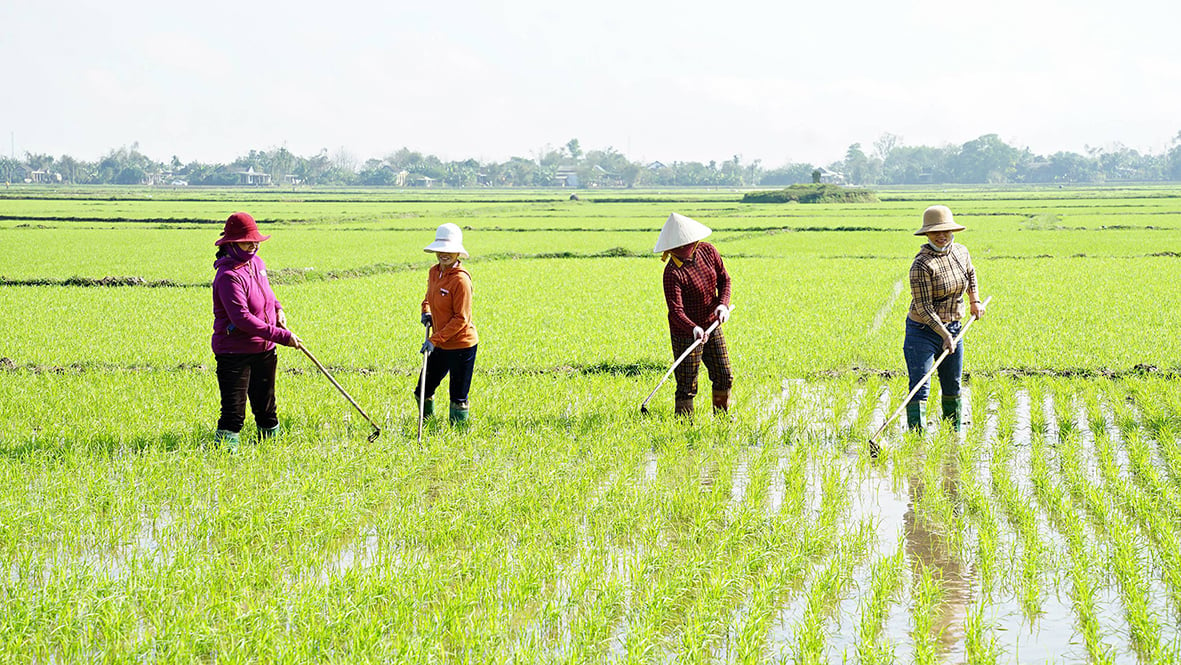
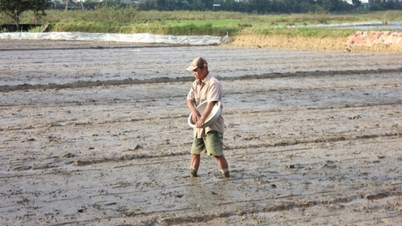
Farmers in Trieu Phong district go to the fields to thin out rice plants right after the Lunar New Year - Photo: LA
Taking advantage of favorable weather, starting from the 3rd day of the Lunar New Year of the Year of the Snake 2025, Ms. Luong Thi Phong from Van Hoa Cooperative, Trieu Hoa commune, Trieu Phong district, has been diligently working in the fields, thinning and fertilizing nearly 1 hectare of rice, using the HC95 rice variety that her family had sown about 20 days ago.
According to Ms. Phong, the rice plants were affected by prolonged cold and rainy weather during the planting season, causing the leaves to turn white and hindering their growth. However, since before the Lunar New Year, the weather has been relatively good, with warm, sunny days, so the rice plants are gradually recovering. To ensure good growth, along with thinning and replanting, she is applying additional NPK fertilizer to stimulate tillering.
“After spending the Lunar New Year holidays with our families, we farmers return to the fields in high spirits. We hope for favorable weather so that we can have a bountiful harvest, bringing a stable income to the people,” said Mrs. Phong.
This year, the Van Hoa Cooperative planted over 180 hectares of rice during the winter-spring season, with the main varieties being Ha Phat 3, HG12, and HC95. This includes two production models linked with businesses: a model in partnership with Quang Tri General Trading Corporation producing organic rice on 23 hectares, and a land consolidation model covering 7 hectares with two participating households.
Taking advantage of favorable weather, starting from the third day of the Lunar New Year, many cooperative members went to the fields to check on their rice crops, thin out seedlings, and fertilize them. According to Nguyen Van Dinh, Director of Van Hoa Cooperative, anticipating that the weather after Tet could be unpredictable, affecting rice growth and creating conditions for pests and diseases to develop, the cooperative instructed its members to urgently go to the fields to care for the rice and fertilize to promote tillering.
"After being affected by the cold and rainy weather, the rice plants are now growing well and green. This is a joy for us farmers in the early days of the Lunar New Year 2025," Mr. Dinh said.
According to Tran Thien Nhan, Head of the Agriculture and Rural Development Department of Trieu Phong district, as of now, the entire district has planted over 5,950 hectares of rice, reaching 100% of the plan. Of this, high-quality rice varieties such as HC95, Ha Phat 3, HG12, HG244, TBR97... account for over 81%, along with more than 350 hectares of corn, 310 hectares of peanuts, and 1,650 hectares of various vegetables.
We directed the production of 71 hectares of naturally grown rice at the Trieu Phong Clean Agricultural Products Cooperative, of which 11 hectares met organic standards. We collaborated with Quang Tri General Trading Corporation to link the production and consumption of organic rice on a total area of 30 hectares in Trieu Hoa and Trieu Tai communes; and collaborated with Dong Tam Company to link the consumption of 40 hectares of Ha Phat 3 commercial rice in Trieu Trung commune.
In coordination with the Quang Tri Agricultural Seed Center, they are linking production and consumption of 16.5 hectares of HC95 rice seeds in Trieu Giang and Trieu Do communes; and linking production and consumption of 13 hectares of Bac Thom No. 7 commercial rice in Trieu Tai commune. According to Mr. Nhan, generally, the rice crop in this year's winter-spring season is growing slower than in previous years due to the prolonged cold weather during the planting period.
Currently, after the Lunar New Year holiday, farmers are focusing on completing the first round of fertilization and thinning out early-sown rice crops. Local authorities are also closely monitoring weather developments to guide farmers in timely care and pest control measures.
Similarly, in Hai Lang district, farmers are currently focusing on thinning and fertilizing their rice plants.
According to Duong Viet Hai, Vice Chairman of the Hai Lang District People's Committee, despite facing many difficulties due to prolonged cold and rainy weather, thanks to the proactive efforts of localities and farmers in closely monitoring the fields, tracking weather developments, strengthening drainage capacity, and taking advantage of favorable weather to accelerate planting, the entire district has completed planting nearly 6,900 hectares of winter-spring rice, ensuring the set plan. Currently, the weather is favorable, so the rice plants are developing well and no pests or diseases have appeared. Farmers in the district are focusing on caring for, thinning, and fertilizing the rice plants.
According to agricultural statistics, the province has completed the planting of the winter-spring rice crop on over 25,500 hectares, exceeding 100% of the plan. Other crops include: corn (2,000 hectares, 50% of the plan); peanuts (1,000 hectares, 30% of the plan); cassava (4,500 hectares, 40% of the plan); and over 2,000 hectares of various vegetables. The weather before and during the Lunar New Year of the Year of the Snake was generally favorable for crop growth.
After the Lunar New Year, farmers are tending to their rice crops, fertilizing them, and accelerating the planting of dryland crops according to the seasonal schedule. Currently, rice and other crops are growing well. There have been no natural disasters or disease outbreaks.
According to Deputy Director of the Department of Agriculture and Rural Development Nguyen Hong Phuong, the current weather pattern of light sunshine interspersed with spring rain, and cold nights and early mornings, is favorable for crop growth but also conducive to the emergence and spread of pests and diseases.
Therefore, farmers need to increase field inspections and proactively implement appropriate response measures to minimize the impact, especially in low-lying rice fields and newly sown crop areas. Specifically, for rice plants, it is necessary to regulate the water level in the fields appropriately (1-2 cm) to create favorable conditions for tillering. When the weather is cold, the water level should cover 2/3 of the rice plants to keep them warm.
Apply topdressing fertilizer and thin out seedlings early to encourage early and concentrated tillering of rice plants; use a rice leaf color chart to adjust the amount of nitrogen fertilizer applied, avoiding over-fertilization which can easily lead to rice blast disease.
For rice fields affected by cold weather, resulting in slow growth, and for late-season rice crops, it is necessary to intensify care and use foliar fertilizers such as Atonic, super phosphate, and Potassium Humate... to spray and help the rice plants recover quickly, produce strong and concentrated tillers, and shorten the growth period.
Focus on controlling rats and golden apple snails, using safe herbicides; strengthen inspection of pests during the rice tillering stage such as blast disease, various types of planthoppers, small leaf-rolling caterpillars... and take timely measures to limit the spread of pests and diseases.
For corn, peanuts, and various vegetables, take advantage of warm, sunny weather to complete planting on the remaining area; increase the application of potassium and phosphorus fertilizers to enhance resistance to severe cold spells. Regularly monitor for pests and diseases, paying attention to cutworms and fall armyworms affecting corn, and wilt disease on peanuts, etc., to implement effective control measures.
“The agricultural sector has also directed relevant units to assign officials to closely monitor the situation at the grassroots level, coordinate with localities to guide farmers in applying fertilizer and thinning seedlings early and at the right stage; and organize the planting of dryland crops. They are also inspecting, forecasting, and guiding farmers on effective methods of caring for and controlling pests and diseases in crops,” Ms. Phuong added.
Le An
Source: https://baoquangtri.vn/khan-truong-cham-care-cay-trong-vu-dong-xuan-191459.htm















































































Comment (0)