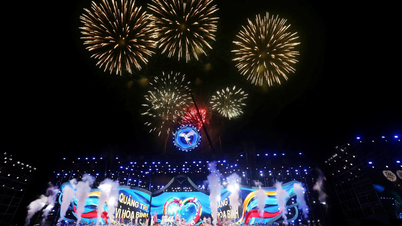
"The Aspiration for Peace" is an idea and theme for the Vietnam Writers Association's literary project in 2024-2025, commemorating the 50th anniversary of national reunification. The two locations chosen for this project are Quang Tri province and Binh Duong commune, Thang Binh district, Quang Nam province – two areas considered to have suffered the greatest losses and sacrifices during the war. In early 2024, a delegation of 20 writers from across the three regions, led by the Chairman of the Vietnam Writers Association, Nguyen Quang Thieu, visited Da Nang and Quang Nam for fieldwork and creative preparation for the book series titled "The Aspiration for Peace." The book is currently in the compilation stage and is expected to be released this year. In line with that principle, "Aspiration for Peace" Volume 1 (Vietnam Writers Association Publishing House), recently published by the Quang Tri Branch of the Vietnam Writers Association, also aims to promote the Peace Festival with the theme "Joining Hands to Build World Peace," which is being held for the first time in Quang Tri.

This book features contributions from over 55 writers, poets, literary theorists, photographers, and journalists. These include renowned poets and writers from Quang Tri province who rose to prominence during the war, such as Che Lan Vien, Hoang Phu Ngoc Tuong, Xuan Duc, and Cao Hanh, as well as later authors like Van Xuong, Nguyen Ngoc Chien, Vo Van Luyen, Nguyen Van Dung, and Pham Xuan Hung.
Living and writing on a land of suffering and unwavering loyalty, courage and heroism, Quang Tri literature expresses pride with the conviction that they "have the right to speak to the entire nation and all of humanity about the 'aspiration for peace'."
Because on this very land, during the war years, the price of peace was paid in blood (Nguyen Quang Thieu). In prose, Hoang Phu Ngoc Tuong - a talented writer of essays, his writings, set in the heart of his motherland, are always full of emotion, expressed in a soaring and captivating language.
"The Corridor of People and Wind" recounts a historical event of Hue students, brimming with enthusiasm on the night of January 27, 1972, defying the obstruction of the South Bank police force, carrying torches onto Hien Luong Bridge, amidst the resounding chant "Long live peace in Vietnam!", expressing their ultimate commitment to peace and national reunification.
Also related to events along the riverbank, the story of erecting the flagpole on the riverbank (That flag in you, in me) is recounted by writer Xuan Duc with the poignant memories of the process of organizing the erection of the flagpole on the North bank. Despite countless difficulties, they were determined to keep the flag flying high in the sky because it carried a very great political significance.
Although poet Nguyen Quang Thieu did not directly participate in the war in Quang Tri, with the responsible and conscientious perspective of a contemporary writer towards this sacred land, he expressed a desire for practical, strong, and decisive actions to "organize a parade for peace with the participation of numerous writers in military uniform" - those who deserve to be honored for having lived, fought, and created literature for a peaceful life in this land of fire.
The memoirs of writers and journalists such as Van Cong Hung, Minh Tu, Luong Ngoc An, Le Duc Duc, Dao Tam Thanh, Pham Xuan Dung, Hoang Cong Danh... reflect a difficult and heroic struggle of Quang Tri in the past with a sense of reflection and contemplation, in conjunction with the reality of peaceful construction and development, expressing the pride and hope of Quang Tri in the future.
The journalists introduced landmarks, cultural, historical, and economic sites, along with action plans aimed at building Quang Tri into a city symbolizing peace.
Short stories by Cao Hạnh, Nguyễn Quang Lập, Sương Ngọc Minh, Nguyễn Đình Tú, Văn Xương, Nguyễn Ngọc Chiến, Nguyễn Hải Yến, Nguyễn Hiệp... are set against the backdrop of war-torn lands such as Quảng Trị Ancient Citadel, Highway 9 Khe Sanh, the banks of Hiền Lương - Bến Hải River, Thạch Hãn River, Cam Lộ River, Cồn Cỏ Island, Cồn Tiên Island, Dốc Miếu, Cùa River, Trường Sơn National Martyrs' Cemetery, the legendary Trường Sơn Road, Tân Sở Citadel, the Provisional Revolutionary Government of the Republic of South Vietnam... during a war of suffering and loss, yet still burning with a dream of peace, which has now become a reality.
In some short stories written in a style close to memoir, it's understandable given the reality of life in this war-torn land, the immense sacrifices and losses, the brutal war, which has become a haunting memory of the bomb-strewn battlefields of the past. Yet, people still love each other, cherishing warmth and camaraderie, showing tolerance and a willingness to sacrifice for the Fatherland. The literature of Quang Tri has resonated like a profound echo in the yearning for peace, a yearning shared by the entire nation.
In terms of poetry, the book also brings together many renowned poets such as Chế Lan Viên, Hữu Thỉnh, Nguyễn Đức Mậu, Anh Ngọc, Vương Trọng, Hoàng Vũ Thuật, Trần Quang Đạo... along with a number of poets who lived and fought in Quảng Trị, including those who passed through this area on their way to fight in the South.
Quang Tri has always been a rich source of creative inspiration for writers. This collection of poems (5 poems) introduces a poetic portrait of Che Lan Vien, showcasing his intellectual depth, overflowing with emotion, reflection, and the heartfelt sentiments he conveys throughout his creative journey.
Hữu Thỉnh's poetry is full of metaphorical imagery, profound, warm, and deeply affectionate, reflecting a deep connection to memories, homeland, and life. The next generation, including poets Nguyễn Hữu Quý, Nguyễn Văn Dùng, Võ Văn Luyến, Võ Văn Hoa, Xuân Lợi, Nguyễn Văn Chức, and others, also produced works rich in poetic quality and a heartfelt love for their homeland. In the space and time bordering on between war and peace, some poets turned their perspectives back to the past with a sense of pride in their homeland and expressed their faith and love for life in this land.
Although "Aspiration for Peace" is mostly about war—a destructive and brutal war that the American and Saigon armies imposed on Quang Tri—the authors, through their writings, poems, and prose, all demonstrate a spirit of compassion, humanity, and tolerance of the Vietnamese people.

Nguyen Huu Quy's poem "Aspiration for Truong Son" serves as a poetic "summary" of the war, reflecting on the fallen comrades in Truong Son: "Ten thousand tombstones, ten thousand more to come / Ten thousand comrades scattered across Truong Son / Ten thousand remains yet to be offered incense / Ten thousand lonely souls in the desolate realm / Ten thousand solitary wanderers in the forest," fueled by the burning desire to be reunited! And that is also the aspiration for peace in Quang Tri literature, a message of freedom and a peaceful life that it wants to send to everyone, to the world.
Poet Nguyen Duy has a deep connection with Quang Tri. In 1968, while fighting on the Khe Sanh and Lang Vay fronts, he recited poems from the Quang Tri front's communication lines to the editorial office of the Literature and Arts Newspaper.
This collection of poems was later published and won the Literature and Arts Newspaper Award, a prestigious award at the time. Nguyen Duy's absence from "Aspiration for Peace" is also regrettable. But this is only volume 1; hopefully, the following volumes will feature poet Nguyen Duy along with other prominent names in Vietnamese literature.
Ho Si Binh
Source