

Under all circumstances, he always maintained unwavering faith in the ultimate victory of the revolution and in the bright future of the nation.
A staunch communist soldier, a respected leader.
Comrade Pham Van Dong, alias To, was born on March 1, 1906, into a family of civil servants in Duc Tan commune, Mo Duc district, Quang Ngai province (now Mo Duc commune, Quang Ngai province); he passed away on April 29, 2000, in Hanoi .
From the early years of the 20th century, as a young man, he was early enlightened by revolutionary ideals, studying the ideology of leader Nguyen Ai Quoc through publications disseminated in Vietnam such as the newspapers "The Oppressed People," "Humanity," and "International Correspondence Magazine"... In 1926, he became a student of leader Nguyen Ai Quoc in the first training courses for revolutionary cadres of Vietnam. From a patriotic intellectual, through training and trials, he became a politician, a member of the leadership of the Vietnamese revolution.
During the period before the outbreak of the nationwide resistance war (December 1946) until January 1949, in his capacity as a special envoy of the Central Party Committee and the Government in South Central Vietnam, he made many contributions to building the free zone of Nam-Ngai-Binh-Phu; consolidating the resistance base; implementing the slogan of self-reliance; and preparing forces for the protracted resistance war.
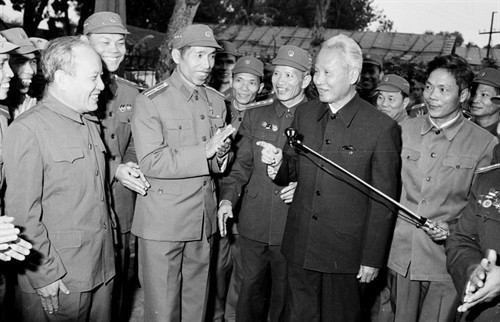
In his roles as Deputy Prime Minister, then Prime Minister, and Chairman of the Council of Ministers, during his more than 30 years at the helm of the Government, he paid special attention to strengthening the state apparatus. Imbued with Ho Chi Minh's thought on a state of the people, by the people, and for the people, he emphasized the principle of democratic centralism in the organization of our State – in which democracy and centralism are two inseparable aspects that must be closely linked and combined. From theoretical understanding to practical organization, he always pondered the building of a truly people-centered government, by the people, and for the people; creating the foundation for a new society, a socialist society consistent with the Vietnamese national identity.
Adhering to President Ho Chi Minh's views on personnel work, he stated that the Party must care for cadres and Party members "like a gardener," both cultivating and nurturing them, while resolutely uprooting weeds and eradicating pests at their source. Regarding bureaucracy, corruption, and negative practices, he demanded that "all rubbish and filth be swept away," considering this a condition for creating a favorable environment for all other work.
A shining example of revolutionary morality.
Not only was Comrade Pham Van Dong a respected leader, but he was also a shining example of revolutionary ethics. He embodied the qualities of a loyal communist: devoted to the Party and the country; devoted to the people; daring to think, daring to act, and daring to take responsibility; diligent, thrifty, honest, upright, and selfless; matching words with deeds; resolutely fighting against bureaucracy, corruption, and waste; and possessing a rich sense of compassion and tolerance…
With a profound sense of humanism, he believed that any Vietnamese person, regardless of background, whether in Vietnam or abroad, who had patriotism and wished to contribute to the people and the nation, should be respected. Immediately after the successful August Revolution, during his trips to France, he met with, influenced, and persuaded a number of Vietnamese expatriate intellectuals to return to their homeland to participate in the resistance and national reconstruction; at the same time, he mobilized many intellectuals in enemy-occupied areas to join the revolution.
As the head of the Government, he always considered caring for the interests of the people and resolving their urgent difficulties as his top priority. He regularly directed all levels and sectors to find solutions to overcome difficulties and improve the people's lives; at the same time, he was ready to accept responsibility for himself and for the agencies under the Council of Ministers before the National Assembly and the people.
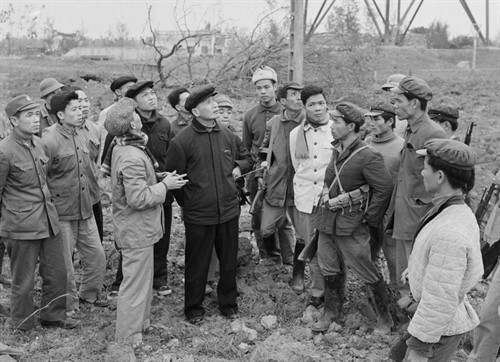
Speaking at the Council of Ministers meeting on July 6-7, 1987, in the face of difficulties and weaknesses in socio-economic management and administration, he emphasized: "If we do not think day and night to strive for socio-economic transformation and development so that the people's lives are better and less difficult, if we do not do so, I think we are unworthy." He considered overcoming weaknesses in the reform process as a cultural undertaking; anyone who did not accept this was "uncultured."
As the country entered the period of reform, Comrade Pham Van Dong affirmed: Reform means building a prosperous, free, and happy life for the people, making the people wealthy, building a new culture, and successfully building socialism. He strictly demanded that he and his team work productively and with quality; practice thrift, and combat corruption and waste.
***
With profound respect and gratitude for the contributions of Comrade Pham Van Dong and other exemplary senior leaders of the Party, every cadre, Party member, and citizen becomes even more deeply aware of their responsibility to study, work, serve, and fight; to uphold the spirit of unity, self-confidence, self-reliance, self-strength; and to promptly implement the Resolution of the 14th Party Congress, building a peaceful, independent, democratic, prosperous, civilized, and happy Vietnam, steadily advancing towards socialism.
Source: https://baogialai.com.vn/tron-doi-vi-nuoc-vi-dan-post581131.html


![[Image] Nearly 125,000 Hanoi students completed the Literature exam for the 10th grade entrance exam.](https://vphoto.vietnam.vn/thumb/1200x675/vietnam/resource/IMAGE/2026/05/30/1780117233041_ndo_br_thiet-ke-chua-co-ten-2-png.webp)











![[Video] Sunset at Lap An Lagoon – Where the sun sets over the fishing nets](https://vphoto.vietnam.vn/thumb/800x450/vietnam/resource/IMAGE/2026/05/31/1780187239592_2222.jpeg)


























![[Video] Sunset at Lap An Lagoon – Where the sun sets over the fishing nets](https://vphoto.vietnam.vn/thumb/402x226/vietnam/resource/IMAGE/2026/05/31/1780187239592_2222.jpeg)






























Comment (0)