


According to the new curriculum requirements, the Literature subject at the lower secondary level does not emphasize the transmission of knowledge through rote memorization. The focus shifts to developing communication skills, encompassing the four skills of reading, writing, speaking, and listening. This places very specific demands on Literature teachers, requiring changes from lesson planning to classroom teaching methods. Practical implementation in lower secondary schools throughout the province shows that innovation in Literature teaching begins with the organization of learning activities in each lesson. Instead of pre-analyzing the text's content, teachers assign tasks for students to read, research, and present their understanding through discussion, group work, or role-playing. This approach forces students to use language to express their thoughts, thereby developing reading comprehension and presentation skills during class, rather than simply receiving information passively.
A study at Vinh Trai Secondary School (Dong Kinh Ward) revealed that organizing Literature lessons with increased student participation has created a significant positive change. Students are more involved in the process of understanding texts, expressing their opinions, and exchanging ideas with their classmates. Tran Nam Trung, a student in class 8A10, shared: "When I get to independently research and participate in activities during class, I find Literature more interesting and remember the lessons longer."
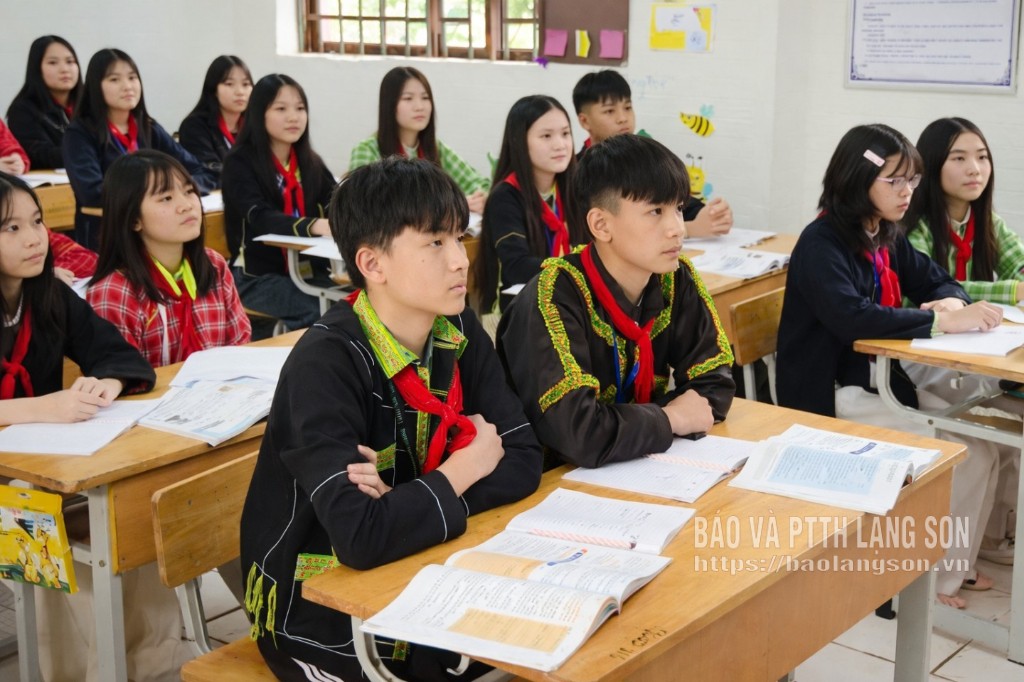
These specific lessons demonstrate that the innovation in teaching Literature that the provincial education sector is aiming for is not about making the classroom outwardly lively, but about changing the roles within the lesson. The teacher is no longer the main speaker, and students are not sitting around taking notes. Each lesson requires the teacher to design a clear roadmap for students to follow independently, from reading to discussion, from writing to presentation. This is also the content emphasized in professional development sessions, lesson observations, and experience-sharing sessions organized by the education sector at the grassroots level.
For schools with a large number of ethnic minority students, especially boarding schools, the innovation of teaching Literature is closely linked to the requirement of improving students' Vietnamese language proficiency. At Cao Loc Ethnic Minority Boarding Secondary and High School (Ky Lua Ward), teachers focus on combining individual and cooperative learning, increasing time for discussion and presentation. Ms. Nguyen Thi Kim Dung, a Literature teacher at the school, said: when students think more, do more, and exchange more ideas, they understand the lesson more deeply and are more confident when speaking in front of the class. For boarding school students, daring to speak and present their opinions is an important step in the learning process.
Through these specific classroom examples, it's clear that the innovative approach to teaching Literature in junior high schools throughout the province is heading towards a very clear goal: not just teaching texts, but teaching how to express thoughts clearly and coherently. The classroom is organized as a safe space where students can express themselves imperfectly, use less-than-perfect vocabulary, and receive immediate feedback and corrections during the learning process. This approach is particularly suitable for students in mountainous areas and ethnic minority groups, who need many opportunities to practice and build confidence in communication.
One factor contributing to the effectiveness of innovation is the standardized assessment method being implemented by the provincial education sector. According to current regulations, teachers can assess students through observation, discussions, learning products, oral presentations, written assignments, and participation in classroom activities, instead of relying solely on end-of-term exams. When assessment is integrated into the daily learning process, literature lessons have more opportunities to value oral presentations, written assignments, and group projects as genuine assessment criteria, aligning with the requirements for competency development.
To effectively implement the 2018 General Education Program, the Department of Education and Training organized training courses on innovative teaching methods for Literature, focusing on guiding teachers in utilizing materials, organizing learning activities, and developing students' self-learning abilities. Through these training courses, teachers exchanged and shared practical teaching experiences, gradually shifting from a traditional, transmissive teaching style to one that promotes student initiative. Sharing her experience from participating in the training, Ms. Doan Thi Hanh, a Literature teacher at Vinh Trai Secondary School in Dong Kinh Ward, said: "Through the training course, we learned many new teaching methods from our colleagues, which helped us to further stimulate students' interest and create conditions for them to actively engage with the lesson."
It is clear that moving literature lessons away from the traditional "read-and-copy" method is not a temporary change, but the result of a process of adjusting teaching and learning methods in schools. From the professional orientation of the education sector to each specific lesson, innovation is implemented through small actions, closely aligned with the class and the students. It is through such lessons that the quality of literature teaching in the province is gradually improved and becomes more substantive.
Source: https://baolangson.vn/khi-gio-van-khong-con-doc-chep-5071606.html





![[Photo] Standing Committee member of the Party Central Committee Tran Cam Tu working with the Central Inspection Committee](https://vphoto.vietnam.vn/thumb/1200x675/vietnam/resource/IMAGE/2026/05/28/1779969579668_ndo_br_bnd-2495-jpg.webp)






































































Comment (0)