When empowered with specific responsibilities, people not only raise their awareness of forest conservation but also view forests as a long-term livelihood for their families and communities.
Handing over forest land to households improves the effectiveness of forest protection.
In Phu Tuc commune, there are currently 125 households in the villages of Ia Prong, Ia Rnho, Ia Rpua, and Ama Giai participating in forest protection contracts covering a total area of over 2,180 hectares.
Assigning forest land to individual households, clearly defining boundaries and areas, has created a local forest protection force, making forest management more practical and enabling timely detection and prevention of forest encroachment.

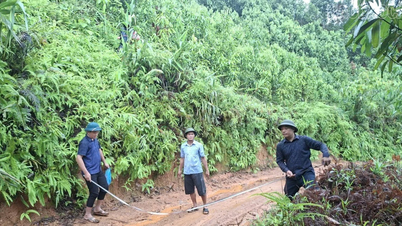
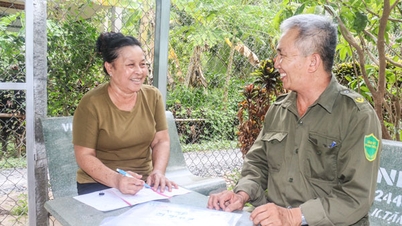
The family of Mr. Alê Tùng (Ia Rnho village) is one of the exemplary households that have been contracted to manage nearly 19 hectares of protective forest in sub-area 1346, plot 6. Although the forest area is nearly 10 km from his home, he maintains regular monthly inspections; during the peak of the dry season, the frequency of patrols is increased to promptly detect potential forest fire risks.
Besides relying on experience, Mr. Tung also received training in using GPS satellite mapping software to monitor forest changes. Thanks to this, when the system issues an alert, he can quickly pinpoint the location and conduct a field inspection.
Besides patrolling, Mr. Tung also coordinates with local forest rangers to encourage households with fields bordering the forest to sign commitments not to cut down trees or burn fields causing forest fires; and to proactively report any unusual signs. “Normally, I patrol 1-2 times a month; from February to June, the peak of the dry season, I patrol about 4 times a month. Thanks to the local authorities' awareness campaigns, we understand our responsibilities in forest protection better,” Mr. Tung shared.
Adjacent to Mr. Tung's forest area is nearly 16 hectares, which has been leased to Mr. Kpa Riem's family since 2023. Despite the difficult forest access, he voluntarily carries out his duties, viewing forest protection as a long-term responsibility.
“The biggest challenges are the roads, the weather, and the travel costs. But when they see the forest turning green again, no longer being cut down as before, everyone becomes more aware. If in the future there is a model of growing medicinal plants under the forest canopy, people will feel more secure and committed to the forest in the long term,” Riem expressed.


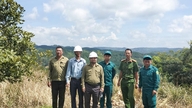
According to Mr. Trinh Thanh Khiet, Deputy Secretary of the Phu Tuc Commune Party Committee, in recent times, the Commune Party Committee has focused on leading and directing the entire political system to participate in strengthening forest management and protection.
"The allocation of land and forests to individual households helps people enhance their responsibility in managing and protecting forests at the grassroots level, contributing to reducing forest encroachment."
In 2024, in addition to state support, the commune implemented a model of sustainable production and livestock development linked with planting, managing, protecting, and developing forests, initiated by the Vietnam Fatherland Front Committee of Krong Pa district (formerly) in Ama Giai hamlet. Nine poor and near-poor households were allocated forest land totaling 108 million VND to purchase livestock for livestock development.
"To date, many households have had more calves, helping families have additional livelihoods so they can feel secure in their commitment to the forest and enhance their responsibility in forest protection," Mr. Khiet shared.
Preserving forests through responsibility and livelihood.
Not only in Phu Tuc, but the forest protection contracting work with local communities in Ia Dreh commune is also proving to be very effective. In 2025, the commune organized forest inspections in 8 communities assigned to manage a total area of over 2,040 hectares; the inspection results reached 100%, with no instances of forest encroachment or damage.
According to community forest management group leaders, the assignment of responsibilities has brought about a shift in people's awareness. Mr. Nay Phơr, head of the Kơ Jing village community group, said: "Our group has 17 people, with a total contracted area of 218.1 hectares. When the forest is assigned to the community, the people consider it a shared asset."
We take turns patrolling regularly, detecting strangers entering the forest early so we can report them to the authorities promptly. By preserving the forest, the payments for forest environmental services will be more stable for the local people.”

Besides contributing to the protection of forest resources, the forest management model also helps people gradually become attached to the forest through long-term responsibility and benefits.



According to Vo Thuy Van, Chairwoman of the People's Committee of Ia Dreh commune: "Handing over forest management to the community is a suitable direction for local conditions. In practice, people have become more proactive in patrolling and protecting the forest. In the future, the commune will continue to strengthen coordination and guide communities to effectively carry out their tasks, linking forest protection with stabilizing people's livelihoods."
Similarly, in Uar commune, forest protection contracting is implemented synchronously with two main forms: contracting to 6 community groups and 6 households, covering a total area of over 1,310.2 hectares.
According to Mr. Nguyen Thanh Van, Vice Chairman of the People's Committee of Uar commune, the clear allocation of land area and boundaries has helped people be more proactive in patrolling and protecting the forest; their sense of responsibility has been significantly enhanced.
Source: https://baogialai.com.vn/khi-nguoi-dan-lam-chu-rung-post576932.html