

Reviving the "undercurrent" of heritage
A decade ago, mentioning Dao Tru often brought to mind a purely agricultural highland commune where poverty clung to the houses at the foot of the Tam Dao mountain range. But today, the road to the commune center is smoothly paved, lined on both sides with spacious houses. The change stems not only from the infrastructure but also from the people's awareness of the value of their cultural heritage.
Leading us through the rich cultural space of the highlands, Meritorious Artisan Le Dai Nam - Chairman of the Soọng Cô Folk Song Club of Dao Tru commune, slowly recounted the origins of his hometown's folk song. For him, Soọng Cô is not just music , but the culmination of ancient legends about the intelligent Ly Tam Moi, who used a carrying pole to retrieve pages of songbooks that had been thrown into the river to teach them to the villagers. "Soọng" means to sing, "Cô" means to chant. From those legendary pages, Soọng Cô was born, associated with the seven-syllable four-line verse form, written in ancient Chinese characters, but its strongest vitality lies in its oral transmission through thousands of generations.

The Soọng cô melodies are preserved by the Sán Dìu people of Đạo Trù commune through club activities, competitions, and village festivals.
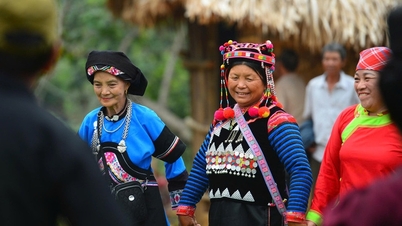
At the Soọng cô singing club in the commune, Ms. Đỗ Thị Sáu, from Đạo Trù Thượng village, Đạo Trù commune, adjusted her indigo-dyed áo chàm (traditional Vietnamese dress) while enthusiastically sharing: "In the past, we sang for each other in the fields and on the farms to forget our fatigue. Now it's different; we sing to welcome tourists , and to make our children and grandchildren proud of their heritage. Our culture is precious; preserving it means having everything."
The beauty of Soọng cô lies in its simplicity and rusticity, reflecting the nature of the Sán Dìu farmers. Although it has only one main melody, the content is incredibly rich, encompassing nearly 1,000 traditional songs. The introductory or final sounds of "a, ư, ơ, ờ..." at the beginning or end of phrases act as a springboard, making the lyrics soft and graceful, like a flowing stream. In particular, the performance space for Soọng cô is very flexible. Ms. Lý Thị Chịu, from Đồng Pheo village, a member of the Soọng cô folk song club, shared: "The people like singing by the fire the most, because we believe the kitchen god (Chạo Am) will bless our family when they hear these beautiful songs."
Local authorities have determined that relying solely on rice and corn cultivation will not lead to a significant improvement in people's lives. Therefore, it is necessary to transform the San Diu culture – a unique spiritual "specialty" of Dao Tru – into a genuine economic product. The recognition of Soong Co as a National Intangible Cultural Heritage by the Ministry of Culture, Sports and Tourism in 2018 not only created a new lease of life and affirmed the position of this melody in the national cultural treasury, but also opened up opportunities to develop it into a cultural tourism product linked to sustainable economic development.
When heritage becomes an economic leverage.
Dao Tru today boasts numerous community-based tourism models that reflect its unique identity. Tourists come here not only to admire the scenery but also to immerse themselves in the cultural space of the San Diu ethnic group. Characteristic dishes such as "banh chung gu" (humpback rice cake), "xoi den" (black sticky rice), and "thit lon man" (a type of local pork)—once everyday meals—have become sought-after specialties. Visitors can participate in making rice cakes, weaving cloth, and joining in the Soong Co festival nights around crackling bonfires.
The shift from purely agricultural production to cultural tourism has yielded impressive results. By 2025, the commune's per capita income reached 55 million VND, achieving 100% of the assigned target. Economic growth reached 9%. Notably, the poverty rate has significantly decreased to only 0.71%. These figures are not just achievements on paper; they represent a better standard of living for every household. Traditional crafts such as embroidery and ethnic costume making have strongly revived, creating jobs and stable income for hundreds of local women.
In this economic landscape, digital transformation is seen as an "extended arm" to propel culture further. The People's Committee of the commune has established a synchronized infrastructure system. The rate of administrative procedures processed online throughout the entire process has reached 96.32%. Propaganda through social media platforms like Facebook and Zalo has seen a significant transformation, with over 200 news articles and posts published in 2025, helping to project the image of a dynamic and culturally rich Dao Tru village to young tourists nationwide. Mr. Lam Van Vuong, a resident of Phan Lan Ha village, shared: "We are aiming for sustainable tourism, where tourists are friends who come to learn, not to change the way of life of the villagers."
Comrade Khong Dinh Ngon - Chairman of the People's Committee of Dao Tru Commune - affirmed: The locality is focusing on developing sustainable agriculture linked with tourism services and protecting the ecological environment. The goal for 2026 is to maintain a production value growth rate of 9-10%, while increasing the percentage of culturally exemplary households to over 90%. The commune is also focusing on building two villages to meet the standards of model new rural areas and maintaining forest cover above 68% to protect the "green lung" at the foot of Tam Dao mountain.
Today, Dao Tru is a living testament to the fact that culture is a precious asset for the future. When the Soong Co songs resound through the green valley, it is not only an invitation to tourists, but also an epic of the self-reliance of a land that knows how to rely on its roots to reach out to the wider world. At the foot of Tam Dao mountain, the cultural "gold mine" of the San Diu people is being exploited in a humane and effective way, transforming Dao Tru into a bright spot on the local economic and tourism map.
Ngoc Thang
Source: https://baophutho.vn/khi-van-hoa-tro-thanh-don-bay-kinh-te-254153.htm


























































Comment (0)