

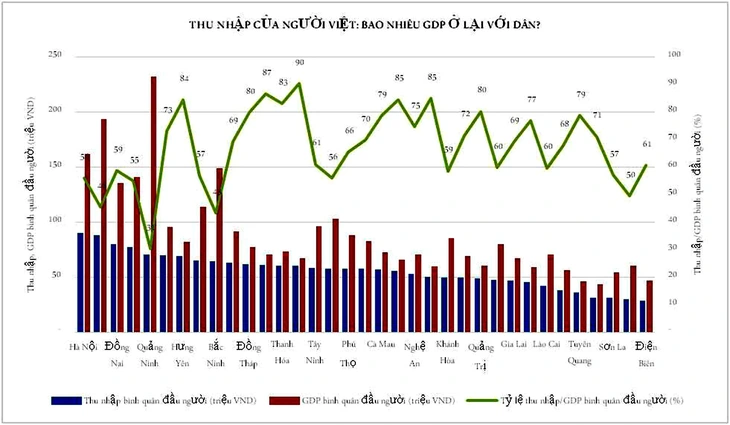
Vietstats' calculations from the 2024 Household Living Standards Survey - Graphic: D.T. ANH TUAN
According to the 2024 Household Living Standards Survey by the General Statistics Office and analysis by Vietstats, on average, each citizen only actually enjoys about 57% of the per capita GDP. This figure reveals a paradox: the economy is growing, but the people are not benefiting as much as they should.
High GDP, low income
In major economic centers like Ho Chi Minh City, Hanoi , Bac Ninh, and Quang Ninh, GDP per capita is higher than the national average. However, the income-to-GDP ratio is low, ranging from only 31% to 56%. This reflects the reality that a large portion of the economic value generated does not return to the pockets of local residents.
The main reason lies in the development structure's dependence on foreign direct investment (FDI) and export industries. Migrant workers, those working in industrial centers but living elsewhere or having family in their hometowns, also skew income data.
Furthermore, the majority of GDP here consists of taxes and contributions, not personal income. The current central-local budgetary decentralization mechanism further reduces the proportion of value retained for local development.
All these reasons mean that the development model based on industrialization and large-scale investment, while generating large outputs, lacks mechanisms to ensure fair distribution for workers, both at the national and local levels.
Where income exceeds the scale of the economy.
In contrast to industrial centers, localities like Can Tho, An Giang , Dong Thap, and Vinh Long have a high ratio of income to GDP, reaching 80-90%. These are regions with modest GDP sizes, but a large portion of the economic value is retained and transformed into real income for the people.
The main reason is the fragmented agricultural and service economic structure. In this system, producers are also beneficiaries, preventing "value leakage" to other regions. Another important factor is the flow of "domestic remittances," meaning workers leave their hometowns to work in developed areas and send money home, contributing to increased income in their local communities even without boosting GDP.
Notably, despite the high income-to-GDP ratio, absolute income in these localities remains low, ranging from approximately 50 to 62 million VND per person per year. These are also areas lacking long-term growth momentum and are vulnerable to climate change and agricultural market fluctuations.
From Growth to Prosperity and Policy Implications
If we want growth to truly become the foundation for prosperity, we need coordinated policies to narrow the gap between GDP and income.
Firstly, it is necessary to increase the value-added share for workers. A flexible minimum wage policy linked to local living standards needs to be developed. Businesses with good welfare policies, vocational training, and the use of local labor should be granted tax incentives. In particular, FDI companies should be required to increase their contributions to the community and local workers.
Secondly, it's crucial to improve living conditions and retain workers. The phenomenon of "GDP staying, income leaving" causes significant income "leakage" at both national and local levels. Therefore, the government and local authorities need to invest heavily in social housing, schools, hospitals, and improve public services to "retain" workers and their families.
Third, a more efficient and equitable redistribution mechanism needs to be established. The government needs to reform income tax policies to enhance its ability to regulate and reallocate resources.
Using tax revenue to invest in public education and healthcare, support vocational training, and expand the social security system is not only a form of income redistribution, but also an effective way to transform economic value into tangible benefits for the people.
Fourth, data transparency and statistical capacity enhancement are crucial. Discrepancies between GDP and income can also stem from a lack of transparency and weak statistical capabilities. Therefore, integrating databases on residence, labor, income, and businesses is necessary to accurately track the flow of value in the economy.
In summary, GDP is an important indicator, but not the ultimate goal. As long as the gap between GDP and income remains wide, growth will not equate to development. To achieve a prosperous economy by 2045, policies are needed that focus not only on production but also on ensuring equitable distribution, investing in people, and improving the quality of life.
Why isn't income keeping pace with GDP?
The difference between GDP and income reflects the nature of distribution in the economy. GDP includes corporate profits, indirect taxes, and reinvestment. These factors do not directly translate into income for the people.
Another factor is labor migration. When workers produce value in one place but reside and consume it elsewhere, income is accounted for in the place of residence, while GDP is calculated in the place of production. Furthermore, the prevalence of informal and uninsured labor makes it difficult for the statistical system to accurately reflect real income.
Particularly in highly industrialized areas, the majority of value added is concentrated in a few large enterprises or investors, while workers enjoy low wages and limited opportunities for skill development.
Ultimately, GDP growth can be driven by investment in machinery and technology without creating additional quality jobs, resulting in labor productivity not being accompanied by improved incomes.
Source: https://tuoitre.vn/khoang-cach-giua-gdp-va-thu-nhap-ai-huong-loi-tu-tang-truong-20250607091952609.htm


![[Photo] Prime Minister Pham Minh Chinh presides over a meeting on private sector economic development.](/_next/image?url=https%3A%2F%2Fvphoto.vietnam.vn%2Fthumb%2F1200x675%2Fvietnam%2Fresource%2FIMAGE%2F2025%2F12%2F20%2F1766237501876_thiet-ke-chua-co-ten-40-png.webp&w=3840&q=75)























































































Comment (0)