

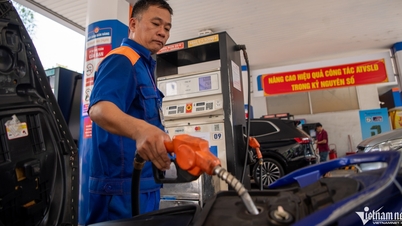
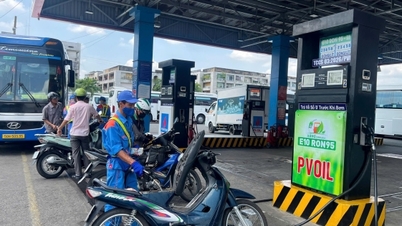
The mid-March price adjustment saw a significant increase in gasoline prices, enough to put pressure on several intermediate stages of the economy . However, in the price structure of most goods, gasoline is only one component, alongside input materials, labor, land, electricity, water, management costs, and market supply and demand factors.
A bowl of pho, a cup of coffee, or a bunch of vegetables at the market doesn't move in a perfectly straight line with the price of gasoline. The fact that retail prices immediately "jump" up as soon as gasoline prices rise isn't simply a cost effect; it's often a psychological reaction, and sometimes even a sign of profiteering. What people worry about most right now isn't just the price increase at gas stations, but the rapid spread to market stalls, restaurants, transportation, delivery services, and even family meals. A single spring onion increases by a few thousand dong; a bowl of pho costs 5,000-7,000 dong more; a taxi ride increases by tens of thousands of dong...
Each individual price increase may seem small, but many small increases combined become a significant burden for wage earners, workers, pensioners, small business owners, and low-income families. More worryingly, this type of "follow-the-trend" price increase often exhibits a familiar characteristic: when input costs rise, selling prices increase rapidly, but when input costs decrease, prices fall very slowly, or even remain stagnant. This imbalance not only distorts market signals but also erodes consumer confidence, creating a chain reaction of price increases where prices no longer accurately reflect real costs.
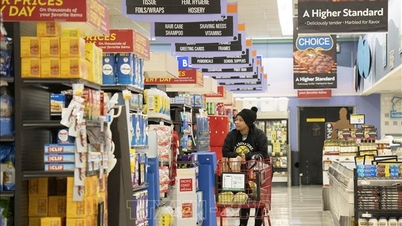
Current price pressures are already significant. According to the latest figures, the consumer price index (CPI) in February 2026 increased by 1.14% compared to the previous month; the average for the first two months of the year increased by 2.94% compared to the same period last year. The main reasons stem from the increase in food prices, dining out, and transportation services during the Lunar New Year holiday. This shows that people's lives were already under pressure; if a fuel price increase is amplified into a wave of uncontrolled price hikes, the burden will fall even more heavily on the people.
The challenge now is for regulatory agencies to maintain market discipline; tighten supervision of price declarations and listings; and demand transparency in cost components, especially in the transportation and distribution sectors. Any price adjustments must have clear explanations: the reasons for the increase, the extent of the increase, and whether it is reasonable. Simply citing the familiar reason of rising gasoline prices is unacceptable. Price control cannot be limited to a single stage but should be considered throughout the entire chain, from production and intermediaries to retail.
In reality, prices at the point of production often don't fluctuate significantly, but costs and profits increase at each stage of distribution. As a result, consumers sometimes pay more, and producers don't benefit proportionally, as these intermediaries are the "inflation amplifiers"... From a business perspective, price adjustments should be based on actual costs, coupled with efforts to optimize operations to reduce input pressure. Fuel price fluctuations cannot be used as an excuse for widespread price increases. In a context of limited purchasing power, ill-considered price hikes can backfire, shrinking market share.
Maintaining price stability at this time is not just an economic issue, but also a responsibility to people's livelihoods. Authorities may accept selective cost increases, but they should resolutely prevent any opportunistic price hikes to protect market confidence...
Source: https://www.sggp.org.vn/khong-de-gia-ca-te-nuoc-theo-mua-post844522.html

































































































Comment (0)