

 |
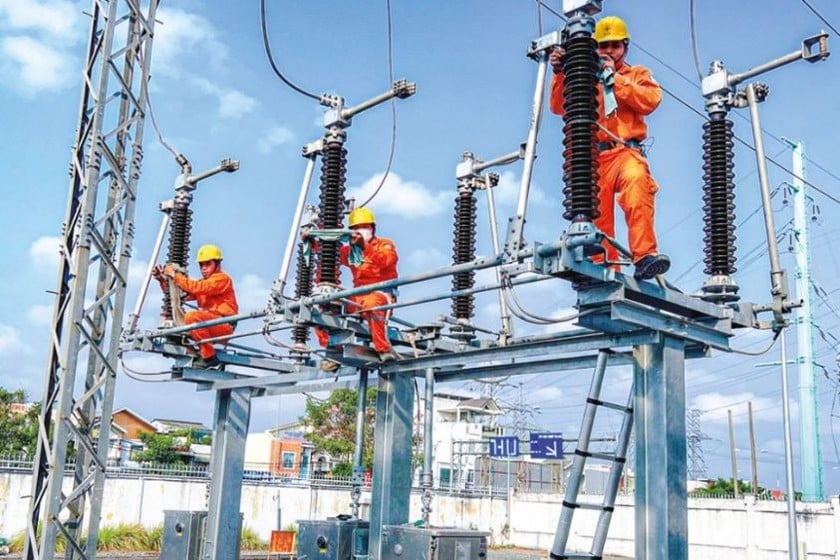
| Electricity growth in 2025 is predicted to reach 13.4%. (Photo: EVN). |
(PLVN) - Electricity supply in 2025 will still meet demand in most months of the year, but there are still some potential risks for the northern region during peak periods at the end of the dry season.
Risks to electricity supply remain during the dry season in the North.
Vietnam Electricity Group (EVN) has just reported to the Government its electricity supply scenarios for 2025. The two growth scenarios project growth of 9.4% and 13.2% respectively compared to 2024. According to the baseline scenario, the load demand is estimated at approximately 339.17 billion kWh, a 9.4% increase compared to 2024. The audit scenario (to prepare solutions to ensure electricity supply in case the economy continues to recover strongly) estimates the load demand at approximately 350.97 billion kWh, a 13.2% increase compared to 2024.
EVN assesses that electricity supply in 2025 will still meet demand in most months of the year, but there are still some potential risks for the northern region during peak periods at the end of the dry season (the period from May to July, if demand increases dramatically).
EVN also stated that there are many difficulties that could affect electricity supply, such as a significant decrease in natural gas supply in 2025 compared to previous years; delays in the progress of many new power plant projects; and the fact that most large hydropower plants have been built and put into operation, with only a few small-scale hydropower projects remaining.
Meanwhile, coal-fired power plants will face many difficulties in securing credit financing, and the implementation of these projects will also entail many risks, especially after Vietnam has made a strong commitment to the international community to achieve net zero greenhouse gas emissions by 2050.
Providing a more detailed assessment of power sources in the coming years, EVN stated that the Power Development Plan VIII aims to achieve 6,000 MW of offshore wind power by 2030, but the implementation time for a project takes 6-8 years. Currently, the Ministry of Industry and Trade is developing a pilot project for offshore wind power development, along with synchronized mechanisms and policies, to submit to the Government. The new renewable energy sources added in the Power Development Plan VIII still require mechanisms and policies from competent authorities to implement according to the plan...
Furthermore, the planned replacement of coal-fired power plants with gas-fired power in the coming years is also uncertain to be completed on schedule. Except for the Nhon Trach 3&4 and Hiep Phuoc 1 power plant projects with a total capacity of approximately 2,824 MW, which may be completed before 2030, the remaining LNG projects are unlikely to meet the completion deadline.
Ensuring sufficient electricity supply is very important.
At the meeting on ensuring sufficient electricity supply and national energy security in the coming years (held on October 19th), Prime Minister Pham Minh Chinh assessed that, at this point, it can be confirmed that there will be no electricity shortage in 2024, even though consumption is expected to increase by about 11-13% compared to 2023 (data from EVN shows that, by the end of the third quarter, total electricity production and import reached 232.8 billion kWh, an increase of nearly 11%; commercial electricity reached over 208 billion kWh, an increase of more than 11%).
According to the Prime Minister, ensuring sufficient electricity supply is crucial to attracting foreign direct investment (FDI) amidst a global investment downturn. In the past nine months, Vietnam disbursed $17 billion in FDI – the highest amount in many years. Therefore, according to reports, with electricity demand increasing by approximately 12-13% in 2025, an additional 2,200-2,500 MW of capacity will be needed.
The Prime Minister stated that this is not a major problem and insisted that there should be no electricity shortages in 2025, with specific solutions in place. Accordingly, the Prime Minister requested the urgent and effective implementation of the Decree on the direct electricity trading mechanism issued by the Government; ensuring sufficient fuel (coal, gas) for electricity production according to system needs, including boosting domestic coal mining with a long-term plan, while also studying the possibility of importing coal from Laos and reducing imports from other sources.
The Prime Minister also directed that the power transmission lines from Laos and China be completed quickly to increase electricity imports from Laos and China. Specifically, the 500kV Lao Cai - Vinh Yen line must be completed within 6 months, and the 220kV Nam Sum - Nong Cong line must be completed in 2024.
In addition, the Government and relevant ministries and local authorities are actively addressing the issues related to transitional renewable energy sources. Recently, Deputy Prime Minister Nguyen Hoa Binh inspected and listened to the difficulties and obstacles faced by transitional renewable energy projects. The Deputy Prime Minister affirmed that these difficulties and obstacles need to be decisively resolved so that the projects currently facing problems can be implemented, put into operation, and exploited as soon as possible, avoiding the waste of resources in investment in renewable energy projects.
This is what many investors in transitional projects expect and believe in, hoping that contract negotiations with EVN will soon be completed to secure the best financial resources for operating power projects, providing stable output, especially in the context of dry seasons when EVN's ability to ensure electricity supply still faces potential risks.
Source: https://baophapluat.vn/khong-de-thieu-dien-trong-nam-2025-post529158.html


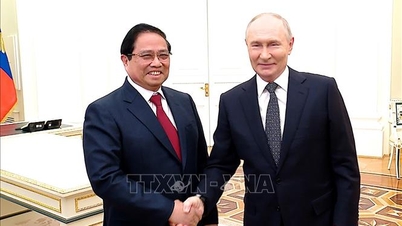
![[Photo] Prime Minister Pham Minh Chinh successfully concludes his official visit to the Russian Federation.](https://vphoto.vietnam.vn/thumb/1200x675/vietnam/resource/IMAGE/2026/03/26/1774482837673_vna-potal-thu-tuong-pham-minh-chinh-ket-thuc-tot-dep-chuyen-tham-chinh-thuc-lien-bang-nga-8663158-4245-jpg.webp)























































































Comment (0)