

The real estate market is recovering strongly, with a rapid increase in supply and gradually easing financial policies. However, this recovery also comes with many concerns, especially regarding speculation, artificial price increases, and imbalances in supply and demand, if not controlled in a timely manner.
It's lively again.
According to the Vietnam Association of Real Estate Brokers (VARS), in the first quarter of 2025, the market recorded 27,000 residential real estate products offered for sale, a 33% increase compared to the same period last year. Of these, more than 14,500 products were newly launched. The number of newly approved housing projects also increased by approximately 18%.
Strong investment in transportation infrastructure is a major driving force for businesses to launch new projects. Ms. Huynh Thi Kim Thanh, Investment Advisory Manager at Savills Vietnam, noted that infrastructure projects not only create short-term effects but also lay a long-term foundation for the real estate market, especially in suburban areas and neighboring provinces.
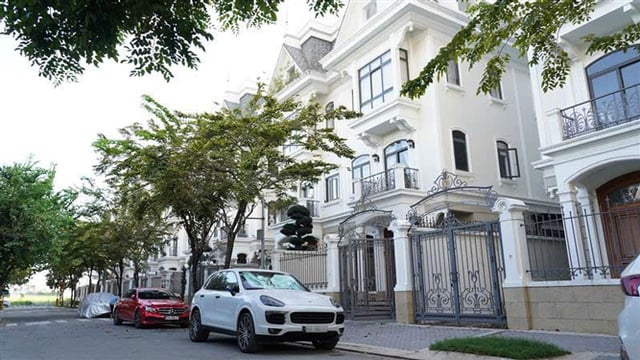
Novaland 's Victoria Village project in Thu Duc City, Ho Chi Minh City, has recently had its legal issues resolved thanks to a new policy.
Mr. Nguyen Quoc Anh, Deputy General Director of Batdongsan.com.vn, said that information about the merger of provinces and cities has also contributed to increasing interest in real estate. For example, in March 2025, the number of searches for houses and land in Da Nang increased by 39%, and in Quang Nam by 96% compared to the previous month.
According to Professor Hoang Van Cuong, a member of the National Assembly 's Finance and Budget Committee, Resolutions 170 and 171, recently passed by the National Assembly, will remove many obstacles for stalled projects, especially those related to land transfer and legal procedures. He believes that many "prime land" projects will be able to continue implementation without re-bidding, requiring only adjustments to the planning or pricing.
Mr. Le Huu Nghia, General Director of Le Thanh Construction Joint Stock Company, predicts that real estate capital will be abundant from 2025 and the market could boom in 2027. However, he also worries about the ability of the banking system to meet the demand if there is a sudden surge in demand.
Directing capital flow in the right direction.
Dr. Nguyen Van Dinh, Vice President of the Vietnam Real Estate Association, assessed that Resolution 170 and Resolution 171 could help release approximately 1,000 stalled projects, equivalent to $30 billion of "tied-up capital". Once this capital flow is unlocked, it will create a major boost for the economy, rekindling confidence among businesses and investors.
Sharing the same view, Mr. Le Hoang Chau, Chairman of the Ho Chi Minh City Real Estate Association, said that the city currently has 343 projects registered for implementation under Resolution 171, covering an area of approximately 1,913 hectares. It is estimated that if each project has about 830 houses, Ho Chi Minh City will have an additional 216,000 houses in the next 3-10 years.
In fact, real estate contributes approximately 7.62% to GDP and impacts more than 40 other economic sectors. Therefore, regulating and controlling capital flows into this sector is always a top priority for the Government. Mr. Nguyen Duc Lenh, Deputy Director of the State Bank of Vietnam's Regional Branch II, reported that real estate credit outstanding in Ho Chi Minh City currently stands at 1,085 trillion VND, accounting for 27.5% of total outstanding loans. The higher-than-average growth in real estate credit indicates that banks are "not making things difficult for businesses." He affirmed that if legal issues are improved, banks will create more favorable conditions for businesses to borrow in the medium and long term.
According to Mr. Truong Van Phuoc, former Acting Chairman of the National Financial Supervisory Commission, Vietnam should refer to China's real estate development model, especially the allocation of capital with clear direction. He proposed rapid reform of the financial market to support sustainable real estate development. The question of "where the capital comes from and who to lend to" should be decided by the market, but the state needs to design a reasonable institutional framework to guide it.
Dr. Nguyen Van Dinh argues that it is necessary to clearly distinguish between investment capital and speculation. Speculative capital often does not create products but only drives up prices for profit. The supply of housing is increasing but does not fully match the actual demand. In some areas, construction is rampant but there are no buyers, because it is not based on actual surveys. Therefore, if the flow of capital is not strictly controlled, it will lead to a situation where those who genuinely need to buy housing have difficulty accessing housing, while it encourages speculators to accumulate real estate in anticipation of price increases.
"This has had serious consequences in China and Japan, affecting the social structure as young people are hesitant to get married because they can't afford to buy a house," Mr. Dinh expressed his concern.
Prescribing a cure for the market.
From another perspective, Professor Tran Ngoc Tho (Ho Chi Minh City University of Economics) likened the real estate market to a middle-aged person suffering from "old age-related illnesses" with three dangerous indicators: high blood pressure (house prices far exceeding income), high blood sugar (credit dependence), and high cholesterol (large inventory, increasing bad debts). If this situation persists, the market is very likely to "suffer a stroke".
Therefore, current policies need to be like a good doctor – diagnosing the illness correctly, prescribing the right medicine, and using a sufficiently strong dose, rather than simply appeasing the market with half-hearted solutions. "Patients" – meaning businesses and investors – must also learn to heal themselves by lowering prices, restructuring profits, and focusing on affordable housing to increase liquidity.
Mr. Tho also proposed imposing high progressive taxes on speculative real estate; reducing input costs by controlling the land market more transparently, conducting public auctions, and setting specific price ceilings. In addition, tighter control over the debt of real estate businesses is needed to avoid systemic risks.
Source: https://nld.com.vn/kiem-soat-dong-von-vao-bat-dong-san-196250422201857251.htm


























































































Comment (0)