

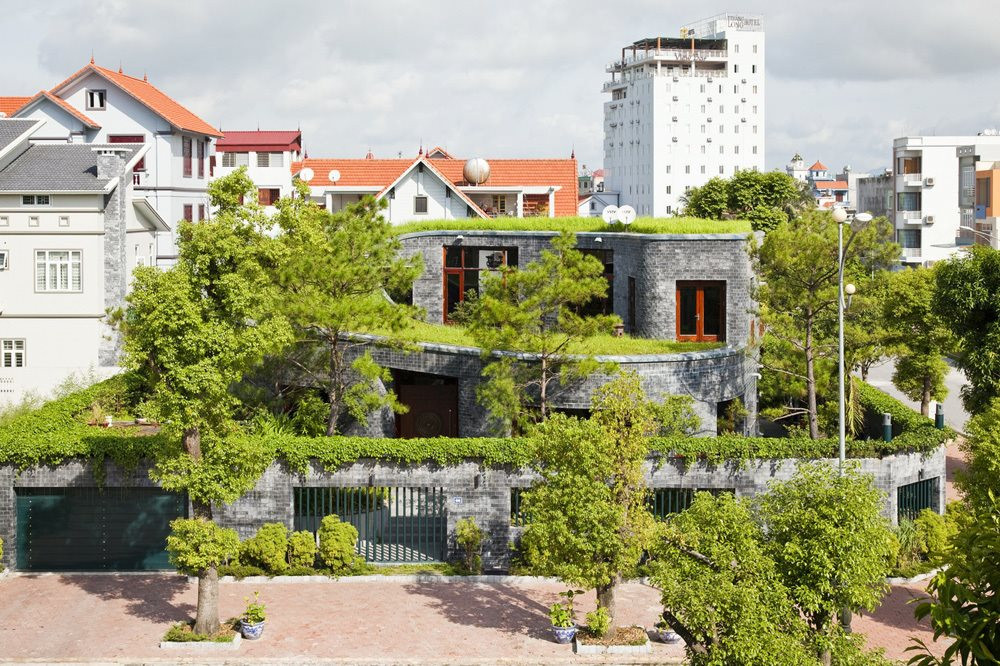
Green architecture is gradually becoming more familiar.
Green architecture is a new trend in the design and construction of architectural projects. Its aim is to minimize the impact of buildings on the environment and nature.
In the context of dwindling natural resources and global climate change, green architecture, with its unique characteristics and principles aimed at minimizing impacts on the natural environment, brings immense benefits to society.
When we talk about green architecture, we're talking about trees and water features, although green architecture isn't just about planting lots of trees. A green city must be a city with a green living environment, with a harmonious arrangement of individual green architectural elements, managed according to urban planning, whether it's an old or new neighborhood.
Architect Pham Thanh Tung, Chief of the Office of the Vietnam Association of Architects, said: "Now, the terms 'green architecture' or 'green building' have become very familiar in social life, and are the hottest and most frequently mentioned terms in the architectural community and the real estate investment and business community."
Although the criteria for defining green buildings or green architecture have not been mandatory (or legally mandated) since their inception, architects, whenever designing any architectural project, large or small, low-rise or high-rise, in plains, midlands, or mountainous areas, strive to create designs based on green architecture principles. This confirms that, in our country, green architecture has become and continues to be the most progressive architectural trend of the 21st century.
According to Mr. Pham Thanh Tung, green architecture, characterized by the use of environmentally friendly materials, rooftop terraces, or indoor parks, is a trend in contemporary architectural design. Green architecture and green buildings are essentially the same.
The difference is that the criteria for green buildings are quantitative, specifically defined by algorithms, measured by numbers through machines, and utilize advancements in science and technology (such as air conditioning, heat-resistant glass, non-fired building materials, artificial intelligence, etc.). In contrast, the criteria for green architecture are qualitative, emphasizing the creativity of the architect, using architectural techniques combined with the use of environmentally friendly materials and technology to meet the requirements (according to the five criteria for Green Architecture of the Vietnam Association of Architects).
It's not just a place with lots of greenery.
Cities in Vietnam are developing rapidly, and the number of people living there is increasing annually. With this rapid urbanization, green spaces on the outskirts of cities are gradually decreasing. Instead, the surface area of buildings – which strongly absorb solar radiation – is increasing, leading to a rise in urban temperatures.
Along with waste (solid, gas, and liquid) from human activities, transportation, and industry, urban environments are undergoing drastic changes, negatively impacting not only humans but also contributing to the disruption of ecosystems and the environment both domestically and globally. Therefore, developing green buildings that are environmentally friendly is extremely necessary.
According to Professor Pham Ngoc Dang, Vice President of the Vietnam Association for Nature and Environment Protection, green buildings are one of the solutions to adapt to climate change and reduce greenhouse gas emissions. The development of green buildings has spread to many countries around the world and has become an inevitable trend in the construction sector.
Looking at the reality over the past period, many construction developers have "monopolized" green park areas, or planted some trees within the grounds of apartment buildings to offer for sale, claiming that these are green features provided by the developer, in order to attract the attention of buyers.
However, it must be clarified that green buildings are not simply buildings with lots of greenery, but rather the product of a construction process that has considered the environmental impact and resource efficiency of the building throughout its entire lifecycle (from design, construction, operation, maintenance, and demolition).
In Vietnam, the Thang Long Number One residential complex (No. 1 Thang Long Avenue, Hanoi) is the first green building, certified and officially designated as a green building by the Ministry of Construction on October 9, 2014. Other notable green buildings in Hanoi include Genesis School (located on Nguyen Van Huyen Street); Concordia International School (located in Dong Anh District); and the headquarters of the Military Industry and Telecommunications Group (located on Ton That Thuyet Street)...
According to a report by the Ministry of Construction: The number of green buildings in Vietnam currently stands at only about 230, a very modest figure compared to the number of buildings constructed and put into operation over the past 10 years. It's not enough to rely solely on the voluntary efforts of investors and architects; for green architecture to truly become a part of daily life, specific guidelines, regulations, and incentives from the State are needed. Only then will environmentally friendly buildings become an essential element linked to social ethics, compelling all stakeholders to participate.
Trends and specific goals
It can be said that, since ancient times, rural architecture has been "green" to suit its surrounding environment. In our country, according to architectural experts, the concept of green architecture emerged in the early years of the 21st century, and was also highlighted by the unique architectural work "Wind and Water Cafe," made entirely of bamboo and traditional leaves by architect Vo Trong Nghia, built in Thu Dau Mot City (Binh Duong, 2006).
Since 2011, with the introduction of the Vietnamese Green Architecture Manifesto and the persistent efforts of the Vietnam Association of Architects, green architecture has developed strongly, becoming a progressive architectural trend that is embraced and receives attention from society.
Currently, green architecture trends are being applied by real estate investors in the architectural design of their projects. However, according to many experts, these trends need to be transformed into specific goals and plans for urban development. Only then can we contribute to the development of green, sustainable, livable cities that reduce greenhouse gas emissions. Integrating green architecture into daily life is not only the responsibility of real estate investors and architects, but more importantly, it is the decisive responsibility of urban authorities and planners.
Regarding urban development orientation, architect Tran Huy Anh, Standing Committee member of the Hanoi Architects Association, noted that Hanoi is one of the cities that possesses many favorable factors for sustainable green urban development. These include natural advantages such as a dense network of rivers and lakes, unique and rich soil with complete agricultural areas, creating space for the transformation and regeneration of excess material during the urbanization process.
In the Master Plan for the Construction of Hanoi Capital City until 2030 with a vision to 2050, approved by the Prime Minister in Decision No. 1259/QD-TTg dated July 26, 2011, Hanoi is defined as a sustainable "green" city in terms of environment; an ecological urban area that harmoniously integrates natural, social, and human elements; and a city that balances conservation and new development. According to Decision No. 1259/QD-TTg, existing district towns will develop according to a low-density ecological urban model.
According to our research, Resolution No. 29/NQ-TW dated November 17, 2022, of the 13th Central Committee on further promoting industrialization and modernization of the country until 2030, with a vision to 2045, also sets out goals, tasks, and perspectives on promoting industrialization and modernization of the country associated with transforming the economy towards a green and sustainable direction.
To achieve the goals of Resolution No. 29 and the Government's commitments at COP 26 on net-zero emissions by 2050, all sectors of the economy, including the construction industry, must simultaneously undergo a green transformation. Developing green buildings is one of the key solutions for the construction industry's green transformation.
The Ministry of Natural Resources and Environment is currently coordinating with relevant ministries and agencies to draft a Government Decision on environmental criteria and the confirmation of investment projects eligible for green finance. The market is eagerly awaiting the early approval of this regulation to create an important legal framework for financial institutions and investors to participate in promoting green projects with preferential credit sources.
Source: https://daidoanket.vn/kien-truc-xanh-cho-do-thi-10283889.html


![[E-Magazine]: A Smile in the Mist](/_next/image?url=https%3A%2F%2Fvphoto.vietnam.vn%2Fthumb%2F402x226%2Fvietnam%2Fresource%2FIMAGE%2F2026%2F01%2F09%2F1767966303539_e-magazine-nu-c-w1200t0-di2601d199d5141507t11920l1-nctsm-155.webp&w=3840&q=75)


![[E-Magazine]: The enchanting fragrance of tea blossoms in the misty season](/_next/image?url=https%3A%2F%2Fvphoto.vietnam.vn%2Fthumb%2F402x226%2Fvietnam%2Fresource%2FIMAGE%2F2025%2F12%2F26%2F1766754191793_e-magazine-dam-w1200t0-di2551d199d5160459t11920l1-tra-112.webp&w=3840&q=75)


![[Photo] General Secretary To Lam receives the Special Envoy of General Secretary and President of China Xi Jinping](/_next/image?url=https%3A%2F%2Fvphoto.vietnam.vn%2Fthumb%2F1200x675%2Fvietnam%2Fresource%2FIMAGE%2F2026%2F01%2F30%2F1769759383835_a1-bnd-5347-7855-jpg.webp&w=3840&q=75)


![OCOP during Tet season: [Part 3] Ultra-thin rice paper takes off.](/_next/image?url=https%3A%2F%2Fvphoto.vietnam.vn%2Fthumb%2F402x226%2Fvietnam%2Fresource%2FIMAGE%2F2026%2F01%2F28%2F1769562783429_004-194121_651-081010.jpeg&w=3840&q=75)

![OCOP during Tet season: [Part 2] Hoa Thanh incense village glows red.](/_next/image?url=https%3A%2F%2Fvphoto.vietnam.vn%2Fthumb%2F402x226%2Fvietnam%2Fresource%2FIMAGE%2F2026%2F01%2F27%2F1769480573807_505139049_683408031333867_2820052735775418136_n-180643_808-092229.jpeg&w=3840&q=75)


Comment (0)