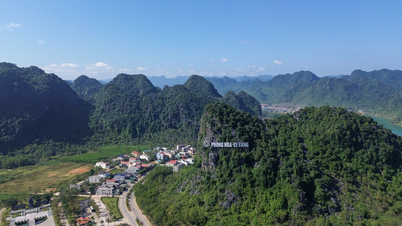
From the Xím Vàng commune headquarters, we chose motorbikes as our companions for the few kilometers we traveled towards the rocky area near Hang Chú village. The road wound across the mountains, with high mountains on one side and a sprawling valley on the other. The ancient rocky area, nestled among terraced rice fields, gradually emerged from the mist.
Mr. Mua A Cho, one of the oldest people in Hang Chu village, said: "I don't know how old this ancient rock formation is, but everyone in the village believes it's a sacred place, so everyone respects and protects it. The name Khe Ho rock formation comes from a story passed down through generations: The valley with the ancient rock formation carved with many characters and images used to be a very desolate and treacherous area. A large tiger often appeared here, hiding behind rocks and bushes to ambush animals and even people passing by, so no one dared to set foot here."
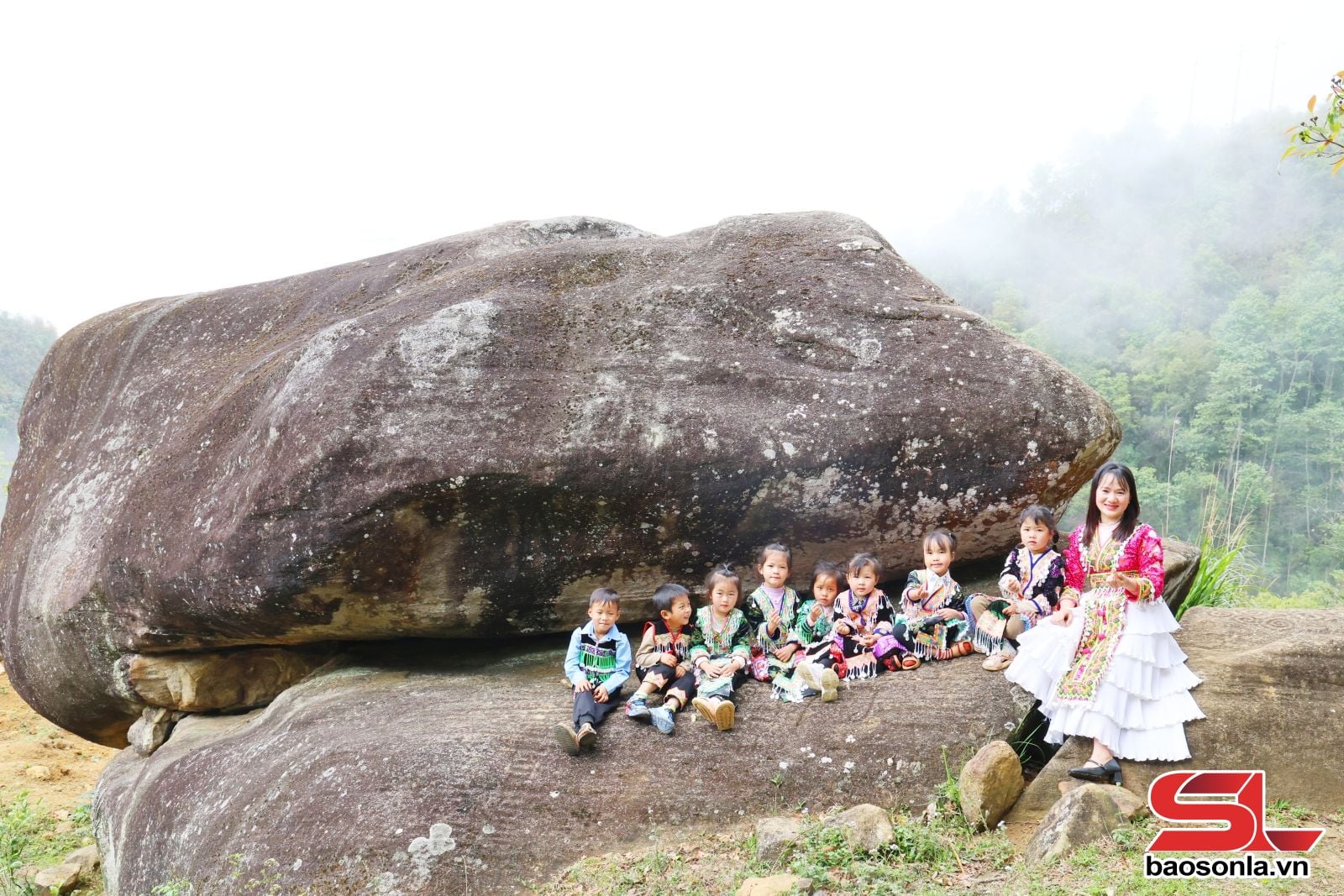
The ancient rock formations consist of nine granite blocks, arranged in six clusters spaced 50-200 meters apart, scattered from the mountaintop to the foot of the mountain. These blocks are roughly the same height, ranging from 1 to 1.5 meters, and about 1 meter wide, with many unusual shapes. Each slab bears carved characters and drawings that, to this day, scientists have been unable to fully explain.
Mr. Mua Pao Song, from Phinh Ho village, said: "When I was little, I heard my father tell stories about the existence of this stone site. The large and small stones are intricately carved, depicting natural scenes: mountains, hills, rivers, terraced fields. Some shapes resemble the sun, while others are drawn like stars, spirals, and wheels... all closely connected to the worldview and spiritual life of the local people. The villagers consider this a 'stone god,' and whenever they face difficulties in their work or have a bad harvest, they come here to pray for peace, good fortune, and success. The ancient stone site is like a protective deity, giving the villagers faith in its protection of their lives."

Over time, despite the erosive challenges of sun and rain, these drawings have remained intact, without fading. With its exceptional historical and cultural value, after being discovered in 2004, the Khe Ho ancient rock carving site was granted National Monument status by the Ministry of Culture, Sports and Tourism in 2015.
Mr. Ngo Van Huynh, Vice Chairman of the People's Committee of Xim Vang commune, informed: Recognizing the potential for tourism development, the commune has reviewed and developed a general plan for Xim Vang commune until 2045 to create a sustainable development space. Along with that, the commune actively promotes and disseminates the value of the Khe Ho ancient rock carving site to raise awareness and responsibility of the community in protecting and promoting the heritage value. The commune is promoting social resources to gradually improve the infrastructure and facilities serving tourism; encouraging households to open more homestay services, food services, traditional costume rentals, and motorbike taxi services to serve the sightseeing and experiential needs of tourists.

In 2025, the "Returning to the Ancient Stone Land of Hang Chu Commune" festival will be held for the first time, featuring many experiential activities and explorations of the unique carvings on the ancient rock formations of Khe Ho, attracting a large number of visitors from all over. In particular, Hang Chu Semi-Boarding Ethnic Minority Secondary School organized a painting activity for its students with the theme "Returning to the Ancient Stone Land." This is a meaningful visual heritage education activity, helping the younger generation gain a deeper understanding of the history and culture of their homeland.




The ancient rock formations of Khe Ho are witnesses to the past, a "stone book" left behind by our ancestors. With the right steps taken by Xim Vang to preserve and promote the value of this heritage, it will become an attractive tourist destination, boosting the socio-economic development of the locality.
Source: https://baosonla.vn/du-lich/ky-bi-bai-da-khac-co-khe-ho-BRntc6xvg.html
![[Photo] "Hanoi Lotus Festival" honors the lotus flower that has been associated with Vietnam for thousands of years.](https://vphoto.vietnam.vn/thumb/1200x675/vietnam/resource/IMAGE/2026/06/27/1782516943048_sen-ha-noi-2026-minh-duy-1-jpg.webp)