

National Assembly Chairman Vuong Dinh Hue has just signed the certification of the amended Land Law and the amended Law on Credit Institutions.
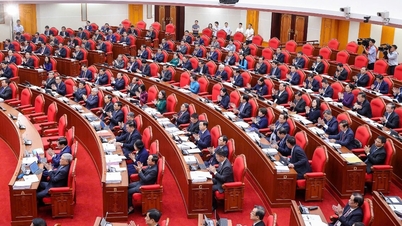
On January 18, 2024, at its 5th extraordinary session, the National Assembly voted to approve two draft laws.
This is the result of close coordination, careful and thorough preparation, and scientific approach, undertaken early and from afar, with the high efforts and determination of the Standing Committee of the National Assembly, the Government, the Vietnam Fatherland Front, the agencies of the National Assembly, National Assembly deputies, and relevant agencies and organizations; mobilizing all resources with a truly open-minded, listening, and democratic spirit; maximizing the wisdom and contributions of experts, scientists, the business community, voters, and the people nationwide; and serving as a valuable lesson in reforming thinking, working methods, and decisive action to further improve the quality and effectiveness of legislative work as well as other decisions of the National Assembly.
Following the session, in accordance with the Law on the Promulgation of Legal Documents, the relevant agencies conducted a technical review of the documents after their approval. National Assembly Chairman Vuong Dinh Hue signed and certified the legal documents as prescribed.
The Land Law of 2024, passed by the 15th National Assembly, aims to institutionalize Resolution No. 18-NQ/TW dated June 16, 2022, of the Central Committee on "continuing to innovate and improve institutions and policies, enhance the effectiveness and efficiency of land management and use, and create momentum to make Vietnam a developed country with high income."
The enactment of the Land Law is a key task in the orientation of perfecting land institutions and policies in line with the socialist-oriented market economy, with the goal of creating a legal framework for the economical, efficient, and sustainable management and use of land resources, maximizing land resources to meet the requirements of accelerating industrialization and modernization, ensuring national defense and security, protecting the environment, and adapting to climate change.
The 2024 Land Law comprises 16 chapters and 260 articles, focusing on perfecting regulations and policies regarding:
(1) Build a synchronous land use planning system at 3 levels; innovate the process, content, and methods of preparing land use plans and schemes.
(2) Land allocation, land lease, land use conversion; land allocation and land lease are mainly carried out through auction of land use rights and bidding for land-use projects; strictly regulate cases of land allocation and land lease without auction of land use rights or bidding for land-use projects; specifically regulate cases of land lease with one-time payment in accordance with the nature and purpose of land use, ensuring stable revenue.
(3) Authority, purpose, scope of land recovery, conditions, specific criteria for land recovery for socio-economic development for national and public benefit; compensation, support, resettlement, land recovery for national defense, security, socio-economic development for national and public benefit.
(4) Mechanisms for determining land prices according to market principles, inspection and supervision mechanisms of the Central Government and People's Councils in building land price tables...
(5) Land for ethnic minorities; land managed and used by agricultural and forestry companies.
(6) Issuance of Certificates of land use rights and ownership of houses attached to land.
(7) Multi-purpose land use regime; agricultural land combined with commerce and services; national defense and security land combined with labor production and economic construction activities; religious land combined with other purposes; multi-purpose water surface land; land reclamation activities...
(8) Decentralize authority to localities in land management and use in their areas, and at the same time establish mechanisms for supervision, inspection and auditing in central management through regulations on land information systems, centralized and unified land databases; promote administrative reform and digital transformation in the field of land management and use; ensure centralized and unified management, operation, connection and sharing of information from the central to local levels.

The Law on Credit Institutions of 2024 was passed by the 15th National Assembly at its 5th extraordinary session in a cautious and thorough manner, ensuring the restructuring of the credit institution system in accordance with the Party's guidelines and the National Assembly's resolutions; ensuring the principle of a socialist-oriented market economy; ensuring continuity; ensuring consistency within the legal system, conforming to accounting standards and international practices; strengthening the autonomy and accountability of credit institutions; increasing the resilience of the credit institution system; and strengthening banking inspection, examination, and supervision.
The law comprises 15 chapters and 210 articles, an increase of 5 chapters and 47 articles compared to the current Law on Credit Institutions, focusing on improving regulations and policies on:
(1) Organizing, governing, operating, and managing the risks of credit institutions; preventing and limiting manipulation and control of credit institution operations through regulations such as: strict standards and conditions for managers and executives of credit institutions; strengthening the duties and powers of the Board of Directors, Board of Members, and Supervisory Board of credit institutions; expanding regulations on related parties of some types of credit institutions, reducing the shareholding ratio of institutional shareholders of credit institutions, reducing credit limits according to a specific roadmap; strengthening information disclosure and transparency.
(2) The activities of credit institutions both meet the requirements for ensuring operational safety and create conditions for credit institutions to provide diverse products and services, including provision through electronic means; supplement regulations on controlled testing mechanisms in the banking sector.
(3) The organization and operation of policy banks aim to affirm their legal status and create conditions for the development of these banks.
(4) Handling weak credit institutions such as regulations on early intervention, special control, and special lending to credit institutions on the basis of enhancing the self-responsibility of credit institutions, ensuring the safety and soundness of the credit institution system.
(5) Handling bad debts and collateral assets on the basis of legalizing some appropriate contents in Resolution No. 42/2017/QH14 of the National Assembly.
(6) State management, inspection, examination and supervision in the banking sector.
(VNA)
Source




























































































Comment (0)