

Production linkages along the value chain ensure that participating economic entities share benefits and responsibilities, regulate market supply and demand, and create branded products with traceability. However, the number of such chains is still small, and maintaining and developing them faces many difficulties.
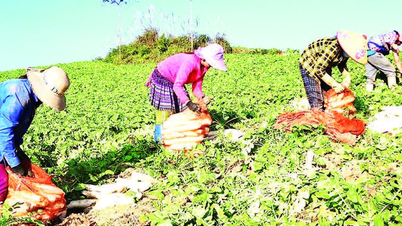
Each year, the entire province has approximately 10,000 hectares of rice, equivalent to about 7% of the cultivated area, under contract for product distribution and consumption.
Production linkage models along the value chain are formed based on large-scale farming, land consolidation, and the application of synchronized mechanization. However, the pace of building and developing existing agricultural production and consumption linkages in the province has not kept pace with its potential and strengths in terms of area and quantity of agricultural products. These linkages are primarily production linkages rather than value chains. Attracting businesses to participate in investment and linkage development in localities remains very limited. Although many concentrated production areas and large-scale farming fields have been established, regional organization and linkages are still limited, and there are not many investment projects to organize production linkages between regions.
The infrastructure of production areas and linkage models are not yet fully synchronized. The awareness of some farmers regarding supply chain linkages is limited, and they lack self-discipline in fulfilling their commitments to businesses. There are still instances of producers breaking their commitments and selling their produce elsewhere when market prices rise in order to gain a little extra profit.
As a business operating in the milling, processing, and trading of food products, Hung Cuc Co., Ltd. has created a closed-loop "four-party" linkage model (government, scientists , businesses, and farmers) from planting to processing and consumption, producing clean, high-quality rice for both domestic and export markets. However, the looseness in the linkage chain, specifically contract breaches, often from the farmers' side, has left the company lacking control over its raw material supply.
Mr. Ly Thai Hung, Director of the company, said: "As a food production and trading enterprise, we earnestly desire to establish strong links with cooperatives and farmers in rice production. However, farmers frequently break their agreements. They often chase prices; if market prices are higher at a certain time, they are willing to abandon the company and sell to traders."
Furthermore, maintaining production chains to prevent disruption among businesses and cooperatives is also difficult due to a lack of initiative and active participation from the people. Some households have not fully grasped the importance of chain linkages and compliance with the terms of linkage contracts; there is a lack of coordination with relevant units in adhering to technical standards during the planting, caring, protecting, harvesting, and preserving of agricultural and aquatic products, affecting product quality.
The Dong Xuyen Commune General Livestock Cooperative (Tien Hai District) is one of the few shining examples of new-style cooperatives, with two products – Dong Xuyen sea ducks and sea duck eggs – certified as OCOP products and widely sold throughout provinces and cities. The products not only demonstrate quality but also establish their value, consistently experiencing demand exceeding supply. While always striving to expand production and increase membership, according to Mr. Ngo Van Duan, Director of the Cooperative, not all livestock farmers meet the requirements.
“Farmers still prioritize quantity and short-term profits. With the VietGAHP farming process, the cooperative's products must ensure no antibiotic residue and no growth hormones. While traditional farming takes only 1.5-2 months per batch of ducks, farming according to the cooperative's process takes 3-4 months. The cost of raising ducks is higher, and the rearing time is longer, but in return, it produces clean products with a high and stable selling price. Therefore, the cooperative only accepts and collaborates with farmers who truly understand and strictly adhere to the VietGAHP farming process to ensure the quality of products bearing the Dong Xuyen sea duck and sea duck egg brand,” Mr. Duan said.
Furthermore, some localities have not focused on land consolidation and concentration for large-scale agricultural production, attracting businesses to invest in production linkages, product distribution, and the formation of raw material areas to serve production and processing. In addition, the capacity of cooperatives in management skills, production planning, and market connectivity to act as intermediaries between farmers and businesses still has many limitations and shortcomings.
With the orientation of transforming agricultural production development towards a sustainable, circular, green, and sustainable agricultural economy built upon existing foundations, comprehensive investment is required, encompassing infrastructure, technology, human resources, production processes, production management, market issues, and brand building and development. Therefore, the formation and development of integrated supply chains are essential.

ThaiBinh Seed is one of the few businesses that has maintained a large-scale and sustainable rice production linkage.
(to be continued)
Ngan Huyen
Source

















































Comment (0)