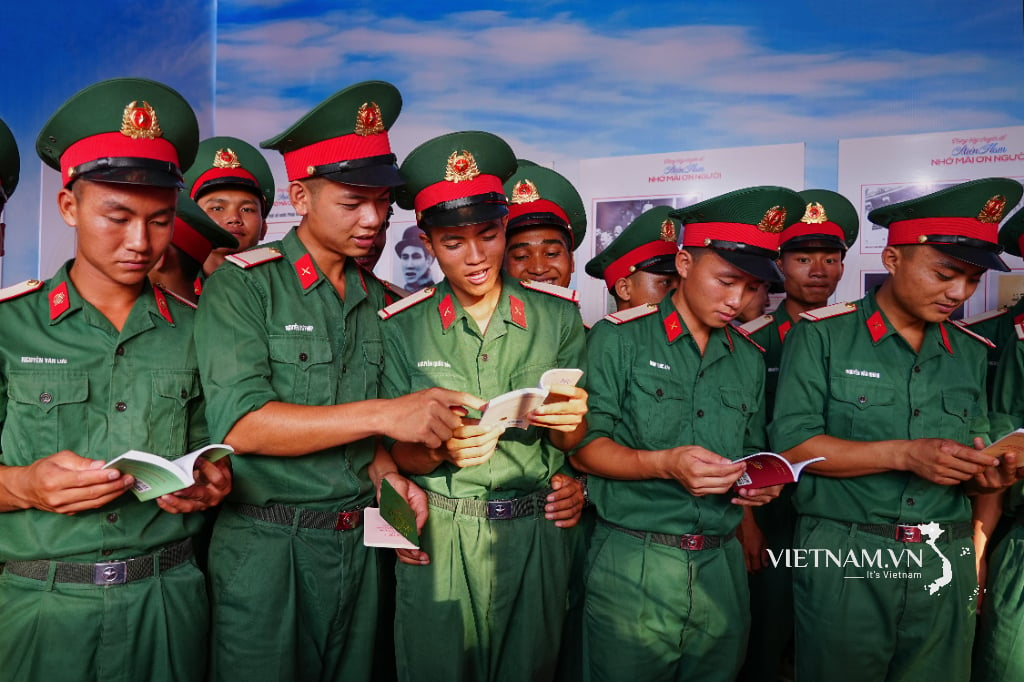
1958 – the year of the first mobilization: Eighty thousand of our officers and soldiers left the army to return to the fields, to factories, and to ordinary life. At the same time, this was also the peak period of military training aimed at building a regular, modern army.
Although called a plantation, the Dien Bien Phu basin was still littered with landmines. The engineering troops continued to clear and destroy them, and occasionally the sound of exploding mines could still be heard; the atmosphere of the battle seemed to linger somewhere… On the summit of Hill A1, two graves of unknown soldiers and a tank with its barrel broken lay amidst a wild area of dense green vegetation, so dark it was almost black… the land steeped in sacrifice was still evident even though the campaign had ended four years ago! Climbing the steps to the hilltop, remembering so many fallen comrades, I was moved to write a few lines in my diary, inspired by the melodies of the Nghe Tinh folk songs:
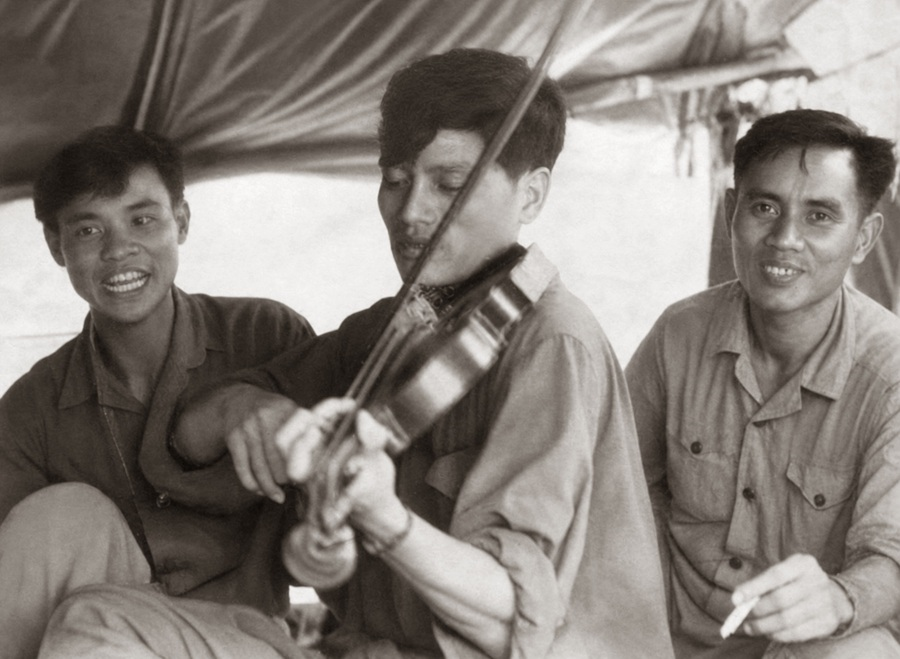 |
| Artist Doãn Nho (center) in Sam Neua (Laos) in 1966. |
From the top of Hill A1, looking across the road, we could see the hill where our troops assembled before the attack. At the foot of the hill was the barracks, where every morning the platoons, in neat rows, marched in unison along the road leading across the Muong Thanh bridge to the training ground. Only a few experienced, seasoned faces remained in the ranks – the core officers from platoon deputy upwards who stayed behind to build the unit. The rest were all new recruits with bright, innocent eyes and cheeks full of downy hair. This very image inspired me to compose the song "Marching Under the Military Banner," which uses two contrasting melodic elements in succession to express how the younger generations, succeeding the older generations, uphold the glorious and victorious traditions of our Army.
Thanks to the melancholic and majestic tone of the diary-style music, I was able to complete the middle section first, with the intention of portraying the image of soldiers who had experienced combat:


From there, I rewrote the opening section with bright, cheerful music to portray the faces of the young, newly enlisted soldiers:



Thus, the song took shape during my reconnaissance trip; when the Army Song and Dance Troupe of the General Political Department arrived, the song was promptly arranged, and the male members of the troupe performed it for the first time right on the historic land of Dien Bien.
I am delighted to contribute a march that follows the previous ones: "Through the Northwest" by Nguyen Thanh; "Victory at Dien Bien Phu" and "Long March" by Do Nhuan… If those marches carried the spirit of the anti-French resistance era, then "Marching Under the Military Banner" bears the mark of a period when our Army has matured and is progressing towards regularization and modernization.
Later, every time I heard my song playing during parades on major holidays, I was deeply moved and felt as if I was seeing again the image of the entire Dien Bien Phu region, where so many of my heroic comrades had laid down their lives so that today, the resounding footsteps of those marching through the historic Ba Dinh Square could exist…
Source: https://www.qdnd.vn/van-hoa/doi-song/ky-niem-khong-the-quen-1044495