

|
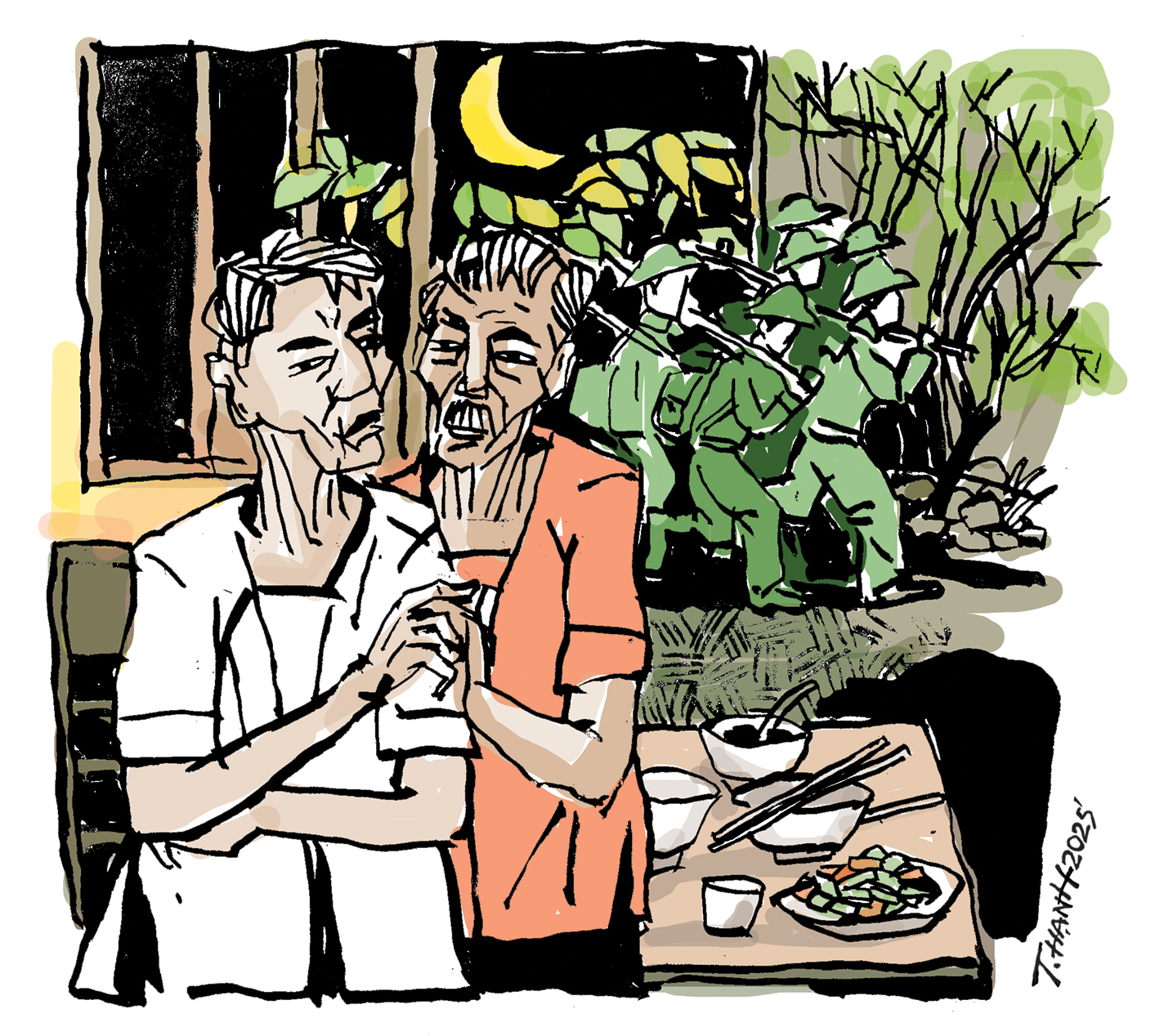
He vaguely noticed that Mr. Nhân was thinner than before… Mr. Hữu thought, well, that’s normal, he’s almost a hundred years old! The same sleeve of his shirt hung loosely, as it was the same day because he had lost his left arm. Mr. Nhân approached the head of the bed and gently shook him, using the hand of his remaining arm: “I’m going home, nephew.” He woke up, startled. Then he got up, turned on the light, and brewed a pot of Tân Cương tea… Mr. Hữu muttered to himself: “Let’s do it!”
The Spring of 1975, the Year of the Rabbit, also held many unusual occurrences. It was only the end of January, yet there were already torrential rains and thunderous lightning. The elders said that year was associated with the element Water – specifically, Great Stream Water (a large body of water in a large stream). In the five elements: Metal, Wood, Water, Fire, and Earth, those with this element are said to be flexible, adaptable, and easily able to respond to circumstances. The country was the same; every Year of the Rabbit brought miracles.
Mr. Huu's hometown is right at the foot of the Tam Dao mountain range, on the eastern slope of Thai Nguyen province, with three towering peaks clearly visible, the highest reaching 1,143 meters, seven or eight kilometers from the district center. The district's high school is located in the center, and graduating students board near the school to save time commuting.
Mr. Nhân's house was a few kilometers from the old school, making it convenient for the students to stay there while studying and preparing for exams. That year, Đồng Chũng village was as poor as most Vietnamese villages. The only difference was that despite their poverty, they were incredibly kind and compassionate. Mr. and Mrs. Nhân and Thanh had seven or eight children in quick succession, resulting in a large and impoverished family. Fortunately, thanks to the Công River flowing behind the village and the fertile fields in front, Đồng Chũng was better off than other villages…
During the previous resistance against the French, this area was nothing short of a battlefield, but during the war against the Americans, it was practically a war zone. During the years when the Americans were bombing North Vietnam, enemy planes from bases in Thailand would fly low over the summit of Quạt Nan mountain, then fly very low below Tam Đảo mountain to avoid radar, quickly dropping bombs before frantically flying back. Because of this, countless enemy planes were intercepted, burned, and shot down by our air force and missiles. As a result, Đại Từ became a target for the American air force. During those years, this area served as a evacuation point for many military units and agencies for training and intercepting American aircraft. The summit of Quạt Nan also witnessed the heroic sacrifice of our air force. On April 30, 1971, a MiG-21U aircraft piloted by a Soviet instructor named Yuri Poyarkov and a young Vietnamese pilot named Công Phương Thảo perished on the mountaintop…
In March 1975, we began major battles on the Southern battlefield. The Voice of Vietnam radio station continuously broadcast war news. Mr. Huu's family wasn't well-off at the time, but they had an Oriongtong radio with excellent reception. Mr. Nhan suggested bringing it to their boarding house so everyone could listen. So, every evening, Mr. Huu and his nephews would spread out mats on the porch to listen to the news.
Mr. Nhân, who had never left his village of Đồng Chũng his entire life, was able to understand the course of the war as explained by his student Hữu: "Our opening of the campaign from the Central Highlands was perfectly accurate, sir. Military strategists have said that whoever controls the Central Highlands will control the entire coastal strip… The enemy was caught by surprise in Buôn Ma Thuột, falling right into our trap… The enemy abandoned the Central Highlands and fled, sir. Nguyễn Văn Thiệu declared he could evacuate at his discretion… Huế and Đà Nẵng have been liberated… Patriotic pilot Nguyễn Thành Trung flew enemy planes and dropped bombs on the Independence Palace. The reports and narratives by Cao Tiến Lê, Ngọc Đản, Vĩnh Quang Lê, Hoàng Nhuận Cầm captivated listeners… The song "The Road We Take" by Huy Du, performed by Doãn Tần, was incredibly stirring…"
On the morning of April 30th, Mr. Huu still went to class. At noon, he cycled back to Dong Trung. Mr. Nhan went to the field at the edge of the village, and as soon as he saw Huu, he shouted loudly: "Saigon has been liberated! We've won!" On the afternoon of May 8th, 1975, Mrs. Thanh, Mr. Nhan's wife, returned from the market and told the boarding students: "Tomorrow, the commune and district are holding a rally to celebrate the victory. The cooperative will slaughter a pig, and each person will receive 300 grams. We invite you all to eat."
Around 11 a.m. on the 9th, Mrs. Thanh brought the meat home. She said everyone was scrambling to get the fat to eat sparingly. She took two and a half kilograms of pork belly and pork leg. She said, "Why not? Let's roast it and celebrate to our heart's content…" The meal was served on two wooden trays placed on two double mats. A few days before, there had been a rain shower, so the water spinach was fresh and green. Since there was fat, Mrs. Thanh made both boiled water spinach and stir-fried water spinach with garlic. She had planted a plot of old six-month rice variety called "Du," which has a low yield but incredibly fragrant and delicious rice. Since there was meat, she milled a basketful of rice the night before. She sliced the pork into small pieces, marinated it with Tan Viet Hoa soy sauce, and roasted it in a cast-iron pan, serving two bowls at each tray. Mr. Nhan solemnly declared the victory celebration began, taking out a bottle of his long-saved "Ngu Da Bi" rice wine…
As the rear base of the resistance against the Americans, the people of Hung Son, like all other localities in the North at that time, participated in many things simultaneously. They raised their children to be healthy enough to enlist and fight; they directly fought against the American war of destruction; and they increased production to supply food and provisions to the battlefield. Movements like "Three Ready, Three Responsible," and "Not a single grain of rice is lacking, not a single soldier is lacking," were born. Mr. Nhan said: Contributing as much pig and rice as possible to the State is a sacred duty and responsibility to the Fatherland. And, Mr. Huu said: We ate a delicious meal and said we would never have anything so delicious again.
That night he muttered, "Let's do it!" He probably meant that this May, on the 50th anniversary of reunification, he would return to Dong Chung and prepare a meal exactly like the one celebrating the victory all those years ago. It would simply be a celebration of memory, nostalgia, and gratitude.
The next morning, Nguyen Duy Ke posted on Facebook: "Farewell, father, grandfather of the children…" Before the coffin of the 98-year-old man, Mr. Huu murmured: "Farewell, grandfather, a pure and quiet farmer who contributed to the nation's victory through his hard work and the beautiful memories of his descendants."
Source: https://baothainguyen.vn/van-hoa/van-hoc-nghe-thuat/202503/ky-uc-bua-com-mung-chien-thang-4090540/


![OCOP during Tet season: [Part 3] Ultra-thin rice paper takes off.](/_next/image?url=https%3A%2F%2Fvphoto.vietnam.vn%2Fthumb%2F402x226%2Fvietnam%2Fresource%2FIMAGE%2F2026%2F01%2F28%2F1769562783429_004-194121_651-081010.jpeg&w=3840&q=75)


Comment (0)