The year 2025 unfolded amidst a mixed international landscape, with more negative than positive developments. The three main positive aspects were: the global economy did not decline, maintaining growth nearly at the same level as the previous year (3.2%), and this momentum is likely to continue into the following year, with economies showing increasing resilience; inflation continued to fall, interest rates decreased, stimulating investment, consumption, production, and business; and the trends of greening, digitalization, energy transition, institutional reform, and infrastructure investment continued to be promoted, although some governments changed their approach to green transition.
However, 2025 will also be a year full of events with geopolitical conflicts, strategic competition in trade and technology, increased protectionism and trade tariffs; slower growth in some economies (such as the US, China, and some European countries); increased risks to energy security, supply chain security, cybersecurity and data security, and economic and technological crimes; volatile exchange rates, gold prices, and cryptocurrency prices; climate change, and unusual natural disasters… In 2026, these risks are predicted to remain present and unpredictable, bringing both opportunities and challenges that are even clearer for deeply integrated countries like Vietnam.
Domestically, many "impressive" results have been achieved amidst numerous external risks and challenges, as well as internal changes. The first bright spot is the decisive breakthrough by the Party and State leadership in institutional reform, streamlining organizational structures, merging ministries and departments, provinces and cities, and operating a two-tiered local government model, which has been supported and anticipated by the people and businesses.
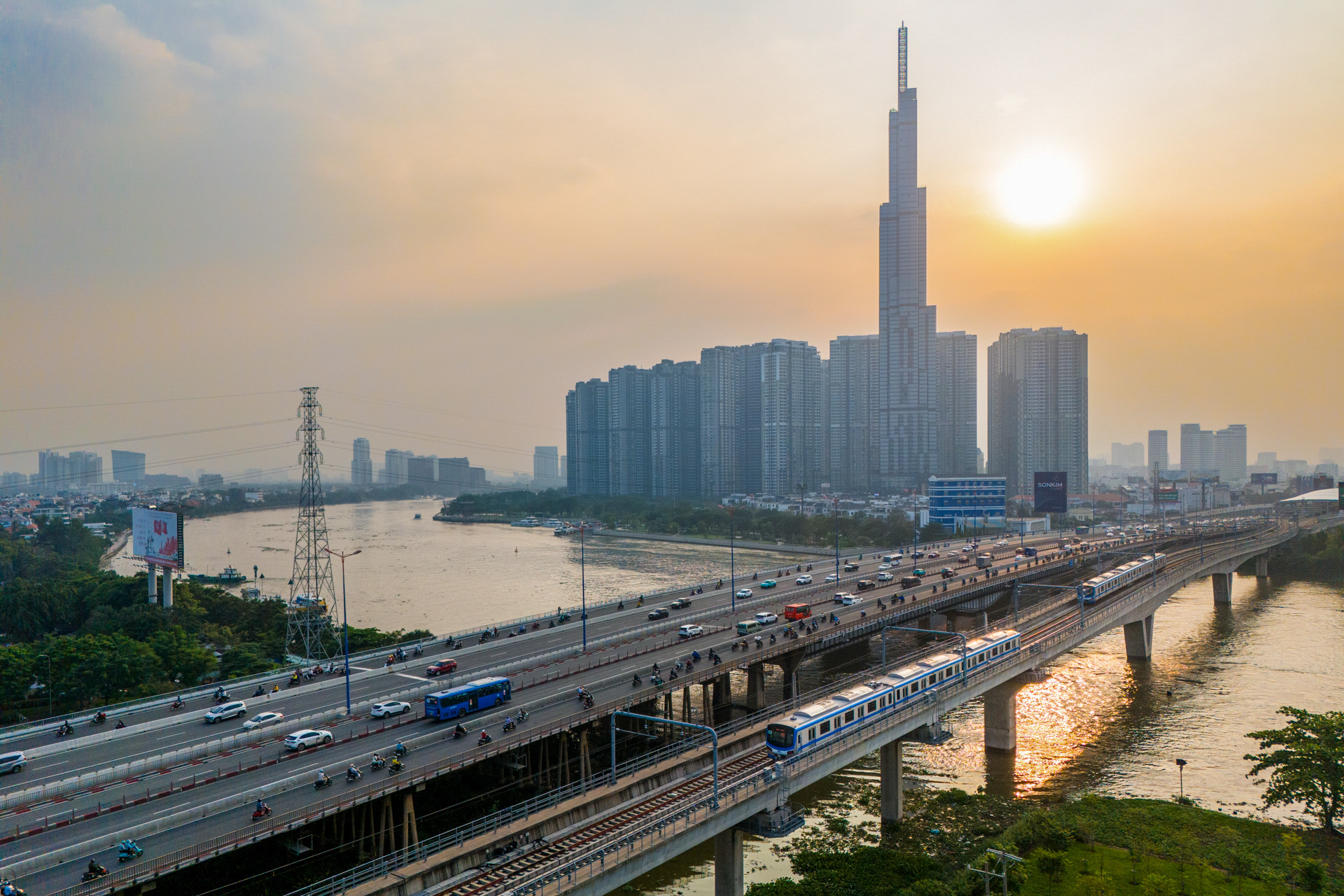
We expect successful "breakthrough" efforts in the new year and beyond. Photo: Hoang Ha
Many groundbreaking mechanisms and policies in key areas (science and technology, international integration, institutional reform, private sector development, energy security, education and training reform, and healthcare, along with many specific mechanisms for some major provinces and cities…) have been issued, creating a solid political foundation for future development goals.
Fiscal policies (tax and fee deferrals and reductions), monetary policies (interest rate stabilization, debt restructuring, increased access to credit, exchange rate stabilization, gold market stabilization, etc.) were enacted. Many important laws and specific resolutions were passed by the National Assembly, aiming to address bottlenecks while fostering development. These decisions contributed to supporting people and businesses, overcoming unprecedented storms and floods, stimulating demand to create momentum for economic recovery, and laying the legal foundation for faster, more sustainable, and inclusive development in the future. As a result, the economy recovered strongly, with growth in each subsequent quarter exceeding the previous one, estimated at around 8% for the whole year, and striving to reach over 10% in 2026 and the entire 2026-2030 period, amidst global uncertainty and slowing growth as mentioned above.
Vietnam's macroeconomic situation is fundamentally stable, with inflation under control (around 3.4%), stable benchmark interest rates (although recently rising), exchange rates and bad debts under control, major balances (trade, budget revenue and expenditure, savings and investment, budget deficit, public debt, foreign debt, government debt repayment obligations, etc.), social welfare, food security, and energy security ensured at safe levels and lower than comparable countries.
The private sector, public investment, FDI attraction, and export market diversification are being actively promoted. The application of science and technology, digital transformation, green economy, circular economy, and energy transition are being accelerated. Many high-tech projects (including electronics, semiconductors, artificial intelligence, data, etc.) are being attracted; cashless payments are increasing rapidly; green finance and green production and consumption are receiving more attention; the revised Power Development Plan VIII has been issued, contributing to ensuring energy security and gradually greening the energy sector. International financial centers, free trade zones, cryptocurrency markets, and carbon markets have been established; and the stock market has been upgraded. These will be traditional and new growth drivers, creating momentum for faster and more sustainable development in the future.
Business activity has shown a clear recovery, albeit unevenly and with many challenges remaining. The ratio of businesses exiting the market to the number of businesses entering the market decreased from 1.23 times in Q1 2024 to nearly 0.75 times at the end of 2025.
Budget revenue achieved positive results, reaching 130% of the projected target, an estimated increase of 17%, reflecting the recovery momentum of exports and imports, production and consumption, as well as the diversification of revenue sources, in the context of continued expansionary fiscal policy with targeted support; creating room for the implementation of expansionary fiscal policy and serving the ongoing salary reform, education and training reform, and healthcare reform.
Foreign relations and international integration have yielded many important results, including numerous high-level visits, the upgrading of comprehensive strategic partnerships with many major countries, the implementation and negotiation of new free trade agreements (FTAs), and the deepening of cooperative relations with many other partners.
However, the economy still faces many difficulties and challenges. Firstly, the growth drivers are not recovering strongly and are unevenly distributed. Goods exports are slowing down (monthly declines from August 2025 to the present, mainly due to the impact of the new US tariff policies), and the proportion of goods exports from the domestic economic sector continues to decrease (from 28% at the end of 2024 to 23.2% at the end of 2025), while this proportion from the FDI sector has increased correspondingly. Public investment disbursement remains slow.
By the end of December 2025, the nationwide disbursement rate is estimated to reach nearly 80% of the plan, and by the end of January 2025 it could reach 95%, still far from the target of 100%. Private investment increased by about 8.5%, recovering from the 7% increase of the previous year, but still quite low compared to the 15-17% increase before the Covid-19 pandemic.
Final consumption is estimated to increase by 8%, recovering from the 7% increase in 2024, but retail sales are still only at 80% of pre-Covid-19 levels, demonstrating weak investment and consumption demand. Non-performing loans increased slightly despite policies to postpone and restructure debt, showing that businesses and borrowers still face many difficulties, uneven recovery, and negative impacts (including the consequences of the three historic typhoons this year).
The real estate market is recovering but lacks sustainability; property prices are high, and supply and demand remain imbalanced; interest rates are trending upwards (liquidity in the banking system is shrinking due to rapid credit growth of 18.5% compared to only 14.5% in deposit mobilization, as other investment channels are more attractive); exchange rates and the gold market are more volatile; and the room for monetary policy is narrowing. The restructuring process of state-owned enterprises and weak credit institutions is still slow compared to requirements.
Government revenue is not yet truly sustainable, with over 20% of revenue coming from real estate (even reaching 25% in the 2026 budget forecast). These factors necessitate our utmost attention to ensuring macroeconomic stability and accelerating the restructuring of the economy and state budget in the context of high growth.
Another challenge is the inadequate quality of institutions, laws, and enforcement, as numerous regulations are issued simultaneously, making it difficult to keep up with guidance and implementation. Operating a two-tiered local government model and transforming the business model of household enterprises still face obstacles.
The quality of growth is not yet high, although labor productivity is estimated to increase by 6.8% in 2025 (up from 5.5% in the previous year), but this increase is uneven. The ICOR coefficient remains high (in absolute terms, at 5 times), indicating that investment efficiency needs improvement. The self-reliance and self-sufficiency of the economy are still modest, with the average localization rate across industries and sectors only reaching about 36.6%.
As 2026 approaches, the global economy is projected to face a mix of opportunities and challenges, but risks and uncertainties are increasing, negatively impacting Vietnam's exports, investment attraction, and energy transition, along with many of the aforementioned internal challenges. Vietnam aims for a growth rate of 10% or higher and an inflation rate of around 4.5%. These are very challenging targets in the context of continuing reforms, combating waste, unlocking resources, and promoting socio-economic development at a much higher level than in 2025, creating momentum for double-digit growth throughout the 2026-2030 period.
However, citizens and businesses have the right to expect breakthroughs, provided certain conditions are met. First, there needs to be unwavering and decisive action in the ongoing vigorous reforms, including breakthroughs in institutions, streamlining of organizations and administrative structures, and the operation of two-tiered local governments, all of which must be linked to salary reform and organizational and personnel management.
Next, there needs to be greater effectiveness in the implementation of mechanisms, policies, and laws that have been issued; a decisive and substantive improvement in the investment and business environment, especially the quality and efficiency of public service delivery at all levels.
Innovating the growth model (shifting from a greater reliance on capital and labor to a greater reliance on science and technology, digital transformation, reform, and productivity enhancement); promoting traditional growth drivers while better leveraging new growth drivers, especially those stemming from strategic resolutions that have been and will be issued. These policies and solutions, if implemented effectively, will undoubtedly contribute to boosting economic growth, both quantitatively and qualitatively.
We must remain steadfast in our goal of macroeconomic stability, accelerate the dual transformation process (green and digital), energy transition, and proactively build capacity to adapt to climate change and natural disasters. We must decisively address the remaining weak businesses and credit institutions; there can be no further delay, as these are "blood clots" that lead to inefficient resource allocation and costly expenditures.
Focus on restructuring public investment (currently 80% of public investment is allocated to infrastructure, while investment in science and technology, education, and healthcare remains very modest) and restructuring the state budget towards diversifying revenue sources and reducing dependence on land and housing.
Stabilize housing prices and create a healthy real estate market; vigorously reform the financial market, increase mobilization of resources from the capital market, reduce pressure on bank credit, diversify other capital mobilization channels, and pay more attention to the efficient allocation and use of resources. Develop and consistently implement a plan to enhance the self-reliance, self-sufficiency, and self-strength of the economy and strategic sectors and fields.
All these policy decisions have been implemented and have yielded initial results. Therefore, we have reason to expect successful "breakthrough" efforts in the new year and beyond.
Vietnamnet.vn
Source: https://vietnamnet.vn/ky-vong-but-pha-2026-2478332.html


![[Image] "Journey of Hope" promotes the organ and tissue donation movement in Vietnam.](https://vphoto.vietnam.vn/thumb/1200x675/vietnam/resource/IMAGE/2026/05/20/1779294400833_1-8910-jpg.webp)




















































































Comment (0)