

Following Hanoi 's decision to demolish the "Shark's Jaw" building and relocate approximately 10 government offices and 40 households to expand the space around Hoan Kiem Lake (also known as Sword Lake), many citizens, experts, architects, cultural figures, and historians have expressed support and hope that the cultural space in the heart of Hanoi will have a new, more beautiful appearance.
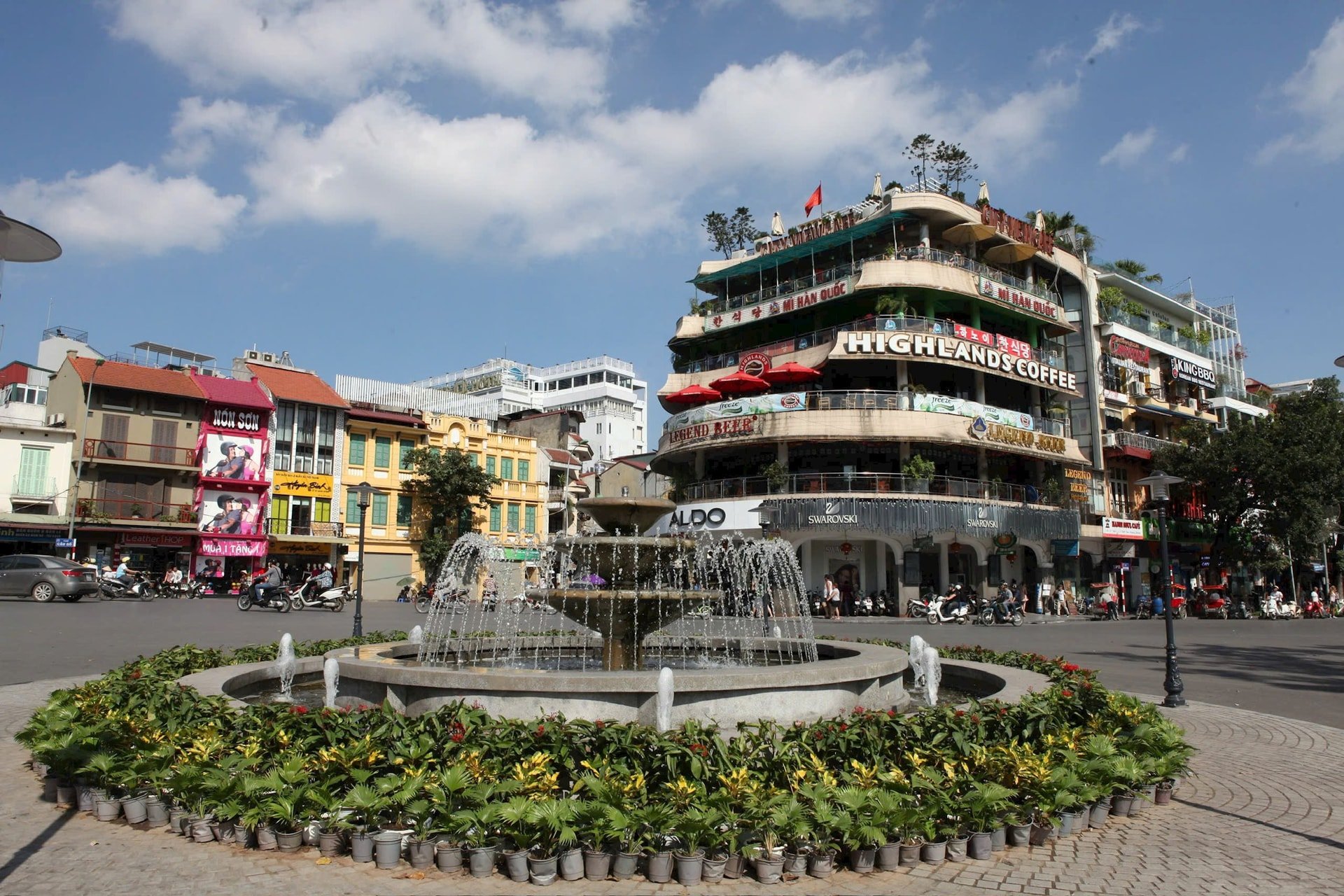
The Hanoi People's Committee's approval of the proposal to demolish the "Shark's Jaw" building and construct an underground space in the existing square area to expand cultural and community development space around Ho Guom Lake has received much support, especially from residents living around the Old Quarter. Experts believe this is an opportunity to systematically re-plan the area around Ho Guom Lake, not only to expand the space but also to enhance the landscape of Dong Kinh Nghia Thuc Square.
From the very beginning, the building was in the wrong place.
By 2025, the commercial building at 7 Dinh Tien Hoang Street, Hang Bac Ward, Hoan Kiem District (also known as the "Shark's Jaw") will be 32 years old. According to the 1950 map of Hanoi, the current location of the "Shark's Jaw" building was an empty plot of land within the space of Dong Kinh Nghia Thuc Square and the Dinh Liet street axis leading directly to Hoan Kiem Lake.
Construction on this building began in 1991 and was completed in 1993. It has six floors primarily dedicated to restaurants and cafes. The "Shark's Jaw" building is located in what could be considered one of the most prime locations in the capital, with the front facing Dong Kinh Nghia Thuc Square and the left side overlooking Ho Guom Lake. From the third floor, one can enjoy panoramic views of Ho Guom Lake, including The Huc Bridge, Turtle Tower, and the Ho Guom Post Office .
According to architect Tran Huy Anh, a member of the Standing Committee of the Hanoi Architects Association, the original design, intended as a metaphor for "The Moon and the Kite," was created by architect Ta Xuan Van. However, after the rough construction was completed, the building was dubbed "The Shark's Jaw" by the public. According to Mr. Anh, construction was then halted and handed over to another architect for revisions and additions. Currently, the building has changed significantly from the original design, lacking the graceful and refined features of architect Ta Xuan Van's original work.
According to architect Trinh Phuong Quan, the building was altered when the investor decided to expand the area and modify the original design. This intervention not only destroyed the original concept but also turned the building into a controversial symbol.
Researcher Nguyen Ngoc Tien also shares this view, arguing that the "Shark's Jaw" building should not have been built in that location. When construction of this building began, it provoked a strong reaction from experts. The opposition wasn't primarily about the architecture, but mainly because the building blocked the view between the Old Quarter and Ho Guom Lake, hindering traffic flow between the two areas.
"Previously, from Cau Go Street and Dinh Liet Street, people could see directly out to Ho Guom Lake, but then this building sprung up like an oppressive wall, blocking the view," Mr. Tien said.
Visual adverse effects
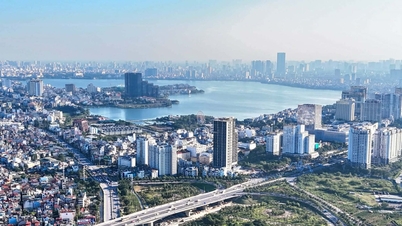
Sharing with reporters, Dr. Architect Nguyen Quoc Tuan - Vietnam Architects Association, said that looking at the two photos of the overall space of Ho Guom Lake taken in 1950 and more than 70 years later - in 2025, we see that Ho Guom Lake is becoming increasingly crowded and densely covered with concrete. The charm of Ho Guom Lake comes from the rows of green trees gently curving along the lake's edge, to the low-rise houses with undulating tiled roofs that are in harmonious proportion with the road and the distance to the lake's edge... All these well-proportioned elements have created the poetic, romantic, cultural beauty and landscape of one of Hanoi's most important public spaces.
“We cannot force cities to stand still, because the nature of a city is that of a ‘living’ entity, always moving and changing. However, this change needs to be harmonious, balancing the old and the new, preserving and developing. The ‘Shark’s Jaw’ building may be a specific example of urban development that does not enhance the beauty of a space that desperately needs to be cherished and protected, like Ho Guom Lake. Although this building was constructed at the time to meet the needs of tourism and commercial infrastructure development, it has had the opposite effect visually,” Mr. Tuan expressed.
Some architects also argue that, despite numerous subsequent renovation efforts, the problem remains unresolved because the structure was in the wrong location from the beginning. Therefore, according to architect Tran Huy Anh, after more than 30 years of existence, demolition is a reasonable and fitting end to begin a new chapter, renovating the architectural landscape of Dong Kinh Nghia Thuc Square; expanding the cultural, historical, and economic space around Hoan Kiem Lake.
From a historical perspective, historian Duong Trung Quoc argues that, in the 1990s, the "Shark's Jaw" building was one of the first architectural works built after the Doi Moi (Renovation) period. "However, upon completion, the building faced public backlash, including from myself and several historians and architects. This was because, for the first time, a construction project significantly impacted the landscape and space around Ho Guom Lake. The construction of many high-rise buildings would turn Ho Guom Lake into a 'pond'."
According to Mr. Duong Trung Quoc, demolishing the "Shark's Jaw" building would create a larger space for the landscape of Dong Kinh Nghia Thuc Square in particular and Hoan Kiem Lake in general. This is especially true when we utilize the depth of the underground structure to increase the space and functionality of this area.
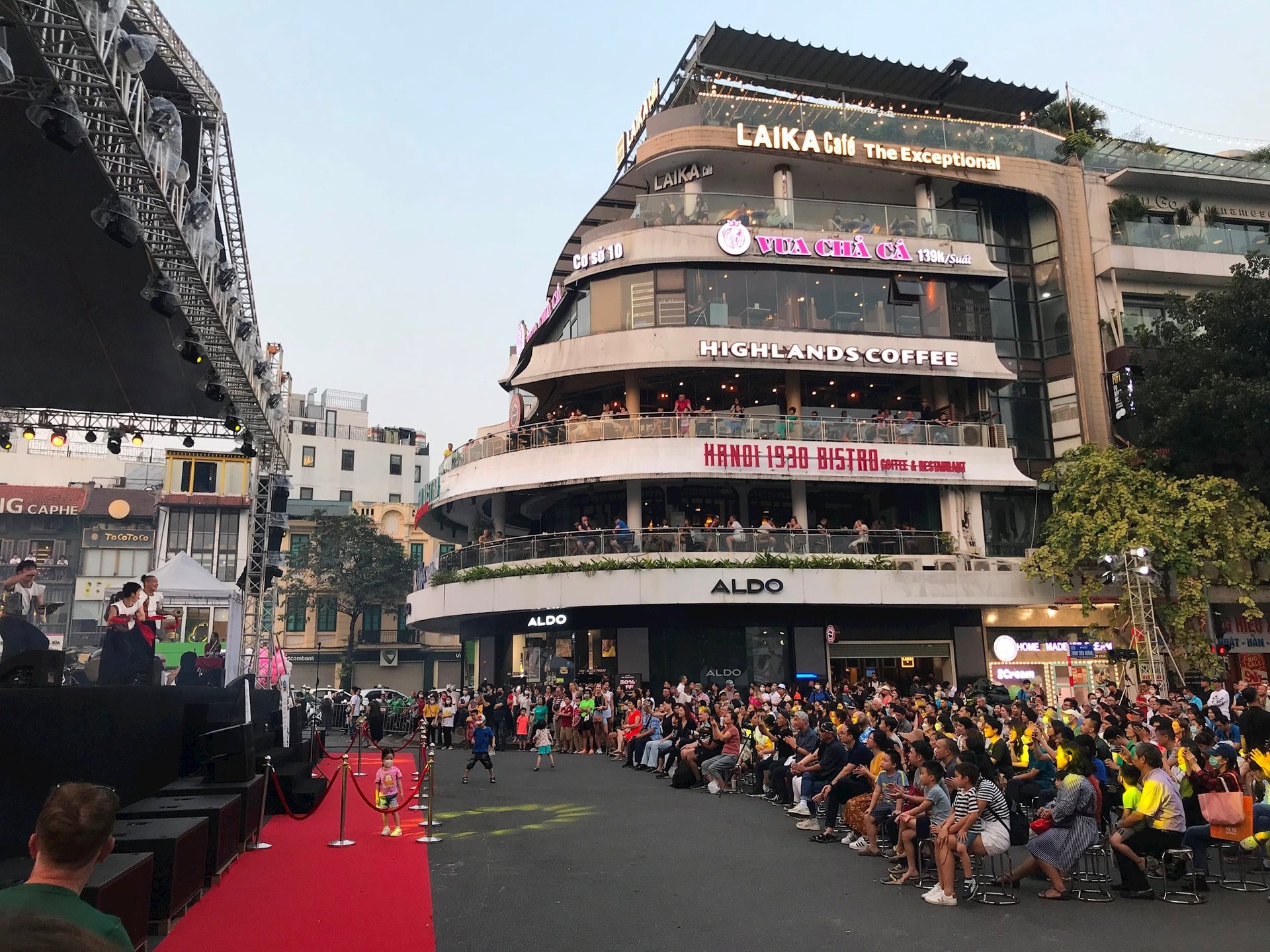
Hoan Kiem Lake will have a new look.
According to researcher Nguyen Ngoc Tien, Hanoi's decision to demolish the "Shark's Jaw" building was a correct one. After the demolition, Dong Kinh Nghia Thuc Square should be expanded, restoring the space to its original state. Absolutely no further construction should take place there, as it would detract from the graceful beauty of Ho Guom Lake.
"Everyone knows that preservation and development are contradictory; not everything ancient is valuable. But things that are valuable need to be carefully considered during the planning process—what to preserve and what not to preserve. The 'Shark's Jaw' building is a prime example of this. A balance between preservation and development must be ensured," Mr. Tien shared.
Sharing his views on this matter, Professor Vu Minh Giang, Vice President of the Vietnam Historical Science Association and member of the National Cultural Heritage Council, stated that Ho Guom Lake is a symbol of the culture and history of the capital city. In the hearts of many, wherever they go, they remember Hanoi and Ho Guom Lake. Therefore, any architectural project that poses a risk to the landscape must be constructed with utmost caution.
Professor Vu Minh Giang also believes that the "Shark's Jaw" building is unsightly and spoils the landscape of Ho Guom Lake, therefore the decision to demolish the building is entirely correct. However, what needs to be done after demolition is crucial. For urban planning in the capital, thorough research is needed, not just on architecture, but also on history and culture.
Architect Dr. Nguyen Quoc Tuan also expressed that Hanoi's approval of the plan to demolish the "Shark's Jaw" building is very welcome. He added that the city should review other areas around Ho Guom Lake and neighboring neighborhoods to expand public spaces, connecting spaces, cultural spaces, and spaces that represent Hanoi.
"Of course, alongside expanding the space around Ho Guom Lake, I hope that the cultural dimensions and the essence of Thang Long - Hanoi will also be promoted and developed accordingly," Mr. Tuan emphasized.
According to Mr. Nguyen Trong Ky Anh, Director of the Hanoi Department of Planning and Architecture, demolishing the "Shark's Jaw" building and integrating it with the surrounding streets will create a spacious area for cultural and artistic activities during major commemorative events. The area east of Ho Guom Lake and Dong Kinh Nghia Thuc Square is interconnected, so creating a space that links historical landmarks and waterfront areas such as Ho Guom Lake, Ngoc Son Temple, the Pen Tower, and Ba Kieu Temple would be very beneficial for the capital city.

Detailed planning is needed, along with input from the people.
Architect Pham Thanh Tung, Chief of the Office of the Vietnam Association of Architects, believes that this building is not a heritage site and therefore will not be governed by the Heritage Law. Demolishing the "Shark's Jaw" building is a correct policy, contributing to changing the urban landscape of the capital and making Hanoi more beautiful. However, I believe that after demolishing the "Shark's Jaw" building, the authorities need to have a detailed plan, organize a public exhibition, and widely solicit feedback from the public, architectural experts, and researchers dedicated to Hanoi. Previously, the area around Ho Guom Lake consisted mainly of low-rise buildings. However, during a period of rapid economic development, many high-rise buildings sprang up there. It is time for the central space to be harmoniously renovated. Ho Guom Lake needs to become a public space, a space for organizing cultural events. Furthermore, Hanoi's Old Quarter, with its rich history, unique architecture, and vibrant cultural atmosphere, has become an attractive destination not only for tourists. In the future, as the number of tourists visiting Hanoi continues to increase, there will be an even greater need for public spaces.
Source: https://daidoanket.vn/ky-vong-dien-mao-moi-cho-ho-guom-10301452.html



























































































Comment (0)