

The figures of 5.8% from the World Bank (higher than many countries in East Asia -Pacific ) and 6.6% from the Asian Development Bank are not just forecasts, but also recognition of Vietnam's efforts in macroeconomic stability, policy reforms, and promoting economic integration in recent years.
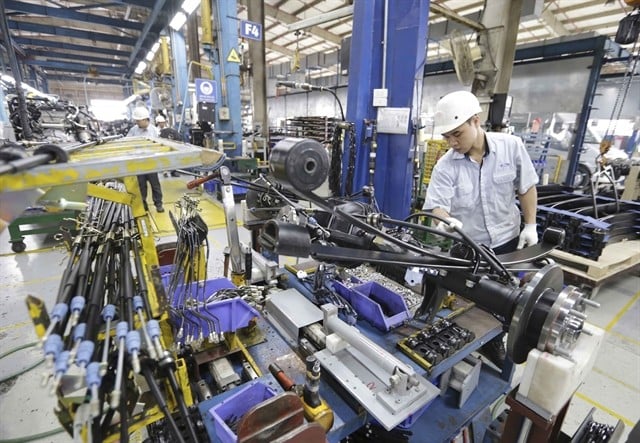 |
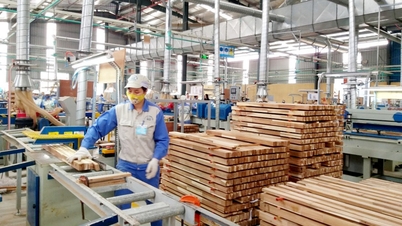
| Passenger car production at the Ford Hai Duong automobile assembly plant. (Photo: Tin Tuc Newspaper) |
Growth drivers come from exports, FDI, and real estate.
The World Bank emphasizes that the current growth momentum is primarily driven by a strong recovery in exports, projected to increase by 15.5% in 2024, along with positive signs in the real estate market thanks to low interest rates and increased supply. These factors have led to a significant improvement in the labor market, with substantial recovery in manufacturing employment and nearly a 5% increase in real income, all contributing to a clear downward trend in poverty, with the poverty rate according to international standards projected to be only 3.6% by 2025.
However, the economy has not yet fully capitalized on the spillover effects. The savings rate among the population remains high at 37.2%. Agriculture, which is the mainstay of income for the poorest groups, is experiencing slow growth, preventing domestic consumption from recovering proportionally.
External risks ranging from geopolitical instability and trade conflicts to new US tariff policies continue to be potential factors that could affect the economic recovery. Both the World Bank and the Asian Development Bank have warned about Vietnam's dependence on global supply chains, especially as the US and China, its two largest trading partners, are showing signs of slowing growth.
In this context, the ADB emphasized the importance of accelerating institutional reforms and effectively leveraging free trade agreements (FTAs) to enhance national resilience and competitiveness. ADB experts also noted that while FDI investors tend to be cautious in the face of uncertainty, they often plan for the long term. Therefore, Vietnam needs to continue improving its investment environment to retain and attract high-quality capital flows.
Prospects for effective trade negotiations
While continuing to push forward with domestic reforms, Vietnam is proactively advancing trade negotiations with the United States to find a solution to tariff issues. According to international sources (Reuters, The Straits Times), on April 23, Vietnamese Minister of Industry and Trade Nguyen Hong Dien and U.S. Trade Representative Jamieson L. Greer held a telephone conversation on “bilateral economic and trade issues”.
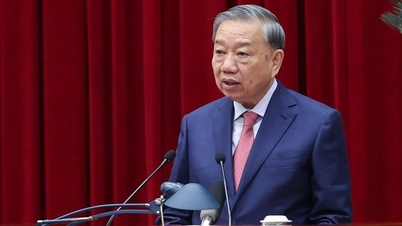
The USTR's website, ustr.gov, posted a statement confirming that the two sides had a productive online exchange. The USTR stated that Mr. Greer discussed the next steps between the USTR and the Vietnamese Ministry of Industry and Trade following President Donald Trump's phone call with General Secretary To Lam on April 4th. Both sides agreed on the importance of achieving rapid progress toward reciprocal and balanced trade between the U.S. and Vietnam.
Vietnam has demonstrated goodwill by increasing imports of goods from the US. The Indian website regtechtimes.com predicts that, although no final decision has been made, the negotiations show that both sides are willing to discuss the issues. The outcome will depend on whether the two countries can find a way to protect each other's interests while maintaining a strong trade relationship.
Beyond macroeconomic reforms, Vietnam is demonstrating a long-term vision with its plan to build an international financial center in Ho Chi Minh City, a major ambition aimed at elevating the nation's position on the global financial map. With its rapidly developing digital economy, strategic location in Southeast Asia, deep integration through FTAs, and cooperative relationships with financial centers like Luxembourg, Vietnam is creating an attractive environment for international investors.
According to b-company.jp (Japan), for this ambition to "take off," Vietnam needs to address several fundamental issues related to barriers to capital flow, high-quality human resources, foreign ownership rights, and currency conversion. Physical and digital infrastructure also needs significant upgrades. b-company.jp suggests that support programs from foreign partners are opening up a viable path forward.
According to the News Report
https://baotintuc.vn/phan-tichnhan-dinh/ky-vong-tang-truong-ben-vung-giua-ap-luc-hoi-nhap-va-cai-cach-20250430194605789.htm
Source: https://thoidai.com.vn/ky-vong-tang-truong-ben-vung-giua-ap-luc-hoi-nhap-va-cai-cach-213139.html





































































Comment (0)