

In early 2026, savings interest rates at commercial banks remained generally above 7% per year for terms of 6 months or more. According to the latest statistics from the Vietnam Banking Association (VNBA), interest rates for 6-12 month deposits at some banks could reach 7.5% - 8.1% per year, an increase of approximately 0.47 - 0.6 percentage points compared to before.
Not something to worry about yet?
According to VNBA, the recent increase in deposit interest rates mainly came from private joint-stock commercial banks, especially small and medium-sized banks such as Bac A Bank, ABBank, KienlongBank, GPBank, PVcomBank, BaoVietBank, Saigonbank, VCBNeo, MBV, PGBank…
This trend has begun to spread to state-owned commercial banks, with Vietcombank, VietinBank, BIDV, and Agribank all simultaneously increasing deposit interest rates by up to approximately 0.6 percentage points compared to before, raising long-term deposit rates to over 5% per year. This is the first time in about two years that state-owned commercial banks have raised interest rates.
The upward trend in deposit interest rates began in late October and has since significantly pushed up the overall input interest rate level. According to the latest statistics from Vietcap Securities Company, many banks are offering deposit interest rates that meet the State Bank of Vietnam's regulated ceiling of 4.75% per year for short-term maturities under 6 months, such as TPBank, VPBank, Sacombank, Techcombank, and VIB. Many other banks, such as NCB, ABBank, Sacombank, LPBank , and Cake by VPBank, are strengthening their preferential policies, adding interest rates of up to 1-1.5 percentage points.
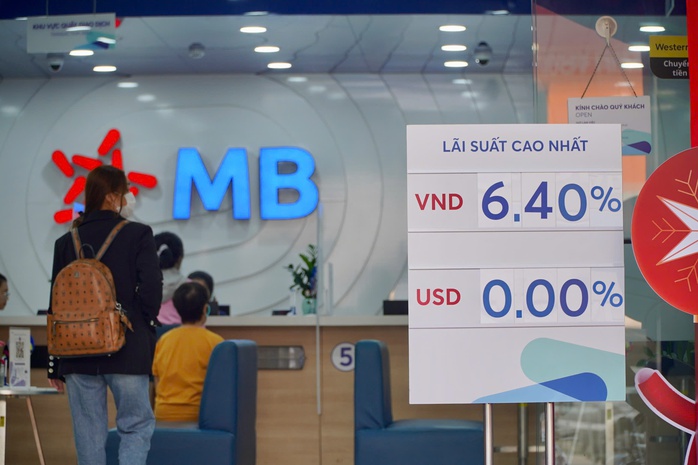
Experts expect the upward trend in deposit interest rates to cool down before the Lunar New Year. Photo: DUY PHÚ
The pressure of rising input interest rates has also led to lending rates no longer being as low as before. Many banks have not only announced the discontinuation of preferential lending rates, but have also adjusted lending rates upwards for some terms. A credit officer at a Vietcombank branch in Ho Chi Minh City said that the interest rate for home loans at this bank is currently 7.9%/year fixed for the first 6 months, and 8.6%/year fixed for the first 12 months, an increase of 0.3 percentage points compared to the beginning of December.
According to experts at Vietcap Securities Company, it is not surprising that large banks and state-owned commercial banks are also increasing deposit interest rates. After the adjustment, the 12-month deposit interest rate of the group of state-owned commercial banks increased to 5.2%, still lower than the lowest level during the pandemic and about 1.6 percentage points lower than the pre-COVID-19 level. This shows that the interest rate level is still supportive of the economy.
Financial and banking expert, Dr. Nguyen Tri Hieu, predicts that the upward trend in deposit interest rates will continue at least until the Lunar New Year in 2026. Statistics show that credit growth is typically about twice the GDP growth rate. "In 2026, credit growth is likely to be even higher if the goal of double-digit GDP growth is to be achieved. When credit increases sharply, banks will be forced to compete to raise capital, leading to continued upward pressure on interest rates. After the Lunar New Year, when the economy enters a more subdued cycle, interest rates may gradually cool down," Dr. Hieu analyzed.
Expectations are that the policy interest rate will remain unchanged.
According to data from the State Bank of Vietnam, as of December 24, 2025, outstanding credit to the economy reached over 18.4 million billion VND, an increase of 17.87% compared to the end of 2024. Despite the highest credit growth in many years, Deputy Governor of the State Bank of Vietnam, Pham Thanh Ha, affirmed that lending interest rates remain stable. As of November 30, 2025, the average lending interest rate for new transactions of commercial banks is 6.96% per year, equivalent to the end of 2024.
Deputy Governor Pham Thanh Ha informed that from the beginning of 2025 until now, the State Bank of Vietnam has continued to maintain the same policy interest rates to create conditions for credit institutions to access capital at low costs, thereby contributing to supporting the economy. The State Bank of Vietnam also regularly directs banks and credit institutions to continue reducing operating costs to lower lending interest rates.
In its latest forecast, the Global Market and Economic Research Department of UOB Bank (Singapore) noted that the exchange rate was controlled last year thanks to the State Bank of Vietnam maintaining the policy interest rate at 4.5% throughout the year and timely foreign exchange interventions to minimize sharp fluctuations. "Along with the positive growth outlook for 2026 and the persistent depreciation pressure of the VND, we expect the State Bank of Vietnam to maintain the refinancing interest rate at 4.5%," a UOB expert stated.
Economist Dr. Can Van Luc emphasized that monetary policy will continue to play a pivotal role in supporting major economic goals in 2026. Therefore, interest rates in 2026 may remain low to support growth. In particular, pressure on the USD/VND exchange rate is easing as the US Federal Reserve (FED) cut interest rates three times in 2025 and plans to continue cutting rates in 2026, giving the State Bank of Vietnam more room to maneuver in monetary policy.
Mr. Vu Binh Minh - Director of Capital and Money Markets Business, Capital Markets and Securities Services Unit, HSBC Vietnam - also expects the State Bank of Vietnam to continue to maintain the stability of the policy interest rate.
According to him, in the context of a high economic growth target for 2026, inflation remaining below target will allow the average interbank VND interest rate to return to a more stable trend in the near future. "The policy interest rate is unlikely to need changing if key economic indicators remain stable. Open market operations (OMO) and new policy tools such as currency swaps continue to play a leading role in guiding the money market, helping to control liquidity and guide interest rate expectations. This is considered a positive point, reflecting a shift towards more effective and flexible open market operations," Mr. Minh said.
Supporting businesses in accessing capital.
According to many experts, lending interest rates have not increased sharply and are not a cause for concern; what is important is access to capital, especially for small and medium-sized enterprises (SMEs). At the recent 4th Vietnam Economic Forum 2025 organized by the Nguoi Lao Dong newspaper, Mr. Le Thanh Thanh, Deputy Director of the Department of Industry and Trade of Can Tho City, stated that although interest rates have decreased, loan conditions and credit access criteria are still not streamlined, causing difficulties for businesses. "It is necessary to remove credit bottlenecks for SMEs by simplifying loan conditions, expanding credit guarantees, and strengthening the role of policies and credit guarantee funds at the local level," Mr. Thanh said.
Dr. Tran Quang Thang, Director of the Institute for Economic and Management Research in Ho Chi Minh City, also believes that businesses in Ho Chi Minh City are currently facing many pressures. The biggest difficulty remains capital. Although interest rates have decreased, access to credit is still difficult because banks are more cautious, especially at the end of the year.
Source: https://nld.com.vn/lai-suat-se-som-ha-nhiet-196260102190854869.htm





































































![[Infographic] Vietnam's Economic Situation Report, Q1 2026: Strong Growth Momentum](https://vphoto.vietnam.vn/thumb/402x226/vietnam/resource/IMAGE/2026/04/04/1775298512042_tang-truong-kinh-te-viet-nam.jpeg)

![[Image] Close-up view of the 10-lane road connecting to Long Thanh Airport](https://vphoto.vietnam.vn/thumb/402x226/vietnam/resource/IMAGE/2026/04/04/1775291871988_ndo_br_1-resize-5690-jpg.webp)




























Comment (0)