

By 2045, the target for industrial production growth in the pharmaceutical sector is 8-11% per year. However, many believe that much work remains to be done to achieve this goal.
The available raw materials only meet a small portion of the demand.
Recently, Deputy Prime Minister Le Thanh Long signed Decision 270/QD-TTg approving the "Program for the Development of the Pharmaceutical Industry until 2030, with a vision to 2045" (the Program).
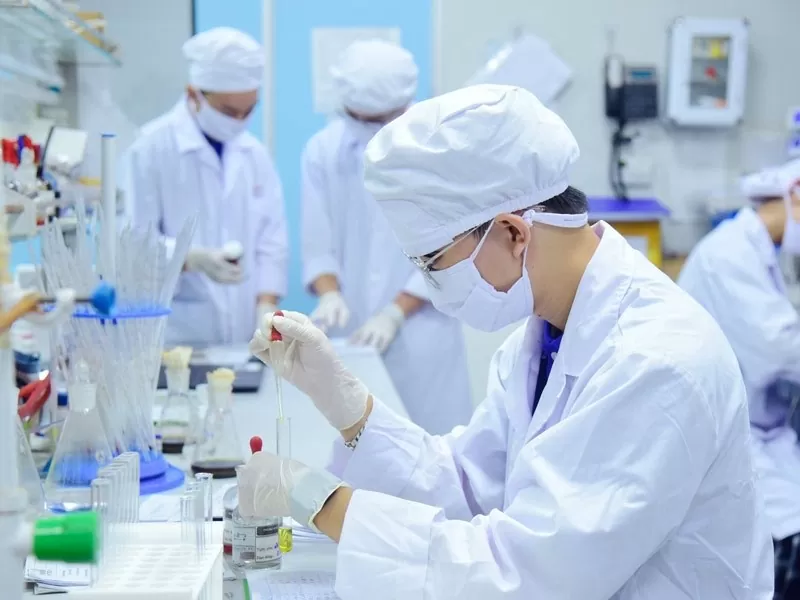 |
| The pharmaceutical industry has the potential to participate deeply in the global value chain, with ripple effects on other economic sectors. Photo: HT |
Specifically, by 2030, the goal is to meet 20% of the raw material needs for pharmaceutical production; and 50% of the raw material needs for the production of functional foods and cosmeceuticals domestically. The export growth rate of some natural pharmaceutical products (pharmaceutical substances, quantitative extracts, essential oils rich in active ingredients) is expected to exceed 10% per year.
By 2045, Vietnam's pharmaceutical industry will become a high-tech, modern, competitive industry that participates in the global pharmaceutical value chain. The industrial production growth rate of the pharmaceutical industry is projected to reach 8-11% per year.
With the above objective in mind, Mr. Hoang Quoc Lam, Deputy Director of the Chemical Department ( Ministry of Industry and Trade ), stated that the Vietnamese pharmaceutical industry has experienced significant growth in production and business in recent years. Many domestic pharmaceutical companies have achieved GMP-WHO standards, with some even meeting EU-GMP or Japan-GMP standards. “However, most domestic pharmaceutical companies produce common, widely available drugs such as some antibiotics, painkillers, fever reducers, and health supplements… while specialized, targeted drugs requiring modern manufacturing techniques are not yet produced,” Mr. Hoang Quoc Lam frankly pointed out the current situation.
According to UNIDO's classification, Vietnam's pharmaceutical industry is ranked at level 3/5, meaning "domestic pharmaceutical industry produces the majority of finished products from imported raw materials." According to WHO's classification, Vietnam's pharmaceutical industry is only close to level 3 (out of 4 levels): "has a domestic pharmaceutical industry; produces generic drugs; exports some pharmaceuticals."
Currently, the pharmaceutical manufacturing industry meets approximately 70% of the demand for drugs in terms of quantity and 50% in terms of value. However, the majority of raw materials are imported, with domestic sources only meeting a small portion of the demand for drug production (approximately 5.2% for Western medicines and about 20% for traditional medicines).
"Due to the underdeveloped pharmaceutical industry and the fact that its products are not yet competitive with those of countries in the region such as China and India, most of the raw materials used to formulate medicines and produce other health protection products have to be imported," the Department of Chemicals stated.
Creating new, groundbreaking products…makes it difficult for domestic businesses.
In reality, businesses believe that most domestic pharmaceutical suppliers lack the resources to exploit the domestic market. Therefore, meeting the needs of the population for pharmaceutical products is very difficult without breakthrough developments.
Domestic pharmaceutical companies currently focus primarily on producing low-value, inexpensive generic drugs, resulting in poor competitiveness. This leads to competition from both imported generic drugs and internal industry competition. Consequently, overlapping production and market segment competition exist.
Furthermore, the challenge of creating new, groundbreaking products poses difficulties for domestic businesses. Even the industry producing active ingredients in Vietnam is still not very developed.
Mr. Ngo Anh Ngoc, CEO of PharmaDi Joint Stock Company, frankly pointed out that consumers still choose imported goods despite their higher prices compared to Vietnamese products. This has resulted in the Vietnamese pharmaceutical market remaining a "playground" for foreign pharmaceutical companies.
Therefore, it is necessary to create a transparent legal environment with incentive mechanisms so that businesses can leverage the potential of the domestic market to develop together.
There is a lot of work to be done to realize the goal.
In light of this situation, the Department of Chemicals proposed: “The Government, Ministries, and relevant agencies need to develop a research program to perfect a comprehensive system of mechanisms and policies. Simultaneously, they should apply high levels of incentives and support for certain activities such as research and development, transfer of new technologies, core technologies, and technologies for producing high-value pharmaceutical products, as well as other breakthrough activities aimed at developing the pharmaceutical industry.”
Furthermore, for sustainable development and enhanced competitiveness, Vietnam needs comprehensive solutions, ranging from investment in R&D and human resource training to improved quality management, encouraging foreign investment, and strengthening international cooperation.
"Only with decisive and coordinated steps can Vietnam's chemical and pharmaceutical industry expand into the international market, serving the pharmaceutical industry and best meeting the healthcare needs of the people," a representative from the Department of Chemicals pointed out.
Regarding policy solutions, the Department of Chemicals also proposed including products using domestically produced pharmaceutical raw materials in the list of drugs covered by health insurance. Priority should be given to bidding for drugs using domestically sourced raw materials in hospital procurement. Simultaneously, favorable conditions should be created regarding the procedures for registering drugs using domestically produced raw materials. The plan also involves combining state budget investment with the mobilization of other resources for the development of the pharmaceutical industry.
From an expert's perspective, Associate Professor Dr. Le Van Truyen, former Deputy Minister of Health, believes that to realize strategic goals, more breakthrough mechanisms for pharmaceutical industry development are needed. The pharmaceutical industry must be restructured to ensure sustainable domestic production and reduce dependence on external sources.
Sharing the same view, Ms. Do Thanh Ha, Deputy Head of the Chemical Industry Development Department (Chemical Department), believes that it is necessary to accelerate the development of the pharmaceutical industry based on the formation and sustainable development of pharmaceutical enterprises of all economic sectors; and to have specific mechanisms and policies that provide special incentives for investment in pharmaceutical production, especially pharmaceutical substances, to encourage businesses to invest in the development of the pharmaceutical industry.
At the same time, expedite the procedures for technology transfer and innovation, machinery and equipment lines; apply advanced and modern technologies to produce high-quality pharmaceutical products that are competitive in the market.
| The program for the development of the pharmaceutical industry until 2030, with a vision to 2045, aims to gradually increase the proportion of domestically produced and used pharmaceutical raw materials and promote the export of pharmaceutical products. At the same time, it contributes to achieving the goals of the Vietnam Chemical Industry Development Strategy, the Program for the Development of the Domestically Produced Pharmaceutical and Medicinal Materials Industry, and the National Strategy for the Development of the Vietnamese Pharmaceutical Industry until 2030 and with a vision to 2045, as approved by the Prime Minister. |
Source: https://congthuong.vn/lam-gi-de-cong-nghiep-nganh-hoa-duoc-dat-8-11-nam-2045-376185.html















































![[Video] Sunset at Lap An Lagoon – Where the sun sets over the fishing nets](https://vphoto.vietnam.vn/thumb/1200x675/vietnam/resource/IMAGE/2026/05/31/1780192137701_beach-landscape-sea-water-nature-grass-745871-pxhere-com.jpeg)

































Comment (0)