

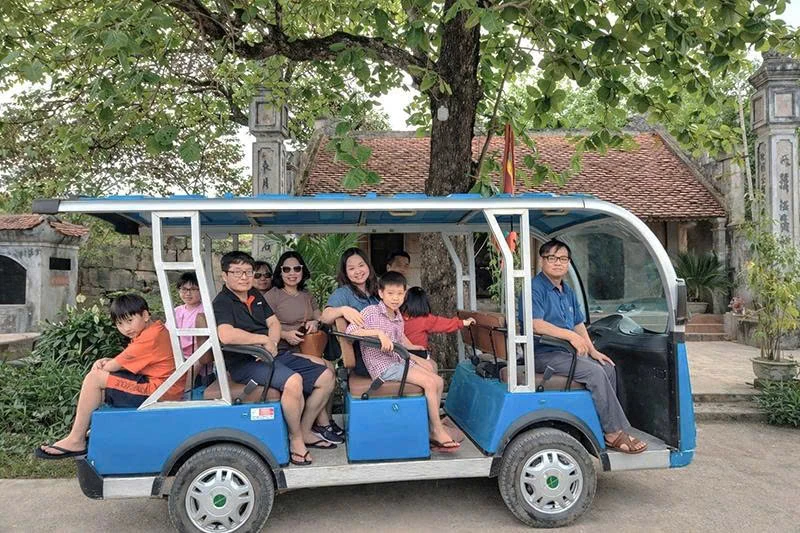
Tourists visit the ancient village near Ho Dynasty Citadel.
Compared to many other heritage destinations such as the Hue Imperial Citadel complex, Hoi An Ancient Town (Da Nang), or Trang An (Ninh Binh), the appeal of Ho Dynasty Citadel is still quite modest. This is evidenced by the short length of stay for tourists, who mostly visit for the day; low tourism spending; and limited supplementary products...
The root cause of this situation lies primarily in the fact that tourism products have long been monotonous, focusing mainly on pure sightseeing. Heritage sites are primarily approached in a "see - listen to explanations - take photos" manner, lacking in-depth experiences to retain tourists. The rural areas surrounding the heritage sites, despite their rich potential, have not been systematically exploited; the connection between the heritage sites and the local community remains weak. Furthermore, tourism promotion and marketing efforts, as well as accompanying services such as shopping, food , and cultural performances, are limited and have not made a distinct impression. A segment of tourists, especially young people, do not truly consider Ho Citadel a "must-visit" destination, but rather see it only as an additional sightseeing stop on their Thanh Hoa travel itinerary.
Recognizing these limitations, in recent years the Management Board of Ho Citadel Heritage and other key historical sites in Thanh Hoa province has gradually reformed its thinking and approach to tourism, focusing on the visitor experience, the community as the main subject, and heritage as the foundation. Instead of merely preserving and showcasing historical values, the heritage is being revitalized through tourism products linked to rural landscapes and local cultural life.
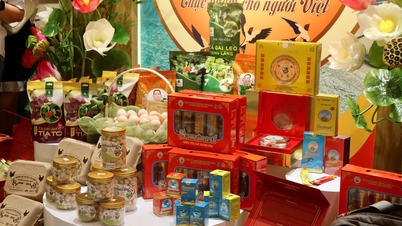
One of the notable highlights is the organization of experiential tours exploring the countryside by bicycle, electric vehicle, and especially by ox carts. Along the way, visitors not only admire the rice fields, embankments, and ancient villages, but also directly experience the slow, peaceful pace of life in the rural areas surrounding the heritage site. This is what creates the difference, helping Ho Citadel stand out from other current heritage destinations. In addition, the heritage management board has collaborated with local authorities to establish clubs for performing traditional folk opera (cheo) and playing traditional musical instruments, creating a blend of past and present. Visitors can both explore, enjoy the arts, and experience local cuisine with familiar products such as Phu Quang sticky rice cake (che lam), thorny cake (banh gai), plowshare-shaped cake (banh rang bua), fragrant sticky rice (nếp hương), etc., allowing visitors to experience the site through multiple senses.
Notably, the revitalization of tourism at Ho Citadel not only targets tourists but also brings practical benefits to the local community. Households engaged in traditional crafts and businesses selling local products have more opportunities to sell their goods. Local people directly participate in tourism activities as guides, artisans, and vendors. Tourism is gradually becoming a supplementary livelihood, contributing to improving the lives and raising awareness of heritage preservation within the community.
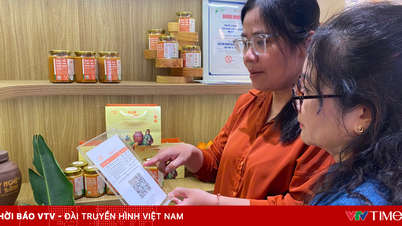
Along with the innovation of tourism products, the application of digital technology has also been promoted to enhance the effectiveness of promotion and the visitor experience. A QR code system integrating information has been installed at tourist attractions; websites and social media platforms have received investment in high-quality content; and 3D cinemas have been built... As a result, images and videos of Ho Citadel are widely disseminated across digital platforms. This approach helps the heritage site reach younger generations and independent travelers – a group that is increasingly significant.
Initial innovation efforts have yielded positive results. By 2025, Ho Citadel is expected to welcome over 270,000 visitors, far exceeding the planned target. While this number is still modest compared to major destinations in the region, it signals the right direction in diversifying products, enhancing experiences, and increasing the attractiveness of the heritage site.
According to Nguyen Van Long, Deputy Director of the Management Board of Ho Citadel and Key Relics in Thanh Hoa Province: "From the experience of Ho Citadel, it can be seen that for a heritage site to truly become an attractive destination, it cannot rely solely on its inherent historical value, but needs to be 'renewed' with a sustainable tourism development mindset. This is a harmonious combination of preservation and exploitation, heritage and community, tradition and modern technology."
Text and photos: Dinh Giang
Source: https://baothanhhoa.vn/lam-moi-du-lich-de-hut-khach-276931.htm











![[E-Magazine]: Gentle Season](https://vphoto.vietnam.vn/thumb/402x226/vietnam/resource/IMAGE/2026/04/03/1775224637323_e-magazine-mua-w1200t0-di2613d199d5164634t11920l1-mdd-022.webp)
![[Infographics] Admission Announcement for Grade 10 at Lam Son Specialized High School for the 2026-2027 Academic Year](https://vphoto.vietnam.vn/thumb/402x226/vietnam/resource/IMAGE/2026/04/03/1775206364883_infographics-th-w1200t0-di2613d199d5153059t11358l1-tb-tschuyenls-09.webp)
































































Comment (0)