

Deputy Prime Minister Tran Luu Quang attended the conference and presented the Prime Minister's Decision approving the Thai Binh Provincial Planning to the Party Committee, government, and people of the province.
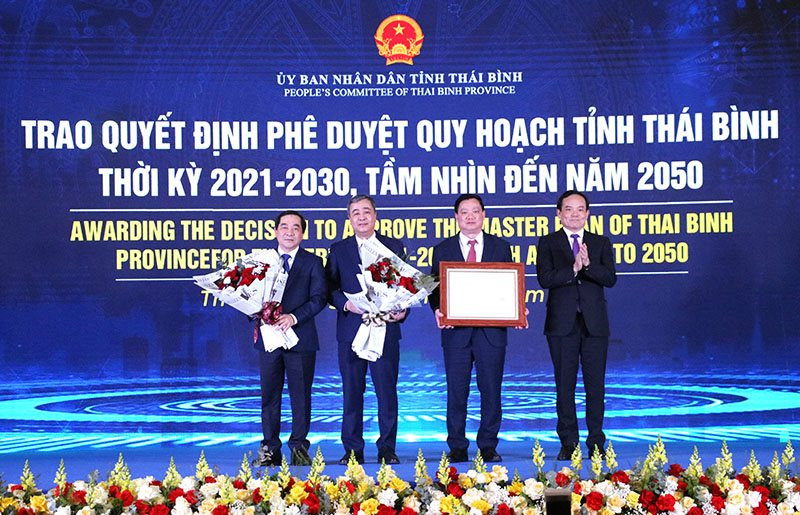
According to the published plan, the Thai Binh Provincial Planning defines a new development mindset and a long-term vision; sets goals for rapid, comprehensive, and sustainable development; strives to make Thai Binh province one of the industrial development centers of the Red River Delta region by 2030; and by 2050, a developed province of the Red River Delta region with a prosperous economy , a progressive society, and a protected ecological environment.
The provincial plan identifies 4 pillars of growth, 3 breakthroughs, 4 socio-economic spaces, 3 economic corridors, development orientations for industries and sectors, and 6 key tasks, aiming to build Thai Binh province into a leading agricultural production center, industrial center, and energy center of the Red River Delta region...
Specifically, the Provincial Planning identifies the opening of new development spaces for the province through "land reclamation," developing a maritime-oriented economy, creating breakthroughs in the fields of seaports, energy, entertainment services, resorts, and marine ecology; expanding land reclamation to create land for functional activities, forming a synchronized industrial-urban-service space, and an attractive coastal ecological landscape.
The provincial planning also identifies the construction of a synchronous and modern urban system in the province, with Thai Binh City as the core urban center, one of the major cities in the region, becoming a green, modern city with its own unique identity, serving as the political, administrative, economic, cultural, service, and commercial center; and a city with scenic views on both banks of the Tra Ly River.
The provincial plan also identifies the province's development of a synchronous, modern, and conveniently connected transportation network; the development of the pharmaceutical and biotechnology industries, a specialized airport, and a railway system, among other things.
In his directive speech at the conference, Deputy Prime Minister Tran Luu Quang requested Thai Binh province to strictly adhere to the orientation and solutions for implementing the Provincial Planning, to be flexible in organizing implementation, to synchronize the Provincial Planning with the system of lower-level planning and the plans already set out, and to "understand" the planning in order to implement it effectively.
At the conference, Thai Binh Provincial Party Secretary Ngo Dong Hai acknowledged that the Provincial Planning has concretized the province's development aspirations; he requested that all levels, sectors, agencies, and units in the province promptly disseminate the core contents of the Provincial Planning to all levels, sectors, the business community, and all strata of the people; thereby creating consensus in awareness and high determination to effectively implement the Plan; allocate resources appropriately, economically, and efficiently, investing in key sectors and fields; and pay attention to resolving investment and administrative procedures well to provide maximum support for investors to organize and implement projects in the province.
He urged businesses, economic organizations, and domestic and foreign investors to pay attention to and study the provincial planning, and based on that, consider investing in Thai Binh in the future.
Meanwhile, Chairman of the People's Committee of Thai Binh province, Nguyen Khac Than, pledged that the provincial government would be more innovative and decisive in its leadership and management; placing the people and businesses at the center of its service.
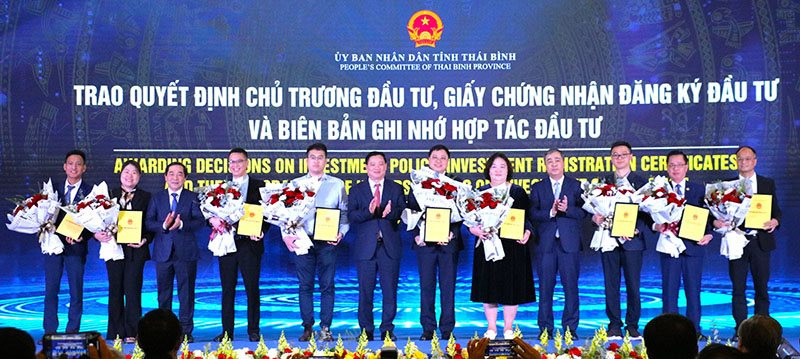
At the conference, the leaders of Thai Binh province presented investment approval decisions, investment registration certificates, and memoranda of understanding on investment cooperation to 9 investors in the province, with a total investment capital of 10,000 billion VND.
Thai Binh is a province located in the northern coastal region of Vietnam, covering an area of over 1,570 km2. It is bordered by rivers on three sides and the East Sea on one side; its coastline is 54 km long; it has one city, seven districts, and a population of over 1.8 million people. The province's coastal area currently includes the Thai Binh Economic Zone, established in 2017, covering over 30,000 hectares across the two coastal districts of Thai Thuy and Tien Hai. This economic zone currently houses the Tien Hai, Lien Ha Thai, and Hai Long industrial parks, with numerous economic projects already underway or being implemented.
Source


![OCOP during Tet season: [Part 3] Ultra-thin rice paper takes off.](/_next/image?url=https%3A%2F%2Fvphoto.vietnam.vn%2Fthumb%2F402x226%2Fvietnam%2Fresource%2FIMAGE%2F2026%2F01%2F28%2F1769562783429_004-194121_651-081010.jpeg&w=3840&q=75)



Comment (0)