

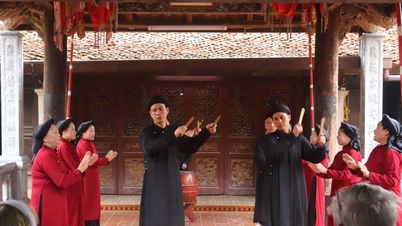
The Cheo (traditional Vietnamese opera) club of Binh Hai village, Yen Nhan commune (Yen Mo district) was established in 2008. Some of the pioneers who laid the foundation for the club are now old, and some are no longer with us, but their passion for this ancient art form remains intact and is being passed on to the present generation.
Mr. Mai Truong Giang and Ms. Kim Ngan were the first two people to establish the first Cheo singing club in Yen Mo district. Mr. Giang recounted that in Binh Hai village, everyone loved Cheo singing. His generation, and subsequent generations, grew up listening to the gentle Cheo melodies of their grandmothers and mothers, and the soulful sounds of their fathers' musical instruments. The people of Binh Hai love Cheo and consider it an indispensable part of their daily lives. Adults and children alike can sing a few ancient melodies... On moonlit nights, during rice planting and harvesting, Cheo melodies still echo across the distant fields.
With the desire to bring together those who love and are passionate about traditional Vietnamese opera (cheo) to preserve the cheo performances of their homeland, in 2008, those deeply committed to the art of cheo established the Binh Hai Village Cheo Singing Club.
"Once we found people who shared our passion for traditional Vietnamese opera (cheo), we started practicing classic cheo plays. This was both a way to preserve the cheo performances of our homeland and to serve the cultural needs of the local people, especially during holidays, festivals, or village celebrations. At that time, there were about 15-16 people participating in the club, and I was the chairman, while Ms. Kim Ngan was the instructor," Mr. Giang recounted.
In its early days, despite facing many difficulties, the team members, driven by passion, overcame them by working in the fields during the day and practicing and performing in the evenings. These village artists used their songs and performances to encourage the spirit of hard work and production, to inspire young people to enlist in the army, and to celebrate national holidays. Although at the village level, the Binh Hai Cheo Club was very well organized: one team leader, one director, five musicians playing instruments such as flutes, zithers, two-stringed fiddles, drums, and wooden clappers, and dozens of performers.
The plays that made the Binh Hai village's traditional opera troupe famous include: Quan Am Thi Kinh, Luu Binh - Duong Le; Tong Tran - Cuc Hoa...; in addition, there are dozens of traditional opera stories, excerpts, and hundreds of ancient opera verses that have been passed down from generation to generation.
Besides performing traditional chèo plays, the people here also write their own works. The melodies of chèo are like the breath of life, with new songs expressing love for their homeland and reflecting the real lives of the people in this region rich in revolutionary traditions. They are widely loved and appreciated by the audience. The chèo troupe has truly become a strong artistic unit in the locality.
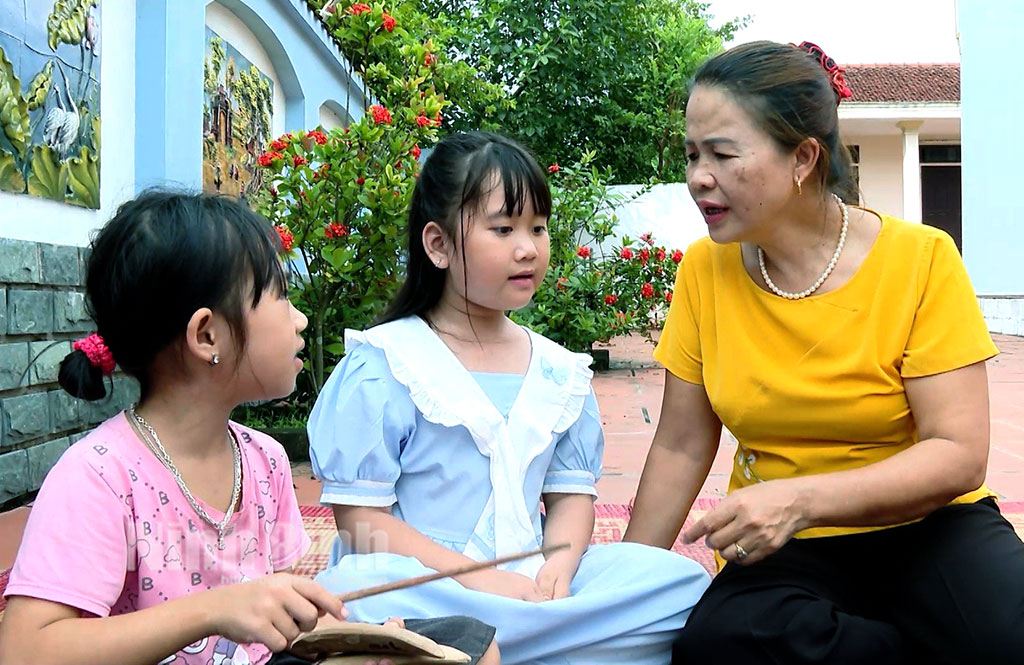
Ms. Tran Thi Lung, a member of the club, said: "I've loved Cheo singing since I was a child. But after getting married, having children, and being busy with farming, I rarely had the chance to sing or listen to others sing. Therefore, when the Cheo club was established, I was one of the first to register. Participating in singing and dancing has satisfied the longing for Cheo in Binh Hai. My husband and children, although they don't know how to sing Cheo, also love it very much. They are my most enthusiastic supporters."
A few years ago, due to his advanced age, Mr. Mai Truong Giang handed over the leadership of the Binh Hai Cheo Club to younger members. In 2022, the Binh Hai Cheo Club merged with another Cheo club and changed its name to the Yen Nhan Cheo and Xam Singing Club, with over 20 members led by Mr. Do Van Nguyen. Mr. Nguyen originally worked in construction. Although his work was demanding, since the Binh Hai Cheo Club was established in 2008, he has always dedicated his free time to practicing and performing with the club.
"Singing Cheo (traditional Vietnamese opera) calms the soul. All the hardships of making a living seem to disappear. After each performance, we feel energized to work better the next day. Thankfully, in this fast-paced life, one might think people would turn their backs on Cheo due to the strong influx of modern music . Yet in Binh Hai, Cheo is still cherished and preserved by the people. Some young people are just over 30, and many families have two or three generations who know how to sing Cheo. In particular, we also organize classes to teach Xam (a traditional Vietnamese folk singing style) to children in the area. Although they are new to this traditional art form, the children are very passionate about it," Mr. Nguyen said.
And so, like old bamboo giving way to new shoots, generations have passed on the preservation of this traditional art form as a precious asset of the village. Their love for Cheo (traditional Vietnamese opera) is so strong that, despite receiving no salary or remuneration, and even having to spend their own money on instruments and costumes, they have continued to sing with passion for many years.
The stage for the traditional opera troupe is just an open space or the village communal house courtyard, but the audience from the commune flocks in, filling it to capacity. The enthusiastic applause of the audience fills the performers with energy and passion. Therefore, for generations, the people of Binh Hai in particular, and Yen Nhan commune in general, have been immersed in this traditional art form.
After their farming work, these people, once they've finished their tasks, put on new clothes and enthusiastically sing, transforming themselves into fairytale characters to ease their worries and fatigue. The heartfelt melodies of the folk songs are like an endless stream, deeply ingrained in their blood and flesh, nourishing the souls of generations of people here.
Dao Hang - Minh Quang
Source

![[Photo] National Assembly Chairman Tran Thanh Man working with the Standing Committee of the Law and Justice Committee](https://vphoto.vietnam.vn/thumb/1200x675/vietnam/resource/IMAGE/2026/05/21/1779378929214_ndo_br_1-4610-jpg.webp)


![[Photo] General Secretary and President To Lam presides over a working session with the Central Policy and Strategy Committee on the development of the materials industry.](https://vphoto.vietnam.vn/thumb/1200x675/vietnam/resource/IMAGE/2026/05/21/1779359935432_a3-bnd-3129-1412-jpg.webp)































































Comment (0)