

For over 70 years, every year on the 21st day of the 11th lunar month, 27 families in Trung Lap village, Xuan Lap commune (Tho Xuan district) have held a memorial service on the same day. "That is the saddest past for the whole village," said Mr. Do Huy Nhat, Party Secretary and Head of the Front Committee of Trung Lap 2 village.

During the resistance war against the French, the villages of Xuan Lap commune served as a strong rear area, becoming a place for evacuation and troop deployment for many provincial and central agencies and units such as: Regiment 9, Regiment 66 (75mm artillery unit), Battalion 355, Division 304; Pham Hong Thai Ordnance Factory; Military Ordnance Department of Military Region 3; the workplace of General Hoang Minh Thao and Chinese experts; the Political and Military Intelligence Department of Division 308, which regularly worked with Generals Vuong Thua Vu and Cao Van Khanh; the Institute of Malaria Control; the Treasury and Finance Department of Military Region 3; the Rear Area Military Hospital B; the K71 Army Hospital (after 1954, it was handed over to Thanh Hoa province and transformed into Thanh Hoa Tuberculosis Hospital); the reception station for French prisoners of war (wounded or sick); the Military Convalescent Camp of Military Region 3 - where wounded and sick soldiers returned from the battlefield were cared for and treated; the Bank of Military Region 3; the provincial war invalids' camp; Weapon and food storage facilities... In addition, the villages of Xuan Lap commune were also chosen as meeting places and training centers for political and military affairs of the province and the Third and Fourth inter-regions...
"Despite the hardships, with fervent patriotism and hatred of the enemy, the people of Xuan Lap in general and Trung Lap village in particular were always ready to sacrifice and share; they supported and helped the agencies and units stationed and working here as if they were family. Therefore, movements such as 'Contributing to National Defense'; 'Rice for the Troops'; 'Self-Sufficient Militia'; 'Supplying Local Soldiers'; 'National Bonds'; 'War Bonds'; Party Funds; Funds for Purchasing Weapons... were all enthusiastically supported and participated in by the people selflessly" (Xuan Lap Commune Gazetteer, Thanh Hoa Publishing House, 2019).

Mr. Do Huy Nhat, Party Secretary and Head of the Front Committee of Trung Lap 2 village, introduces the memorial plaque.
The resistance war against the French became increasingly intense, demanding greater contributions of manpower and resources to the front lines. On May 1, 1951, to address the food shortage, the Government issued Decree No. 13-SL on agricultural tax, and on July 15, 1951, it issued Decree No. 40 to promulgate the Provisional Regulations on Agricultural Tax. This was a major policy and initiative that was thoroughly understood by the entire Party and the entire population.
Under the close guidance of the Party branch and the supervision and encouragement of the government and mass organizations, in the first tax collection period of 1951 alone, the villages of Xuan Lap commune collected more than 100 tons of rice.
“Besides the joy of fulfilling the agricultural tax target with the state, to commemorate the founding day of the Vietnam People's Army (December 22nd) and celebrate the Ha Nam Ninh campaign (also known as the Quang Trung campaign), the people of Xuan Lap village held a celebration from the morning of December 21st, 1951. The joy was instantly turned into tragedy. The French colonialists dropped nine bombs on this area, killing 36 people and destroying houses and gardens,” shared Mr. Do Huy Nhat, Secretary and Head of the Front Committee of Trung Lap 2 village.

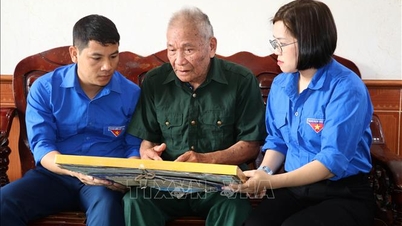
Mr. Do Dinh Ton witnessed the event where 36 people died when he was just 7 years old.
Although he was only 7 years old at the time, Mr. Do Dinh Ton still remembers the event very clearly. He explained, "In my family alone, seven people died, including my grandmother, my eldest uncle, my second uncle, my aunt-in-law, my father, my mother, and my younger brother. Almost everyone died, and our five-room house was completely destroyed. Only my 10-year-old sister, my 7-year-old self, and my 2-month-old baby sister, along with the land and two bomb craters, survived."
Of the 36 people who died that day, 31 were from the same village, including 3 very young children, about 1-2 years old, who hadn't yet been named. Therefore, the elders in the village named them Red. The identities of the remaining 6 people remain unknown to this day.
"Located right at the village crossroads, the memorial monument to 36 innocent civilians reminds the descendants of Trung Lap village in particular, and Xuan Lap commune in general, of the years when the whole nation overcame hardships and sacrifices, and villagers lost their lives to the bombs and bullets of the French colonialists. Filled with hatred for the enemy, many young men in the village volunteered to join the army and participate in various campaigns, including the Dien Bien Phu campaign," Mr. Do Huy Nhat added.
Kieu Huyen
Source


















































































Comment (0)