

Coconut has been identified as the province's key crop and is gradually asserting its role as a major economic sector, with the largest scale in the country.
For sustainable development, value enhancement, and improved competitiveness in the international market, the requirements go beyond simply expanding cultivated areas or increasing production; they must also involve building and operating an efficient supply chain from production to consumption.
 |
| More than 60% of coconut production is currently consumed through the province's local processing industry, creating a closed value chain. |
Great potential, solid foundation.
According to information from the Department of Agriculture and Environment, by the first quarter of 2026, the province will have 122,870 hectares of coconut trees, accounting for more than 61% of the total coconut area nationwide; of which, the area producing fruit will reach over 114,000 hectares. This is a huge advantage for the province to develop the coconut industry towards large-scale commercial production, serving processing and export.
According to Mr. Le Van Dung, Deputy Director of the Department of Agriculture and Environment, the province currently has over 30,700 hectares of organically certified coconuts, with an annual production of approximately 337.8 million coconuts, meeting the stringent standards of the US, EU, and Japanese markets. The system of planting area codes and packaging facilities is being perfected, creating favorable conditions for official export, especially to the Chinese market.
One of the highlights of the coconut industry is the formation of production-consumption linkage models through cooperatives and cooperative groups. Currently, the province has approximately 153 agricultural cooperatives and 32 cooperative groups; most of which participate in the coconut value chain. These models help farmers stabilize their output and contribute to increasing the value of their products. A typical example is the organic coconut production model linked with businesses; in which businesses provide technical support, certification costs, and commit to purchasing at prices 10-20% higher than the market price.
According to Mr. Pham Phuoc Trai, Deputy Director of the Department of Industry and Trade, there are approximately 151 enterprises operating in the processing industry, with a wide range of products from food and cosmetics to biomaterials. By 2025, the production value of the coconut processing industry is estimated to reach over 8,150 billion VND, making a significant contribution to the province's industrial structure.
 |
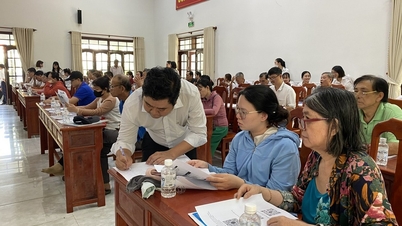
| The Department of Industry and Trade is interested in investing in technology for producing coconut-based products in the province. |
Currently, the province's coconut industry is not only developing domestically but also expanding into the global market, with products present in approximately 90 countries and territories. Export turnover is projected to reach US$1 billion in the 2024-2025 period; and has already reached approximately US$600 million since the beginning of 2026. Notably, over 60% of the province's coconut production is consumed through local processing, creating a closed value chain, increasing added value, and reducing dependence on raw material exports.
The key to developing the coconut industry.
The agricultural sector has identified bottlenecks in the coconut industry. Firstly, production remains fragmented and small-scale, with each household cultivating only about 0.3-0.4 hectares, hindering the uniform application of technical standards. The linkages between businesses and farmers are not strong enough, contracts lack binding force, and the intermediary role of cooperatives is limited. Only about 30% of the coconut growing area participates in these linkages, which is low compared to the requirements for developing a sustainable value chain. The volatile price of coconuts also significantly impacts the morale of growers. After a period of high prices in mid-2025, prices have fallen sharply, currently only around 50-60 thousand VND per dozen for dried coconuts. This is due not only to increased supply but also to competition from imported coconuts and difficulties in the export market.
From a business perspective, Mr. Pham Phuoc Trai stated that rising logistics costs due to geopolitical fluctuations, along with competitive pressure from Indonesia and the Philippines, are reducing the profitability and competitiveness of Vietnamese coconut products. More worryingly, the Vinh Long coconut brand has not yet been truly established in the international market. Many products entering large distribution systems still bear intermediary brands, failing to create their own distinct identity.
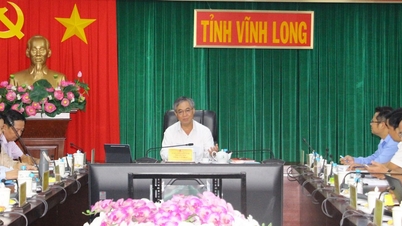
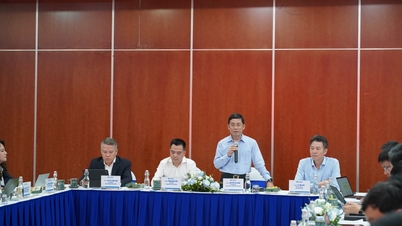
Comrade Chau Van Hoa, Provincial Party Committee member and Vice Chairman of the Provincial People's Committee, stated that in the face of these challenges, the province is implementing many comprehensive solutions; the focus of which is strengthening supply chain linkages and enhancing product value. One of the proposed breakthrough solutions is to establish a "floor price" mechanism for coconuts through the linkage between key enterprises. Accordingly, when market prices fluctuate, enterprises will still purchase at the minimum price, helping to stabilize farmers' income and prevent price manipulation.
Comrade Chau Van Hoa, Provincial Party Committee member and Vice Chairman of the Provincial People's Committee, emphasized that for the coconut industry to develop sustainably, it must be centered around supply chain linkages; in which cooperatives play a "core" role. Building large-scale organic raw material areas, aiming for 36,000 hectares, is a key task, linked to a shift in production mindset towards a green and circular economy.
Digital transformation is also identified as an inevitable trend. The application of technology in managing growing areas, tracing origins, and forecasting yields will help improve production efficiency and market transparency.
With its advantages in scale, production infrastructure, and the coordinated efforts of all levels, the province's coconut industry is facing a great opportunity for breakthrough. However, to realize the goal of becoming a sustainable multi-billion dollar industry, the prerequisite remains the establishment of a strong and harmonious supply chain linking farmers, cooperatives, and businesses. When this linkage is strengthened, the province's coconut industry will not only increase added value but also be competitive and establish its brand in the global market. Therefore, supply chain linkage is identified as the "key" to unlocking sustainable development for the province's coconut industry in the new phase.
Text and photos: CAM TRUC
Source: https://baovinhlong.com.vn/kinh-te/202603/lien-ket-chuoi-de-phat-trien-nganh-dua-9fc3e75/


![[Image] The appearance of the Bien Hoa-Vung Tau expressway before its opening.](https://vphoto.vietnam.vn/thumb/1200x675/vietnam/resource/IMAGE/2026/03/25/1774430324663_ndo_br_2-resize-6064-jpg.webp)


























































Comment (0)